





In the high-stakes environment of modern manufacturing, a microsecond is no longer just a unit of time—it is the difference between a perfectly synchronized robotic assembly line and a catastrophic operational failure. As factories globally accelerate their transition toward Artificial Intelligence (AI) and autonomous workflows, the limitations of traditional networking infrastructure have become glaringly apparent.
Standard Ethernet, the backbone of modern communications, operates on a “best-effort” delivery model. In this environment, data packets arrive when the network permits, not when the mission demands. For an AI-driven factory floor where machine vision systems, Automated Guided Vehicles (AGVs), and high-speed robotic arms must operate in lockstep, this latency jitter is unacceptable. To bridge this gap, industry leaders are turning to Time-Sensitive Networking (TSN) chips—specialized semiconductors designed to transform standard Ethernet from a simple data pipe into a precision-engineered instrument.
The Core Facts: Moving Beyond “Best Effort” Networking
At its heart, TSN is not a replacement for Ethernet, but an evolutionary leap for it. Defined by the IEEE 802.1 standards, TSN technology introduces deterministic timing to standard Ethernet infrastructure. While traditional network chips prioritize throughput—moving as much data as possible as quickly as possible—TSN chips prioritize predictability.
The Deterministic Shift
In a conventional network, data packets compete for bandwidth. During periods of congestion, packets can be delayed or arrive out of order, leading to "jitter." In an industrial context, if a control signal for a robotic welding arm arrives even a few milliseconds late due to network traffic, it can result in mechanical collision, product defects, or safety hazards.
TSN chips mitigate this by enforcing a "Time-Aware" architecture. They utilize hardware-based scheduling to ensure that mission-critical traffic is delivered at a precisely defined interval. By effectively “clearing the road” for high-priority packets while allowing standard, non-critical data (like administrative logs or video surveillance) to flow in the remaining bandwidth, TSN enables a unified network where IT and Operational Technology (OT) can coexist without compromising safety.

Chronology of an Industrial Evolution: From Analog to Deterministic
The transition to TSN represents a multi-decade shift in industrial automation.
- The Early Era (1980s–2000s): Manufacturing relied on proprietary fieldbus protocols. These were highly deterministic but fragmented, creating "silos" where hardware from different vendors could not communicate effectively.
- The Ethernet Boom (2000s–2015): Manufacturers shifted toward standard Ethernet for its speed and ubiquity. However, the lack of inherent determinism forced engineers to implement "Industrial Ethernet" protocols, which often added overhead and complexity.
- The Birth of TSN (2015–2020): The IEEE 802.1 Working Group began formalizing standards to make Ethernet natively deterministic. This allowed for the consolidation of multiple proprietary networks into a single, standardized, time-aware fabric.
- The AI/Autonomous Era (2020–Present): With the integration of AI-driven robotics and edge computing, the demand for sub-microsecond latency has moved from a "nice-to-have" to a "mission-critical" requirement. TSN chips have moved from experimental prototypes to essential components in modern semiconductor roadmaps.
Supporting Data: The Physics of Synchronization
To understand the necessity of TSN, one must look at the mathematical requirements of high-speed automation. In a high-speed packaging facility, a conveyor belt might move at several meters per second. A machine vision system must capture an image, process it via AI, and trigger an actuator to reject a defective product within a window often smaller than 10 milliseconds.
The Anatomy of a TSN Chip
Unlike standard Ethernet ASICs, TSN chips incorporate several hardware-level features designed to "honor the microsecond":
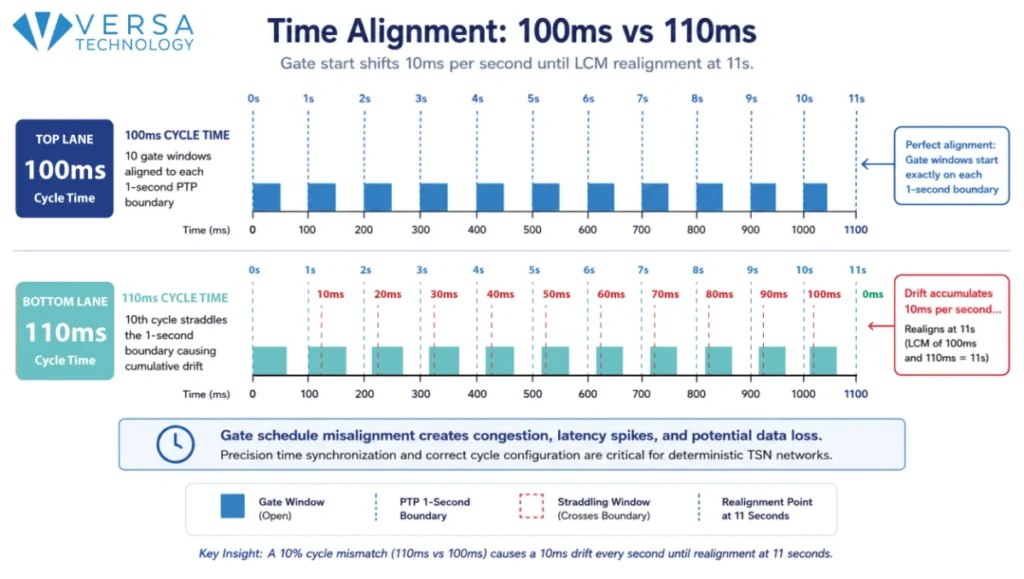
- Time-Aware Scheduling (TAS): By utilizing a gate-control list, these chips open and close transmission windows at the nanosecond level. This reserves specific slots for time-sensitive traffic, ensuring critical packets never wait in line behind large, non-critical data transfers.
- High-Precision Synchronization (IEEE 802.1AS): Every device on a TSN network is locked to a "Grandmaster" clock. Through hardware-based timestamping, the entire network operates on a synchronized heartbeat, ensuring that disparate devices act as a single, cohesive unit.
- Frame Replication and Elimination (IEEE 802.1CB): To ensure maximum reliability, TSN chips can send duplicate packets across two separate network paths. The receiver accepts the first one to arrive and discards the second. If a cable is severed, the network continues to operate without a single millisecond of downtime.
Implications for Industry: The AI-Driven Future
The implications of implementing TSN-enabled hardware extend far beyond simple efficiency. By creating a reliable, deterministic infrastructure, manufacturers can unlock the full potential of AI.
Consolidating IT and OT
Historically, factories maintained separate networks for the office (IT) and the factory floor (OT) to ensure the latter remained stable. TSN renders this separation unnecessary. By prioritizing critical traffic on a unified wire, businesses can reduce cabling costs, simplify network management, and allow AI models to access sensor data from the production floor in real-time without interfering with critical control loops.

Enabling Autonomous Operations
Autonomous Guided Vehicles (AGVs) and mobile robots are the future of logistics. These machines require constant, low-latency communication with centralized control systems to navigate safely. TSN ensures that these vehicles receive navigation instructions with the strict timing guarantees required to prevent collisions and maintain high-speed movement.
The Reliability Paradox
As factories become more reliant on AI, the "cost" of a network glitch increases exponentially. An AI model that detects a micro-fracture in a metal component needs to relay that information to the assembly line immediately. If the network experiences latency, the AI is effectively "blinded" for those few milliseconds. TSN provides the structural guarantee that when an AI system detects a failure, the command to halt production is delivered with absolute certainty.
Official Perspectives and Market Landscape
Industry analysts have consistently identified TSN as a foundational technology for "Industry 4.0." Organizations such as the Avnu Alliance and the Industrial Internet Consortium (IIC) have championed the adoption of TSN as the definitive bridge to a reliable, AI-driven future.
While major semiconductor firms like Microchip, NXP, Texas Instruments, and Intel continue to expand their TSN-capable product lines, the competition is increasingly focused on the integration of these capabilities. Modern chips are no longer just network interfaces; they are becoming intelligent nodes that combine processing power with deterministic connectivity.
According to lead engineers at industrial automation firms, the shift is not merely about hardware—it is about the "democratization of precision." Previously, high-speed, deterministic control was the domain of ultra-expensive, proprietary systems. TSN brings these capabilities to the standard Ethernet ecosystem, allowing smaller manufacturers to leverage the same level of performance as global automotive giants.

Conclusion: Preparing for the Next Level of Connectivity
The evolution of the industrial network is reaching a critical inflection point. As AI moves from the data center to the edge of the manufacturing floor, the network must evolve to match the speed of the silicon it supports. TSN chips offer the necessary hardware framework to achieve this, providing the determinism, synchronization, and redundancy required for the factories of tomorrow.
For organizations currently planning their transition to AI-driven operations, the network architecture is just as important as the AI models themselves. Investing in TSN-enabled switches and controllers is not just an upgrade to a network; it is an investment in the reliability and future-proofing of the entire industrial enterprise.
As we look toward a future defined by autonomous production, the mastery of time will remain the ultimate competitive advantage. By embedding logic that honors the microsecond, TSN chips are ensuring that the promise of the AI revolution—higher quality, safer operations, and unprecedented efficiency—is finally realized on the factory floor.
For organizations looking to navigate the complexities of implementing TSN-ready infrastructure, consulting with specialists in industrial networking and PoE-integrated systems is a recommended first step. By aligning your hardware strategy with the requirements of tomorrow’s AI, you ensure that your production remains not only fast, but perfectly on time.