






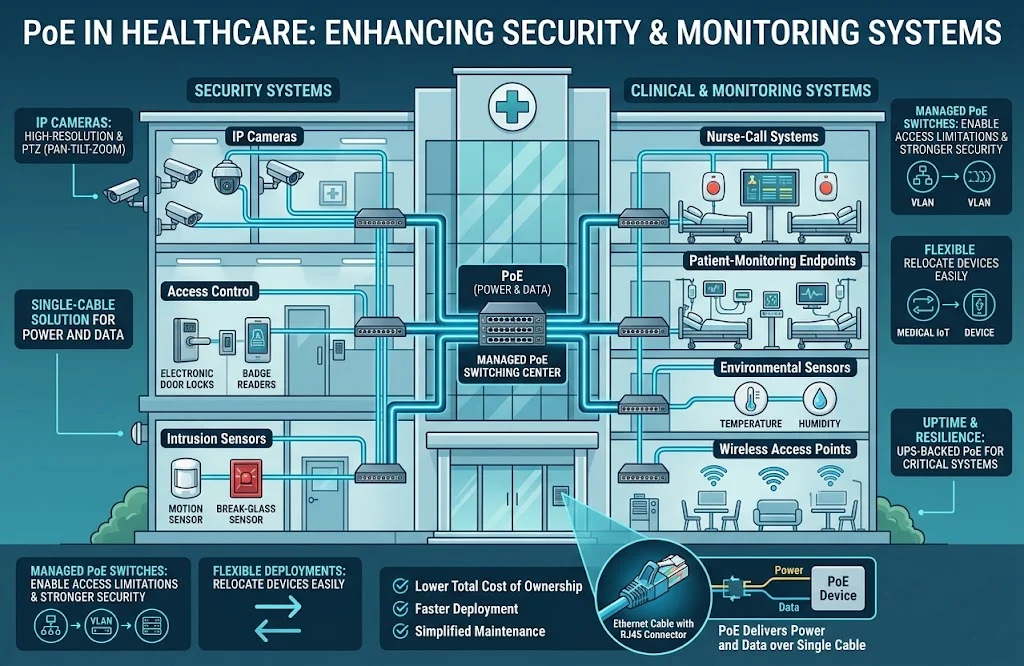
In the contemporary healthcare landscape, the line between medical care and information technology has effectively vanished. Hospitals and clinics have transformed into highly connected digital ecosystems where patient outcomes are inextricably linked to the reliability of data streams. As these facilities integrate an ever-expanding array of connected technologies—from life-critical patient monitors and security surveillance to sophisticated nurse-call systems—the demand for a robust, resilient, and secure power-delivery infrastructure has reached a critical inflection point.
Power over Ethernet (PoE) has emerged as the linchpin of this digital transformation. By consolidating electrical power and high-speed data transmission into a single Ethernet cable, PoE is fundamentally changing how healthcare facilities deploy, manage, and scale their technology stacks.
The Convergence of Power and Data: Core Fundamentals
At its simplest, PoE is a technology that allows network cables to carry electrical power to devices. This eliminates the need for separate electrical cabling, which is often a prohibitive cost in healthcare environments where specialized conduit and electrical retrofitting must meet stringent safety codes.
Understanding PoE Standards
The evolution of the Institute of Electrical and Electronics Engineers (IEEE) standards has been the primary driver for PoE’s adoption in clinical settings:
- IEEE 802.3af (PoE): Delivers up to 15.4 watts of DC power, sufficient for basic IP phones and standard sensors.
- IEEE 802.3at (PoE+): Offers up to 30 watts, supporting more complex devices like dual-band wireless access points and standard security cameras.
- IEEE 802.3bt (PoE++/Ultra PoE): The latest iteration, capable of delivering 60 to 90+ watts per port. This standard is a game-changer for healthcare, enabling the deployment of high-resolution PTZ (pan-tilt-zoom) cameras, LED lighting systems, and advanced medical IoT (mIoT) peripherals.
Chronology of Infrastructure Evolution
The adoption of PoE in healthcare did not happen overnight; it followed a logical progression defined by the needs of the medical sector:
- The Early Adoption Phase (2000s): Initial use cases were limited to VoIP desk phones and basic connectivity, driven primarily by cost savings in office administration areas of hospital campuses.
- The Connectivity Expansion (2010–2015): As wireless medical devices and mobile workstations on wheels (WOWs) became standard, IT teams turned to PoE to power the wireless access points (WAPs) required to keep these devices connected across sterile environments.
- The Security and Integration Era (2016–2020): With rising concerns over hospital security, the focus shifted to powering IP-based security cameras, electronic badge readers, and door-access controls via the network.
- The Modern Integrated Ecosystem (2021–Present): Today, we are in the era of "Smart Hospitals." PoE is no longer just a cabling convenience; it is a foundational layer for facility-wide environmental monitoring, real-time location systems (RTLS), and high-bandwidth telehealth endpoints.
Supporting Data: Why Facilities are Pivoting to Managed PoE
The shift from unmanaged to managed switches represents the most significant technical advancement in this field. While unmanaged switches provide basic "plug-and-play" power, they are blind to the traffic they carry. In a HIPAA-regulated environment, this lack of visibility is a liability.
Managed Switch Advantages
- Granular Access Control: Through protocols like 802.1X, managed switches ensure that only authorized devices can handshake with the network. If an unauthorized actor attempts to plug a rogue device into a patient-room port, the switch can automatically disable that port.
- Dynamic VLAN Assignment: IT administrators can logically segment the network. For instance, patient-monitoring data can be placed on a separate, high-priority VLAN, completely isolated from guest Wi-Fi traffic or building management systems.
- Remote Power Management: Managed switches allow IT teams to power-cycle a remote camera or access point without dispatching a technician to a sterile or restricted area, significantly reducing mean-time-to-repair (MTTR).
Official Perspectives: Security and Compliance
Regulatory bodies, including the Department of Health and Human Services (HHS), emphasize that data security is not just an IT concern—it is a patient safety imperative. Managed PoE switches are increasingly viewed as a "security appliance" rather than a networking utility.

"The ability to monitor power draws in real-time is an underutilized security tool," says one leading healthcare systems engineer. "If a medical device suddenly consumes an irregular amount of power, it can indicate a hardware failure, but it could also signal a compromised device or a malicious firmware injection. Managed switches provide the logs necessary for modern SIEM (Security Information and Event Management) systems to flag these anomalies before they escalate into a breach."
Implications for Healthcare Operations
The integration of PoE has profound implications for how hospitals operate, design their facilities, and manage their capital budgets.
Flexibility in Clinical Design
Healthcare environments are dynamic. The ability to pivot a room from a standard observation area to a temporary isolation ward requires flexible technology. PoE eliminates the need for expensive electrical contractors to install new outlets every time a clinical layout changes. This "plug-and-play" capability allows facilities to scale in real-time, meeting surges in patient volume without structural disruption.
Total Cost of Ownership (TCO)
While managed PoE hardware carries a higher upfront cost than traditional power solutions, the long-term TCO is significantly lower. Facilities save on:
- Cabling Complexity: Running one cable instead of two (power and data) reduces installation labor costs by as much as 30–40%.
- Energy Efficiency: Intelligent power allocation ensures that switches only deliver the exact wattage required by the device, minimizing waste.
- Centralized Maintenance: The ability to manage power and data from a single dashboard reduces the burden on facility management teams, allowing them to focus on clinical support rather than infrastructure repair.
Sustainability and Energy Management
Modern healthcare facilities are under increasing pressure to meet sustainability goals. PoE-powered LED lighting and smart occupancy sensors allow for automated energy management. For example, lights in unoccupied clinical wings can be dimmed or shut off automatically, significantly reducing the facility’s carbon footprint.
Addressing Challenges and Best Practices
Despite the benefits, the transition to a PoE-heavy infrastructure is not without risk. IT and facility teams must navigate several key challenges:
1. Power Budgeting
As device density increases, so does the risk of "power oversubscription." IT teams must conduct a thorough audit of their power budgets. If a switch is rated for a total power budget of 500W, adding eight 90W devices will trigger a failure. Planning for "headroom"—typically 20-30% of total capacity—is essential to accommodate future device additions.

2. Thermal Management
High-density PoE deployment generates heat within bundles of Ethernet cables. In drop ceilings or confined wiring closets, this heat can degrade data performance and shorten cable lifespans. Proper ventilation and the use of high-quality, category-rated cabling are vital.
3. The "Medical-Grade" Hurdle
Not all devices are created equal. Any device that touches a patient must be tested for electrical compatibility and interference. Clinical engineering teams must be involved in the design phase to ensure that PoE-powered devices do not introduce electromagnetic interference (EMI) that could affect sensitive diagnostic equipment.
Future-Proofing: The Path Forward
The future of healthcare infrastructure lies in the ability to adapt. As AI-driven diagnostics and remote surgical robotics continue to evolve, the underlying network must provide both the bandwidth and the consistent power to support them.
For IT and facilities teams looking to modernize, the roadmap is clear:
- Inventory Assessment: Categorize all existing devices by power requirements and security sensitivity.
- Infrastructure Audit: Replace aging unmanaged switches with managed, industrial-grade PoE switches that support 802.3bt standards.
- Cross-Departmental Collaboration: Establish a committee consisting of IT, Clinical Engineering, and Security. This ensures that new deployments satisfy the requirements of all stakeholders.
- Pilot Programs: Begin by upgrading one high-impact area—such as the security camera network or the nurse-call system—to demonstrate the operational and security benefits to leadership.
In conclusion, PoE is no longer just about convenience; it is a strategic asset. By embracing managed PoE, healthcare facilities can build a foundation that is as secure as it is flexible, ensuring that they are ready to meet the challenges of modern medicine, both today and for the decades to come. As the industry continues to prioritize patient safety and digital resilience, the role of intelligent, power-efficient networking will only grow in significance, marking a permanent shift in how we build the hospitals of the future.