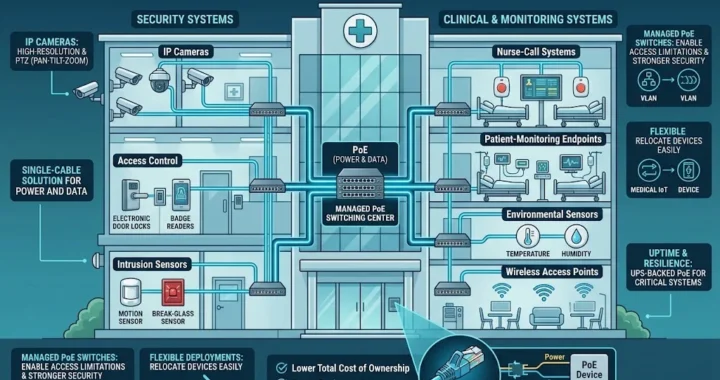







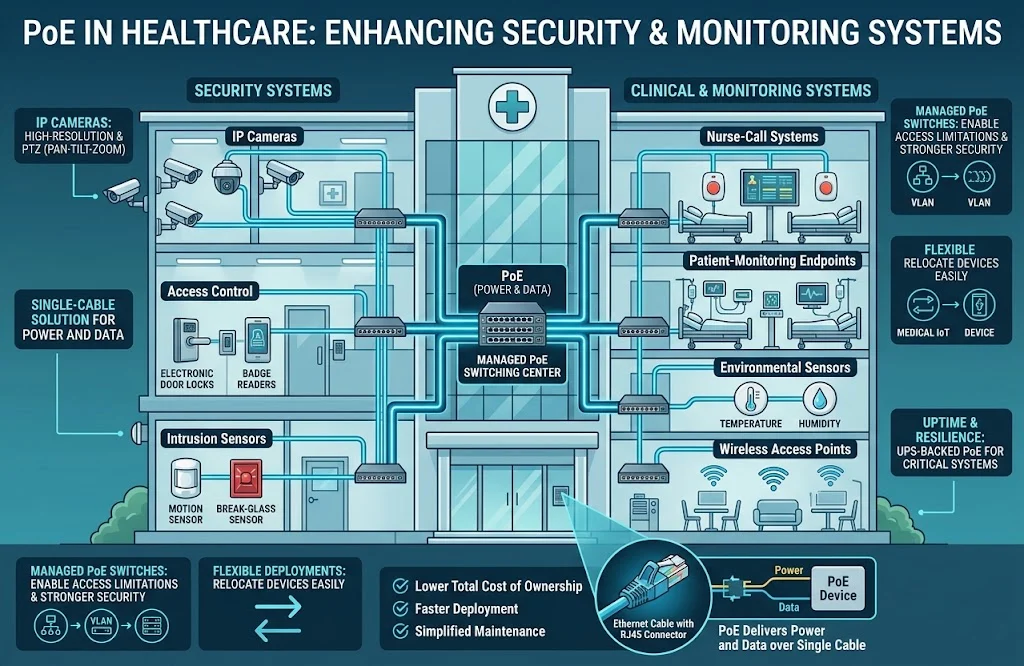
In the modern healthcare landscape, the "Internet of Medical Things" (IoMT) is no longer a futuristic concept—it is the backbone of patient care. From high-definition patient monitoring systems and precision security cameras to automated nurse-call systems and seamless wireless access points, hospitals and clinics have become massive, data-driven ecosystems. However, this technological explosion brings a significant physical challenge: how to power and connect thousands of disparate devices reliably, securely, and within the strict confines of HIPAA compliance.
Power over Ethernet (PoE) has emerged as the definitive solution. By delivering both electrical power and data transmission over a single Category 5e or 6 cable, PoE is fundamentally changing how healthcare facilities are designed, built, and operated.
Main Facts: The Power of Convergence
At its core, PoE eliminates the "two-cable" requirement for network devices. In a traditional setup, an IP camera or a wireless access point requires a data connection to the switch and a separate electrical connection to an AC outlet. In a busy hospital environment, the logistics of installing high-voltage electrical outlets near patient beds, ceilings, or security perimeters are prohibitively expensive and often disruptive to clinical workflows.
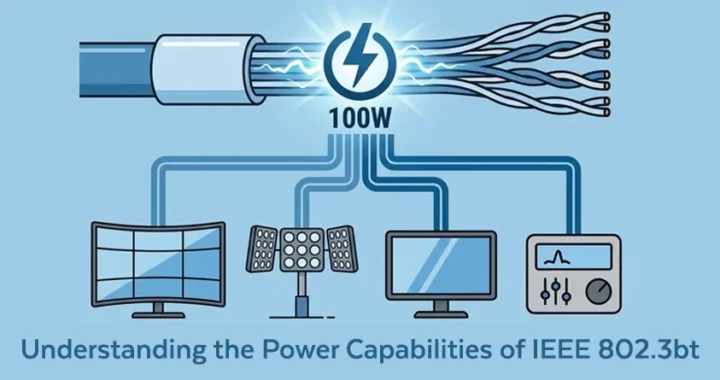
PoE streamlines this by utilizing IEEE standards—specifically 802.3af (15.4W), 802.3at (30W), and the robust 802.3bt (up to 90W)—to deliver power directly from the network switch. This allows IT departments to:
- Centralize Power Management: With Uninterruptible Power Supplies (UPS) in the server room, PoE-powered devices remain operational even during a building power outage.
- Simplify Deployment: Devices can be installed in optimal locations regardless of proximity to wall outlets.
- Reduce Infrastructure Footprint: By eliminating the need for licensed electricians to install new AC power drops for every new device, facilities realize a significant reduction in total cost of ownership (TCO).
Chronology of PoE Adoption in Healthcare
The evolution of PoE in the clinical setting has tracked alongside the broader digital transformation of medicine:
- Early 2000s: The introduction of IEEE 802.3af (PoE) allowed for basic VoIP phones and low-power Wi-Fi access points. Adoption was limited to administrative areas.
- 2009–2015: With the advent of 802.3at (PoE+), higher power budgets enabled the rise of pan-tilt-zoom (PTZ) security cameras and more advanced clinical monitoring tools, marking the start of mass deployment in patient-care areas.
- 2018–Present: The 802.3bt (PoE++) standard revolutionized the industry. By providing up to 90 watts per port, it enabled the deployment of high-performance wireless access points, digital signage, and even intelligent LED lighting systems, moving PoE from a "convenience" to a "critical utility."
Supporting Data: Infrastructure Demands
Healthcare facilities are currently facing unprecedented pressure on their network backbones. According to industry benchmarks, the average hospital now supports thousands of connected endpoints.
Power Budgeting and Scalability
IT teams must navigate the complexities of power budgets. A modern 48-port switch may have a total power capacity, but if every port is drawing maximum wattage—such as powering 48 high-performance medical-grade cameras—the switch will hit its thermal and electrical limits.

Strategic planning requires:
- Over-provisioning: Calculating the peak power draw for all devices plus a 20-30% buffer for future hardware upgrades.
- Cable Management: Ensuring the use of high-quality copper cabling to mitigate heat buildup in high-density bundles.
- Managed Intelligence: Using managed switches to monitor power consumption per port, allowing administrators to prioritize critical life-safety devices over non-essential equipment.
The Role of Managed Switches in Security and Compliance
The transition from unmanaged to managed switches is the most critical step in securing a healthcare network. Unmanaged switches act as "dumb" bridges, passing data without insight. In contrast, managed switches provide the granular control required by HIPAA and other regulatory bodies.
Port-Based Security (802.1X)
Managed switches allow IT teams to enforce 802.1X authentication. Before a device can draw power or access data, it must authenticate against the network. This prevents unauthorized devices—such as a rogue laptop or a compromised IoT device—from gaining access to the clinical network.
Segmentation via VLANs
Through Dynamic VLAN assignment, managed switches can logically separate traffic. For example, a guest waiting room’s Wi-Fi traffic can be completely isolated from the hospital’s electronic health record (EHR) systems. If a patient’s device is compromised, the threat is contained within the guest VLAN, leaving the surgical and patient-monitoring networks untouched.
The Hardware Standard: Industrial-Grade Solutions
Hardware such as the Versa Technology D60-084-90 Managed L2 Industrial PoE Switch exemplifies the new standard. These units are designed to provide up to 90W per port, ensuring they can handle the most demanding medical hardware while offering advanced management features like SFP uplinks for high-speed fiber connectivity, ensuring that the network backbone is never the bottleneck.
Implications: Building for the Future of Care
The shift to a PoE-centric infrastructure has profound implications for the future of hospital architecture and clinical efficiency.
Operational Resilience
By centralizing power, hospitals move away from relying on the integrity of local wall outlets. In an emergency, or during routine maintenance, IT staff can cycle power to a hung device remotely, avoiding the need to enter sterile or restricted patient zones. This capability is invaluable in isolation units or intensive care settings where physical access is strictly limited.

Sustainability and Energy Efficiency
Modern managed switches provide telemetry on power usage. Facilities managers can now track the energy consumption of every camera, sensor, and light fixture on the network. By scheduling "sleep" modes for non-critical systems or identifying inefficient hardware, hospitals can significantly reduce their carbon footprint—a growing priority for large health systems.
Clinical Agility
The ability to rapidly deploy technology is a competitive advantage. When a facility needs to convert a general ward into a surge-capacity ICU, the speed of deployment is vital. With PoE, clinicians can add extra monitoring stations or temporary communication hubs in hours rather than days, as they are not waiting for electrical contractors to install new circuits.
Expert Recommendations and Best Practices
For healthcare facilities looking to modernize their infrastructure, the path forward requires a coordinated, multi-disciplinary approach.
- Cross-Departmental Collaboration: IT, Facilities, Biomedical Engineering, and Security teams must sit at the same table during the design phase. A decision made by the security team to install 4K cameras will directly impact the power budget managed by the IT department.
- Compatibility Testing: Before mass-deploying any medical-grade or FDA-regulated device, verify its PoE handshake compatibility. Not all devices adhere perfectly to the IEEE standards, and interoperability testing is essential to prevent system failures.
- Future-Proofing the Wiring: Always install higher-grade cabling (Cat6A) than what is required for today’s devices. The labor cost of pulling cable far outweighs the cost of the wire itself, and future-proofing prevents the need for major infrastructure overhauls in 5–10 years.
- Security Integration: Ensure that the managed switches chosen for the network integrate with existing Security Information and Event Management (SIEM) tools. This allows for real-time alerting; if an unauthorized device is plugged into a port in a secure wing, the network should automatically shut down that port and alert the security operations center (SOC).
Conclusion: The Foundation of Modern Medicine
As healthcare continues to digitize, the importance of a robust, secure, and flexible infrastructure cannot be overstated. PoE in healthcare is more than just a way to power devices; it is the silent, efficient nervous system that allows modern medicine to function. By leveraging managed switches to gain granular control, and by planning for the increasing power demands of tomorrow’s medical technology, healthcare facilities can ensure they remain at the forefront of patient care.
For facilities leaders, the takeaway is clear: the infrastructure of the future is defined by convergence. By bringing power and data together, you aren’t just simplifying the wiring—you are building a safer, more responsive, and more resilient environment for those who need it most.
For further information on integrating advanced PoE solutions into your healthcare facility, please contact Versa Technology online or speak with our engineering team at 909-591-8891.