






For decades, the humble Ethernet cable was viewed primarily as a conduit for data—a digital umbilical cord connecting workstations to the broader world. However, the paradigm shifted with the advent of Power over Ethernet (PoE), a technology that fundamentally transformed network infrastructure by allowing a single cable to carry both high-speed data and electrical power. Today, as we enter an era defined by the Internet of Things (IoT), smart buildings, and high-performance edge computing, the IEEE 802.3bt standard—often referred to as PoE++—has emerged as the pinnacle of this evolution.
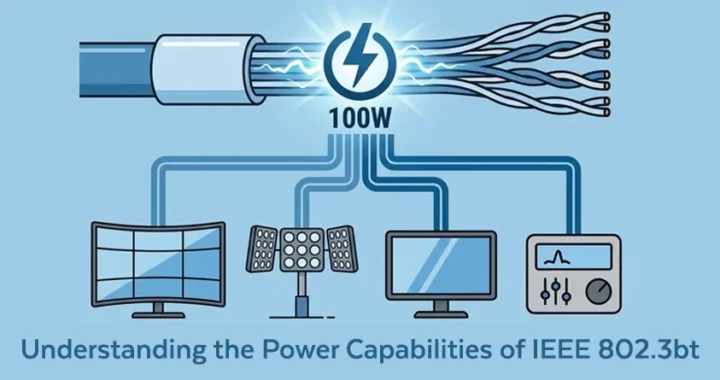
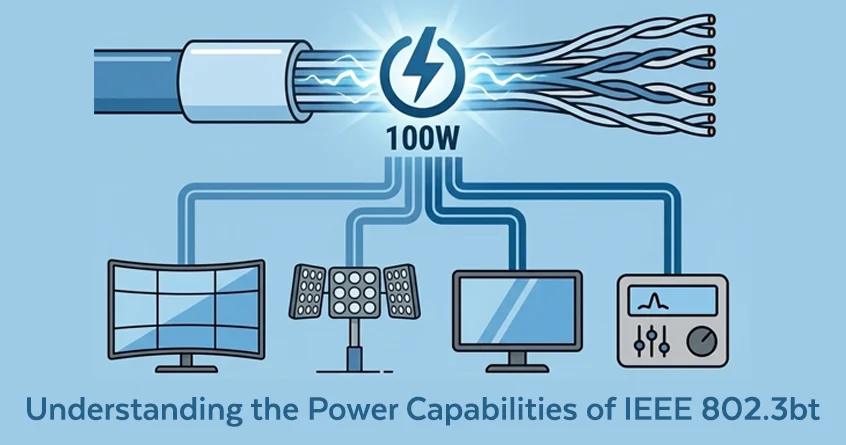
By delivering up to 100 watts of power, 802.3bt has moved beyond the simple powering of IP phones and static cameras, enabling a new generation of high-demand, intelligent connected devices.
The Evolution of Connectivity: A Chronology of PoE
To appreciate the significance of 802.3bt, one must understand the steady, iterative progression of PoE standards. Since its inception, the technology has been defined by a constant push to increase power delivery without sacrificing data integrity.
The Foundation: Type 1 (IEEE 802.3af – 2003)
When Type 1 PoE was introduced in 2003, it revolutionized the office environment by eliminating the need for localized power supplies for basic VoIP phones and early-generation static IP cameras. Providing 15.4W at the Power Sourcing Equipment (PSE), it laid the groundwork for centralized network management.
The Expansion: Type 2 (IEEE 802.3at – 2009)
The introduction of PoE+ in 2009 doubled the power budget to 30W. This milestone allowed for more sophisticated hardware, including Pan-Tilt-Zoom (PTZ) cameras, dual-band wireless access points, and biometric security readers, which required more current to drive motorized parts or increased processing capacity.

The Modern Era: Type 3 and Type 4 (IEEE 802.3bt – 2018)
Ratified in 2018, the 802.3bt standard represents the most significant leap in power delivery. By utilizing all four twisted pairs within a standard Ethernet cable—rather than the two pairs used by previous standards—Type 3 (60W) and Type 4 (100W) standards have unlocked capabilities that were once restricted to AC-powered devices.
Data-Driven Power: The Technical Mechanics
The leap to 100W is not merely a matter of increasing voltage; it is a sophisticated engineering feat. By leveraging all four pairs of copper wire, 802.3bt optimizes thermal distribution. In older standards, the electrical load was concentrated on two pairs, which created thermal hotspots in dense cable bundles.
Modern 802.3bt infrastructure distributes this load across all four pairs, significantly reducing heat buildup. This improvement in thermal efficiency is critical for modern data centers and enterprise environments where high-density cable runs are the norm. Furthermore, the standard introduces "dual-signature" power device (PD) support, which allows the switch to negotiate power more precisely. This granular control ensures that the power budget is not wasted, allowing for a mix of legacy 802.3af/at devices and high-power 802.3bt endpoints on the same network.
Strategic Implications for the Modern Enterprise
The transition to IEEE 802.3bt is more than a technical upgrade; it is a strategic shift in how organizations plan their physical and digital architecture.
1. Architectural Flexibility and Cost Reduction
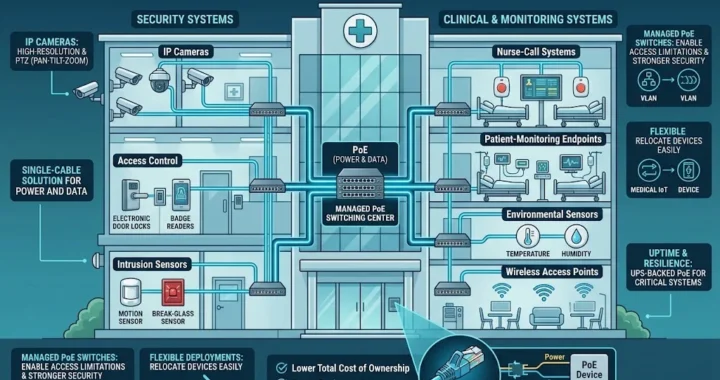
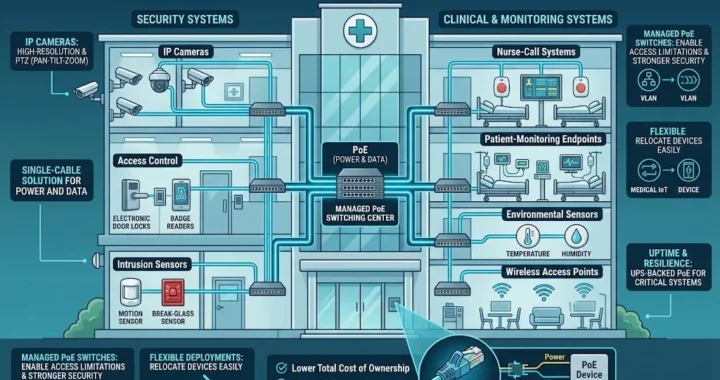
The most immediate benefit is the radical simplification of infrastructure. In traditional setups, deploying a high-end surveillance camera or a smart lighting system required a licensed electrician to install an AC outlet near the device. With 100W PoE, that requirement is eliminated. This change in project economics—reducing dependency on high-voltage electrical infrastructure—accelerates deployment timelines and significantly lowers total cost of ownership (TCO).

2. The Power of Centralization
By moving the power source to the telecommunications closet, organizations gain the ability to centralize power management. When high-capacity Uninterruptible Power Supplies (UPS) are installed in the main data closet, critical infrastructure such as security systems, emergency signage, and building access controls remain operational during a local power failure. This centralized reliability is a key pillar of modern business continuity planning.
3. Future-Proofing in an IoT-Driven World
As organizations integrate more processors, sensors, and displays into their workspaces, power demands continue to rise. 802.3bt-capable infrastructure ensures that the network is ready for the next generation of "smart" endpoints, such as high-definition video conferencing terminals, edge-computing nodes, and sophisticated building automation sensors.
Industry Perspectives: The Shift Toward Smart Buildings
Industry analysts and network architects alike point to 802.3bt as the backbone of the "smart building" movement. By enabling high-end LED lighting, automated HVAC sensors, and complex security arrays to communicate and draw power through a single cable, 802.3bt facilitates a truly integrated Building Management System (BMS).
"The capability to deliver 100W over existing Cat 6A cabling effectively turns the entire network into an electrical grid," notes one lead network integrator. "It is no longer just about data throughput; it is about providing a robust, manageable, and safe electrical architecture that supports the convergence of IT and facilities management."
Practical Deployment Considerations
While 802.3bt is designed to be backward compatible, organizations must be diligent during the planning phase to ensure peak performance:

- Cabling Standards: To maximize the benefits of 802.3bt, Category 6A cabling is highly recommended. The thicker gauge conductors in Cat 6A minimize DC resistance, which is essential for maintaining efficiency over longer cable runs and ensuring support for multi-gigabit (10GBASE-T) speeds.
- Thermal Management: Even with four-pair power delivery, dense cable bundles can generate heat. It is vital to use higher-temperature-rated cabling if the installation involves large, tightly packed bundles in cable trays.
- Power Budgeting: While 802.3bt switches are highly efficient, network administrators must still carefully calculate their total power budget. Ensuring that the PSE can handle the aggregate load of all connected Type 4 devices is critical to preventing system-wide power shedding during peak operation.
The Future of Connected Hardware
The current trajectory of network hardware suggests that we have only scratched the surface of what is possible with 100W. We are already seeing the emergence of high-performance devices that were previously tethered to traditional power:
- Smart Video Walls: Massive, multi-screen displays that act as digital signage or command-center monitors.
- Outdoor Enclosures: Remote monitoring stations equipped with active heating and cooling, essential for harsh environments.
- Compact Computing: Thin clients and desktop-in-a-monitor setups that operate entirely off the network.
Conclusion: Investing in the Next Frontier
As organizations look to modernize their operations, the role of IEEE 802.3bt cannot be overstated. It is the bridge between the simple, data-only networks of the past and the sophisticated, powered, and automated infrastructures of the future.
For those looking to future-proof their network, adopting 802.3bt is a logical and necessary step. By leveraging high-capacity managed switches, such as the VX-GPU2626—which provides the necessary power budget to support 24 ports of 802.3bt-compliant hardware—businesses can create a scalable environment that is as robust as it is efficient.
As we continue to push the boundaries of what connected devices can achieve, the standard for power delivery will remain a cornerstone of progress. By aligning with the IEEE 802.3bt standard today, organizations ensure that their network infrastructure is not just a utility, but a powerful engine for innovation.
For more information on transitioning your infrastructure to support 802.3bt, contact specialists at Versa Technology to discuss how modern switching solutions can transform your current network deployment.