





In the rapidly shifting landscape of enterprise IT, Artificial Intelligence (AI) is no longer a futuristic concept confined to data centers; it is being pushed to the "edge." As organizations integrate AI-powered cameras, sophisticated IoT sensor arrays, and edge inference engines into their security and operational frameworks, they are encountering a significant bottleneck: the physical limitations of existing network infrastructure.
For many industrial facilities, transit hubs, and commercial buildings, the backbone of connectivity remains legacy coaxial cabling. While reliable for analog signal transmission, this aging copper infrastructure is often viewed as a hurdle to digital transformation. However, a new generation of Ethernet and Power over Coax (EPoC) switching technology is proving that organizations do not need to tear down their walls to build a smarter, AI-ready future.
The Core Challenge: Infrastructure vs. Innovation
The transition to AI-driven operations is defined by a fundamental shift in data processing. Unlike traditional surveillance systems that simply record video, modern AI-enabled systems perform real-time analytics, facial recognition, and anomaly detection at the edge. These applications require high bandwidth, low latency, and, crucially, a stable, high-wattage power supply.
For facility managers and IT directors, the traditional path to modernization involves a "rip-and-replace" approach—tearing out legacy coaxial cabling to install Cat6 or fiber optic lines. This process is notoriously expensive, labor-intensive, and causes significant operational disruption. It often requires intrusive construction, downtime, and the disposal of massive amounts of perfectly functional, albeit outdated, cable.
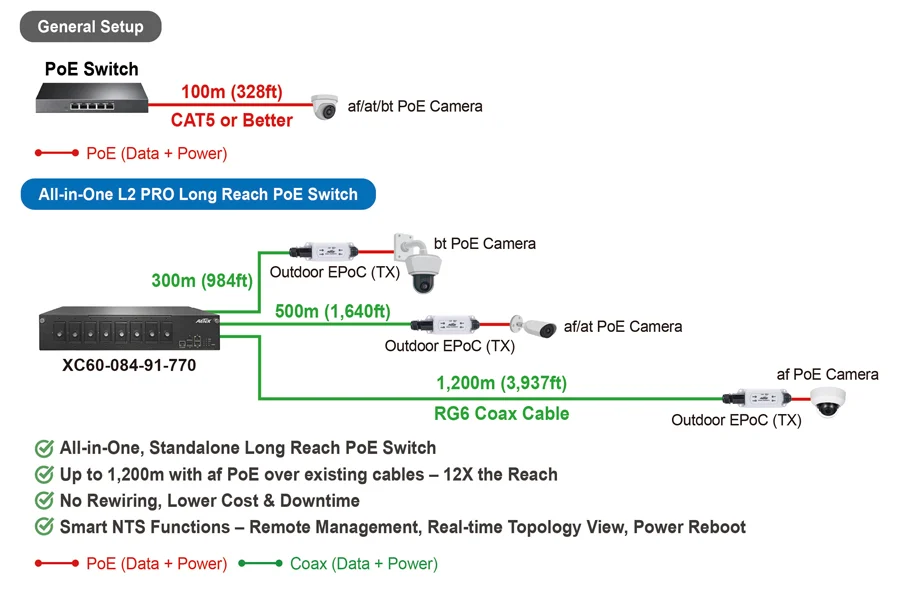
The Versa Technology XC60-084-91-770 EPoC managed switch has emerged as the industry’s solution to this dilemma, allowing organizations to maintain their existing cabling while unlocking the full potential of high-performance, AI-capable IP devices.

Understanding EPoC: The Technology Behind the Transformation
EPoC (Ethernet and Power over Coax) is a sophisticated networking standard that bridges the gap between legacy physical layers and modern digital demands. By utilizing the existing 75-ohm coaxial infrastructure—such as the ubiquitous RG59 or RG6 cables—EPoC transmits high-speed Ethernet data alongside low-voltage electrical power.
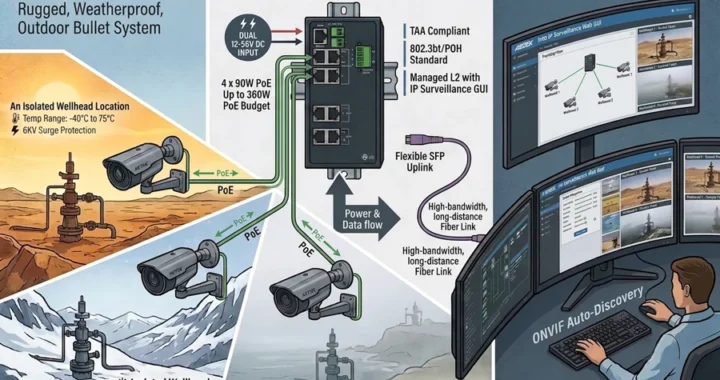
The XC60-084-91-770 acts as the central hub in this architecture. With eight 75-ohm BNC ports, two Gigabit Ethernet (GbE) ports, and two SFP ports for high-speed fiber uplinks, it provides a versatile bridge. This switch doesn’t just pass data; it acts as a power delivery powerhouse, offering up to 90W of Power over Ethernet (PoE) per port—a critical requirement for high-end AI cameras that demand significant power for heaters, blowers, and onboard processing units.
Chronology of Network Evolution: From Analog to AI
To understand the significance of EPoC, one must look at the historical trajectory of enterprise networking:
- 1990s – Early 2000s: The era of analog surveillance. Facilities were wired with extensive coaxial runs to connect cameras to VCRs and later DVRs.
- 2010s: The rise of IP networking. Many organizations began the difficult transition to digital cameras, often forced to rewire entire buildings with Ethernet cabling to support PoE.
- 2020s – Present: The AI-at-the-Edge revolution. Networks are now required to handle massive, consistent data streams and provide high-wattage power to intelligent sensors, exceeding the capabilities of traditional standard-reach Ethernet.
EPoC technology serves as the "Missing Link" in this chronology. It allows organizations currently stuck in the 2010s-era transition to skip the expensive rewiring phase and jump straight into the AI-enabled future.
Technical Specifications and Performance Data
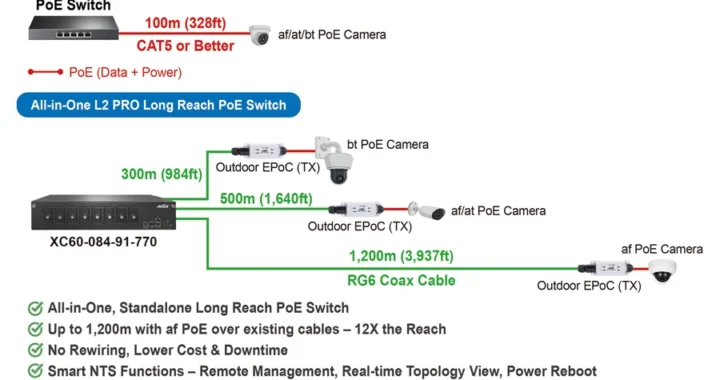
The XC60-084-91-770 is designed for environments where failure is not an option. Its ability to extend network range is arguably its most transformative feature. While standard Ethernet is constrained by the 100-meter (328 ft) limit, the EPoC-enabled system can push data and power up to 1,200 meters (3,937 ft) without signal degradation.

Key Technical Advantages:
- Extended Range: Up to 1,200 meters, enabling connectivity in large campuses, warehouses, and remote security perimeters.
- Power Budget: A total of 720W, with 90W per port (PoE++ 802.3bt), ensuring that even the most power-hungry AI devices remain operational.
- Topology Flexibility: Supports daisy-chain, peer-to-peer, and ring configurations, allowing for highly resilient network design.
- Integrated Diagnostics: Features a Network Topology System (NTS) with auto-discovery (ONVIF support) and real-time cable health monitoring.
The Role of AI in Modern Surveillance Architectures
Modern AI surveillance is not just about image quality; it is about "inference." An AI-enabled camera processes video frames locally to detect intruders, identify license plates, or monitor crowd density. This requires a stable, high-bandwidth pipe.
The XC60-084-91-770 ensures that these AI nodes remain "always-on." By utilizing built-in monitoring tools, IT administrators can track live traffic trends and power consumption at the port level. If a sensor reports an anomaly, the switch’s management interface can pinpoint the exact cable run, drastically reducing Mean Time to Repair (MTTR).
Implications for Corporate Sustainability and CapEx
The financial implications of choosing EPoC over a total infrastructure overhaul are profound. By reusing existing coax, organizations see an immediate reduction in:
- Labor Costs: No need for large-scale cabling installation teams or construction to pull new wire through walls and ceilings.
- Material Waste: Avoiding the disposal of thousands of feet of existing copper reduces the carbon footprint of the project.
- Operational Disruption: Because the physical cabling remains in place, businesses can maintain daily operations while the upgrade takes place in the server room or wiring closet.
Furthermore, the centralized power management of EPoC switches optimizes energy efficiency. By allocating power only to active AI nodes, the system reduces "vampire" power draw, aligning with corporate sustainability goals.

Strategic Implementation: Best Practices
For organizations looking to deploy EPoC, Versa Technology recommends a phased approach:
- Infrastructure Audit: Conduct a thorough physical assessment of existing coax. Ensure that shielding and copper quality are sufficient for the desired throughput.
- Phased Migration: Begin with high-value, high-risk areas. Upgrade perimeter security with AI cameras first, leaving interior analog cameras on legacy systems until they reach their end-of-life.
- Topology Planning: Utilize the switch’s support for daisy-chaining to reach difficult areas where individual cable runs back to the central closet are impractical.
Official Perspectives: The Future of Connectivity
"The transition to AI is being driven by a fundamental physical shift in where data is processed," says the technical team at Versa Technology. "Organizations no longer have the luxury of slow, piecemeal upgrades. Our EPoC solutions are designed to ensure that the physical layer of the network finally matches the intelligence of the applications running on top of it."
By providing a robust, reliable, and cost-effective pathway to AI, Versa Technology is positioning the XC60-084-91-770 not just as a piece of hardware, but as a strategic asset for digital transformation.
Conclusion: A Future-Ready Foundation
The promise of AI lies in its ability to extract actionable insights from data. However, that data must first be collected and transmitted. For organizations hampered by legacy cabling, the EPoC switch represents a bridge to a more efficient, intelligent, and scalable architecture.
As businesses continue to navigate the demands of the digital age, the ability to do more with less—to modernize without the excessive cost of total infrastructure replacement—will be the defining factor in competitive success. With EPoC technology, the foundation for the intelligent edge is already built; it simply requires the right switch to wake it up.

For more information on integrating EPoC into your network or to request a consultation regarding your infrastructure requirements, visit Versa Technology.