




In the hyper-accelerated era of Industry 4.0, the margin for error in manufacturing has shrunk to the microsecond. As artificial intelligence (AI) and machine learning permeate the factory floor, the limitations of traditional networking have moved from a technical nuisance to a critical operational bottleneck. Modern robotic assembly lines, autonomous guided vehicles (AGVs), and high-speed machine vision systems require more than just "connectivity"—they require deterministic, synchronized precision.
To bridge this gap, organizations are turning to Time-Sensitive Networking (TSN) chips. These specialized semiconductors are transforming standard Ethernet infrastructure from a "best-effort" data pipe into a precision instrument capable of orchestrating complex industrial movements in real time.
The Evolution of Connectivity: Moving Beyond "Best Effort"
For decades, standard Ethernet has served as the backbone of digital communication. However, its fundamental architecture is built on the principle of "best effort" delivery. In a conventional network, data packets are buffered and transmitted as bandwidth allows. While this is perfectly adequate for email, file transfers, and general web traffic, it is insufficient for a robotic arm performing precision welding or an automated logistics vehicle navigating a busy warehouse floor.
In these environments, timing jitter—the variance in the latency of packet arrival—can lead to catastrophic mechanical failures. When a motion controller sends a command, that command must arrive at the actuator at a precise, pre-determined interval. If the network is congested, the delay can cause the machine to stutter, miss a step, or worse, collide with an object or human operator.
TSN technology, defined by a set of IEEE 802.1 standards, provides the deterministic framework necessary to solve this. By embedding logic directly into the silicon, TSN chips ensure that critical control data arrives exactly when it is needed, effectively marrying the speed of data transmission with the physical realities of the manufacturing floor.

Chronology: From Proprietary Buses to Deterministic Ethernet
The shift toward TSN represents the latest chapter in a long-standing evolution of industrial communication:
- 1980s – 1990s: The era of proprietary fieldbuses. Manufacturers relied on specialized, non-interoperable communication protocols to control factory equipment. While reliable, these systems created "silos" that made data integration with IT systems nearly impossible.
- 2000s – 2010s: The rise of Industrial Ethernet. Protocols like PROFINET, EtherCAT, and EtherNet/IP attempted to bring the flexibility of Ethernet to the factory. However, these still often required specialized hardware and isolated network segments.
- 2015 – 2020: The inception of TSN. The IEEE 802.1 working groups began finalizing standards for Time-Sensitive Networking, aiming to make standard Ethernet natively deterministic.
- 2020 – Present: The AI Integration Phase. As AI-driven edge computing and high-speed machine learning models demand real-time data ingestion, TSN has moved from a "nice-to-have" feature to a foundational requirement for the smart factory.
The Technical Architecture: Why TSN Chips Are Different
The fundamental difference between a standard Ethernet ASIC (Application-Specific Integrated Circuit) and a TSN-enabled chip lies in the handling of time. While standard chips prioritize throughput, TSN chips prioritize temporal accuracy.
Time-Aware Scheduling (TAS)
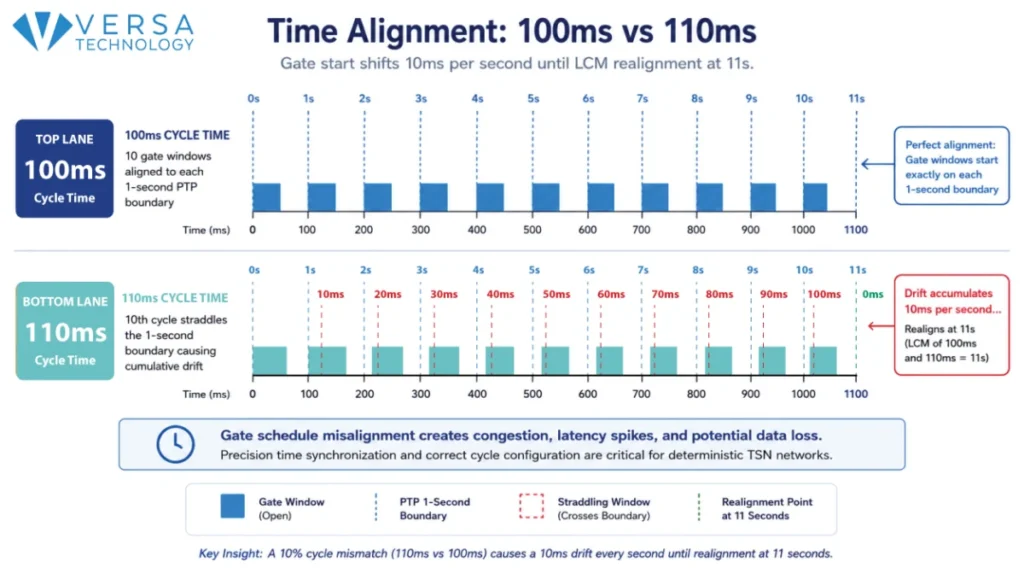
The crown jewel of TSN capability is Time-Aware Scheduling. Through the use of a gate-control list, these chips open and close transmission windows at nanosecond intervals. Imagine a highway where certain lanes are reserved exclusively for emergency vehicles at specific times. If the network is flooded with non-critical background data—such as video analytics or firmware updates—the TSN chip creates a "clear path" for the critical control packet, ensuring it reaches its destination without delay.
Hardware-Based Synchronization
TSN chips utilize IEEE 802.1AS to synchronize the clocks of every device on the network to a "Grandmaster" clock. This ensures that a sensor on one side of the facility and a robot on the other are operating on the exact same microsecond-level timeline. Without this synchronization, coordinated movement is impossible; with it, a factory can behave like a single, perfectly timed organism.
Seamless Redundancy
In an industrial environment, downtime is measured in thousands of dollars per minute. TSN chips offer zero-millisecond recovery through packet replication. A single packet is sent simultaneously across two distinct physical paths. The receiver accepts the first one to arrive and discards the duplicate. If one cable is severed, the network continues to operate without the slightest delay, providing the high availability required for mission-critical operations.

Supporting Data: The Impact on Industrial Reliability
The integration of TSN chips is not merely a theoretical improvement; it is backed by measurable gains in operational efficiency. According to industry benchmarks, networks utilizing TSN-enabled switches and endpoints have demonstrated:
- Jitter Reduction: A decrease in packet arrival variance from milliseconds to sub-microsecond levels.
- Bandwidth Utilization: Increased efficiency by allowing real-time control traffic and high-bandwidth "best-effort" traffic to share the same physical infrastructure without interference.
- Infrastructure Consolidation: A reduction in cabling and hardware costs by as much as 30% by eliminating the need to maintain separate, isolated OT (Operational Technology) and IT (Information Technology) networks.
Implications for the Future of AI-Driven Manufacturing
The rise of artificial intelligence is placing unprecedented demands on the network. Modern AI systems are not just centralized; they are distributed, relying on a constant loop of data exchange between edge sensors, local controllers, and cloud-based analytics engines.
The Real-Time Feedback Loop
In a smart factory, a machine vision camera might detect a defect in a product. The AI must process this information and send a "stop" or "re-route" command to the conveyor belt in milliseconds. If the network is bogged down by unrelated traffic, the defect passes through. TSN ensures that this critical "stop" command is prioritized over all other data packets, enabling the AI to act with the reflexes of a human, but with the consistency of a machine.
Autonomous Operations
As factories transition to fully autonomous operations, the network becomes the "nervous system" of the facility. Whether it is an AGV navigating a complex warehouse layout or a collaborative robot (cobot) working alongside a human, the network must guarantee that every command is executed on time. TSN provides the deterministic reliability required to make these autonomous systems safe enough for widespread deployment.
Official Industry Perspectives
Leading hardware manufacturers, including companies like Microchip, Intel, and NXP, have pivoted their roadmaps to focus heavily on TSN integration. According to industry spokespeople, the push toward TSN is driven by the realization that "proprietary network protocols are no longer viable in an open, interconnected world."

By aligning with IEEE standards, these manufacturers are enabling a future where industrial devices can communicate seamlessly, regardless of the brand or the specific application. This standardization is the final piece of the puzzle for the "Universal Factory," where IT and OT departments can finally speak the same language.
Conclusion: Preparing for the Next Level
As manufacturers continue to race toward an AI-driven future, the network can no longer be an afterthought. The ability to manage time with the same precision as data is the new benchmark for competitive advantage.
TSN chips are more than just a component upgrade; they are the definitive bridge to a reliable, scalable, and truly intelligent industrial infrastructure. Organizations that integrate TSN today are not only solving current bottlenecks—they are building a foundation that will support the autonomous, real-time innovations of the next decade.
For those looking to future-proof their operations, the journey begins with an audit of the current network’s ability to handle time-sensitive traffic. As the demand for synchronization grows, the transition to deterministic, TSN-enabled Ethernet is not just a strategic choice—it is an operational imperative. For more guidance on navigating this complex landscape and securing the right infrastructure components, consult with industry experts in network connectivity and PoE technology.