






In a milestone decision that underscores the shifting landscape of North American critical mineral production, Toronto-based Hudbay Minerals and its partner, Mitsubishi Corp., officially approved the $2.07-billion construction phase for the Copper World mining project in southern Arizona on October 21, 2026. The project, situated approximately 31 miles southeast of Tucson, represents a significant leap forward in domestic copper production, with the joint venture partners aiming to reach first production by the second half of 2029.
The final investment decision (FID) follows the completion of a rigorous definitive feasibility study, signaling the commencement of a project that has been heavily scrutinized, revised, and recalibrated over the better part of a decade. With a ownership structure split 70% to Hudbay and 30% to Mitsubishi, the partners are positioning Copper World as a cornerstone of U.S. copper supply chain resilience.
A Chronology of Development: From Rosemont to Copper World
The journey to the current Copper World plan is rooted in the history of the controversial Rosemont Copper project. After initial economic assessments for the site faced significant regulatory hurdles, Hudbay pivoted in 2022. The company recast its development strategy into a phased approach, focusing exclusively on private land holdings to avoid the complex federal permitting processes that had previously stalled progress.
- 2022: Hudbay issues a preliminary economic assessment, pivoting away from the failed Rosemont model to a phased development strategy focused on private land.
- 2023: A prefeasibility study introduces the 60,000-ton-per-day concentrator model, setting the groundwork for the current infrastructure design.
- August 2024: The Arizona Department of Environmental Quality (ADEQ) issues the necessary Aquifer Protection Program permit, marking a critical regulatory milestone.
- October 21, 2026: Hudbay and Mitsubishi formally approve the $2.07-billion construction budget, triggering the start of the three-year development cycle.
- 2029: The anticipated date for the commencement of commercial production.
Infrastructure and Technical Scope: Engineering for Efficiency
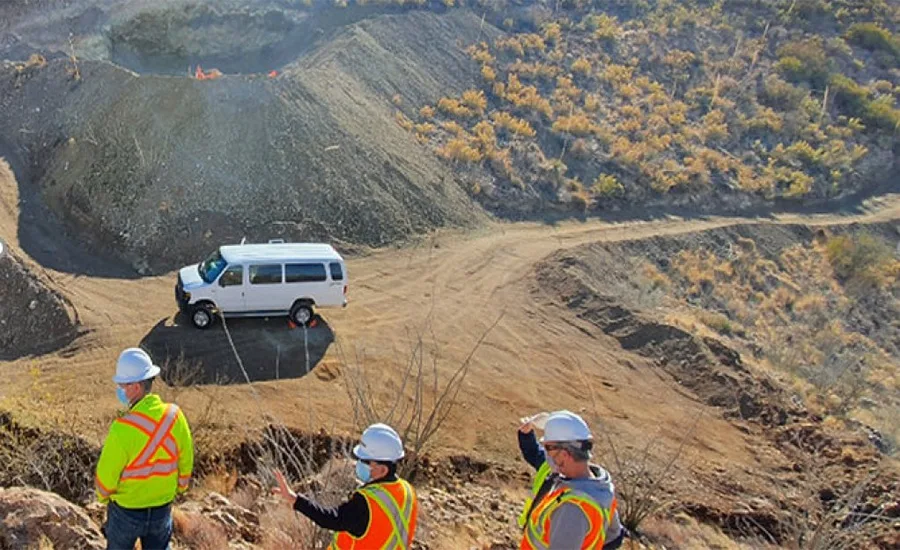
The Copper World project is designed as a conventional open-pit, truck-and-shovel operation. The mine will extract ore from four primary pits—East, Broadtop, West, and Peach-Elgin. Initial construction includes the development of waste-rock facilities, grade-segregated ore stockpiles, and a state-of-the-art tailings storage facility.
Hudbay has emphasized efficiency in its technical design, integrating advanced systems to manage the projected 60,000 tons of ore per day. A central component of the long-term plan is the implementation of an in-pit crushing and conveying (IPCC) system, slated for installation in the project’s third year. By replacing a portion of the traditional haul-truck fleet with a high-capacity conveyor system, Hudbay expects to significantly reduce carbon emissions and operational expenditures.
Scalability and Future Expansion
The development plan is not static. Hudbay has outlined a clear path for expansion:
- Phase 1 (Startup): 60,000 tons-per-day concentrator.
- Year 1: Construction of a $25-million molybdenum processing plant.
- Year 3: Installation of the $242-million IPCC system.
- Year 5: A $443-million expansion of the concentrator to 90,000 tons-per-day, supported by a filtered-tailings strategy that optimizes water consumption.
By utilizing filtered—or "dry stack"—tailings, the company aims to facilitate this expansion without needing to increase its water draw, a key concession to the environmental concerns surrounding the arid Arizona climate.

Financial Architecture and Investment Capital
The capital intensity of Copper World is substantial, but the financing structure is designed to mitigate immediate pressure on Hudbay’s balance sheet. According to Eugene Lei, President and CFO of Hudbay Minerals, the company’s funding model requires it to cover only one-quarter of the project capital, with the first major capital contributions deferred until 2028.
The construction budget is bolstered by:
- $600 Million: Mitsubishi’s initial equity investment.
- $230 Million: A precious-metals stream deposit from Wheaton Precious Metals.
- $127 Million: Anticipated equipment financing.
- $650 Million: Project-level debt.
Furthermore, Hudbay plans to fund the year-five expansion primarily through operating cash flow and a supplementary $70-million payment from Wheaton Precious Metals, ensuring that the project remains self-sustaining once it enters the production cycle.
Official Responses and Regulatory Oversight
The project’s progress has been accompanied by intense oversight from state and local authorities. In an October 21 memo to Pima County supervisors, County Administrator Jan Lesher acknowledged the "apparent use of dry stack or filtered tailings" and "changes in mine facility configurations," noting that county staff would conduct a thorough review of the definitive feasibility study.
The Arizona Department of Environmental Quality, which granted the Aquifer Protection Program permit in 2024, has maintained that design evolutions are a natural part of the lifecycle of a mine. "Design changes during mine development are common and must be addressed through the established permitting process," the agency stated during the permit review.
However, the regulatory road ahead is not entirely clear. Pima County staff are currently preparing to engage with state water regulators to discuss the status of Hudbay’s existing water-pumping permit, which is set to expire in early 2028—roughly one year before the projected start of operations.
Local Opposition: A Deepening Divide
Despite the economic promise of 1,000 construction jobs and 500 permanent operating roles, Copper World faces stiff resistance from local government and indigenous groups. The Tohono O’odham Nation, led by Chairman Verlon Jose, has been a vocal opponent, emphasizing the cultural and historical significance of the Santa Rita Mountains, which the Nation refers to as Ce:wi Duag.

"The Santa Rita mountains hold our history, our sacred places, and the living connections between our people and the natural world," Chairman Jose stated in July. "We have a collective responsibility to protect the Santa Rita Mountains for future generations."
The opposition is not limited to cultural concerns. Both the Tucson City Council and the Pima County Board of Supervisors have formally expressed their opposition to the project. The primary arguments from local leaders center on the long-term impact on an already stressed aquifer and the risk of land subsidence.
Pima County Board of Supervisors Vice Chair Matt Heinz articulated a nuanced stance in a recent interview, noting that the county is not fundamentally anti-mining, but rather skeptical of the project’s specific location. "We work with ASARCO. We partner with them," Heinz remarked. "So this isn’t like a no-mining—not in my backyard—never ever. It’s just, why here?"
Future Implications: A Long-Term Vision
The current 15-year base mine plan is restricted to private land, but Hudbay’s vision extends well beyond this timeframe. The company is already evaluating a potential expansion onto adjacent federal lands that could, if approved, extend the life of the Copper World operation from 15 to 37 years.
This potential expansion represents the next major battlefield in the project’s development. While the private land strategy has allowed the project to bypass certain federal roadblocks, moving onto federal land would subject the venture to a much more rigorous National Environmental Policy Act (NEPA) review.
As the project moves into the construction phase, the tension between the national imperative for copper security—essential for the global energy transition—and local concerns over environmental stewardship and indigenous rights will likely remain at the forefront. For Hudbay and Mitsubishi, the challenge will be to execute a multi-billion-dollar build-out while navigating a complex landscape of regulatory requirements and public opposition that shows no signs of abating.
As of late 2026, the Copper World project stands as a high-stakes test case for the future of large-scale mining in the American Southwest. With $2.07 billion on the line, the eyes of the mining industry are firmly fixed on the Santa Rita Mountains.