




1. Main Facts: The Strategic Shift in Physical Layer Infrastructure
The global data center landscape is undergoing a structural metamorphosis. As artificial intelligence (AI), high-performance computing (HPC), and sovereign cloud mandates push rack power densities from the traditional 5 kW toward the 100 kW threshold, the internal plumbing of these facilities—the optical fiber backbone—has moved from a background utility to a critical business driver.
In the modern colocation model, the fiber backbone is no longer a static utility; it is a shared, high-stakes ecosystem. Unlike enterprise data centers that serve a single entity, colocation facilities must provide seamless, secure, and ultra-high-speed connectivity to hundreds of tenants, ranging from hyperscale cloud providers to financial institutions and government agencies.
The core challenge facing operators today is the "topology bottleneck." Many facilities are operating on legacy distribution strategies—designed for the 10G and 40G eras—that are physically incapable of supporting the 400G, 800G, and 1.6T interconnects now standard in AI-driven workloads. This article explores why the design of the Meet-Me-Room (MMR) and the distribution architecture radiating from it has become a defining factor in attracting premium tenants and maintaining long-term operational competitiveness.
2. Chronology: The Evolution of Data Center Interconnectivity
To understand the current crisis in fiber distribution, one must look at the rapid acceleration of the industry over the last decade:
- 2010–2015 (The Capacity Era): Data centers focused on "reach." The primary goal was connecting the server hall to the carrier gateway. Backbone topologies were relatively simple, often utilizing centralized patching zones with limited fiber density.
- 2016–2020 (The Hyperscale Surge): The rise of massive cloud campuses necessitated the first wave of "MMR-to-MMR" architectures. Operators began to realize that fiber density was becoming a spatial constraint, leading to the introduction of higher-count fiber cables and early modular MPO (Multi-fiber Push-On) connectors.
- 2021–Present (The AI and HPC Inflection Point): We have entered the era of massive parallelism. AI clusters require low-latency, massive-bandwidth interconnects that are pushing the physical limits of traditional cabling. Today, a single tenant cage might require thousands of fibers. The focus has shifted from mere connectivity to "non-disruptive scalability"—the ability to add capacity without interrupting existing, high-value traffic.
3. Supporting Data and Technical Realities
The transition to high-density, modular fiber backbones is supported by three primary pillars: Scalability, Density, and Spatial Efficiency.
The Math of Density
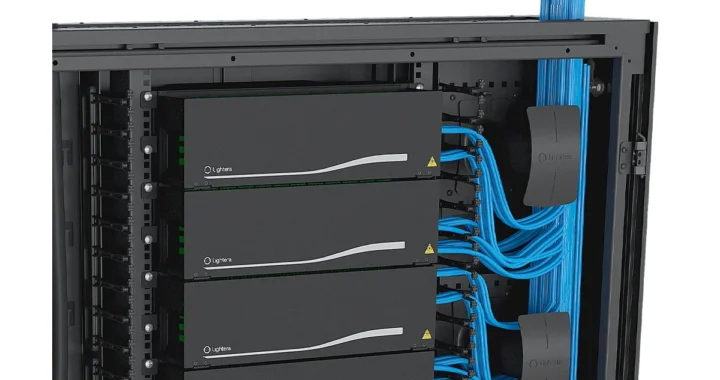
The shift from 5 kW to 100 kW per rack necessitates a proportional increase in fiber count. Modern distribution systems must now support up to 3,456 fibers (or more) per cabinet. When these are managed via high-density termination modules, operators can reduce the physical footprint of the cabling infrastructure by as much as 40–60%.
The Cost of Disruption
Industry data indicates that a single hour of downtime for a high-density colocation tenant can cost tens of thousands of dollars in SLA penalties and lost revenue. Traditional "rip-and-replace" upgrades are no longer financially viable. Modular, plug-and-play backbone topologies allow for "live-environment" expansion, where new fiber paths are provisioned alongside existing ones without the risk of accidental cable disturbances—a major risk factor in legacy systems.
4. Official Perspectives and Industry Best Practices
According to Cássio Cardoso, a Senior Engineer at Lightera and an expert in high-density optical infrastructure, the physical layer is now a primary procurement criterion for sophisticated tenants.
"When a hyperscale tenant audits a colocation facility, they aren’t just looking at power and cooling," Cardoso explains. "They are auditing the fiber path diversity. They want to see physical separation between redundant paths, secure, locked-down transition points, and a modular framework that proves we won’t need to perform a major construction project the next time they need to scale to 1.6T. The topology is, in effect, a proxy for the quality of the operator’s engineering team."

Regulatory Compliance
For sectors like finance (PCI DSS) and government (ISO 27001), the physical security of the fiber is paramount. Industry standards now emphasize:
- Path Segmentation: Physical isolation of tenant fibers to prevent cross-talk or accidental disconnects.
- Documentation Rigor: Every fiber run must be labeled and tracked within an automated DCIM (Data Center Infrastructure Management) system.
- Secure Access: Transition points, such as splice enclosures and patch panels, must be housed in physically restricted areas with audit trails.
5. Implications: A Strategic Business Decision
The implications of these topology choices extend far beyond the server room floor. They ripple through the operator’s entire business model.
Competitive Differentiation
In a crowded colocation market, the ability to promise "instant" or "near-instant" connectivity is a massive marketing advantage. An operator with a modular backbone can provision cross-connects in hours, whereas an operator with a rigid, legacy architecture might require weeks of labor-intensive cable pulling and testing.
The Revenue-per-Rack Metric
In high-end colocation, every Rack Unit (RU) is a revenue-generating asset. Traditional cabling systems that consume excessive rack space for cable management are essentially "wasting" square footage that could be sold to clients. High-density termination modules allow operators to maximize the sellable space, directly improving the Return on Investment (ROI) for the facility.
Long-Term Asset Lifecycle
By adopting standardized, modular frameworks, operators avoid the "technical debt" of legacy systems. As transmission speeds continue to evolve, modular backbones allow for the replacement of individual components—such as upgrading from LC to MPO-based adapters—without replacing the entire fiber plant. This turns the physical infrastructure into a dynamic platform that grows alongside the tenant’s business.
6. Conclusion: The Path Forward
The optical backbone is invisible when it works—but it is the most consequential failure point if it doesn’t. As we look toward a future defined by AI-driven workloads and global sovereign cloud initiatives, the "set-and-forget" mentality toward fiber distribution is a liability that no colocation operator can afford.
The transition to centralized Meet-Me-Room (MMR) models, combined with modular, high-density distribution, is not merely a technical upgrade. It is a fundamental shift in business strategy. It represents a commitment to engineering discipline, security, and agility. For operators, the choice is clear: either treat the physical layer as a static constraint, or optimize it as a competitive engine. Those who choose the latter will find themselves the preferred partners for the next generation of global digital infrastructure.
About the Author
Cássio Cardoso, ATD®, RCDD®, PMP®
Senior Engineer, Lightera
Cássio Cardoso specializes in high-density optical infrastructure for mission-critical environments. With a background spanning structured cabling, fiber optic design, and data center operations, he partners with colocation providers to future-proof their physical layer assets. For further insights or consultation, he can be reached at [email protected].