


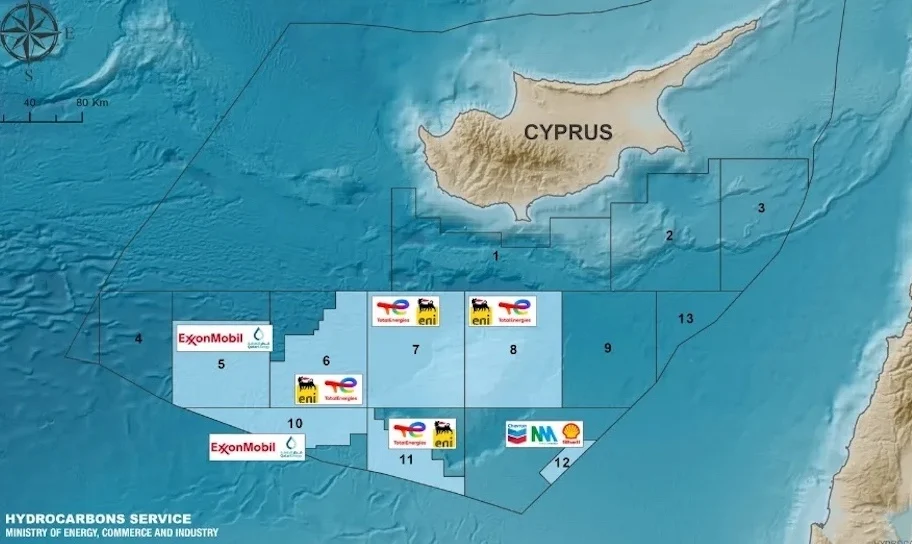
In a landmark decision that promises to reshape the energy landscape of the Eastern Mediterranean, European energy majors Eni and TotalEnergies have officially committed to the development of the Cronos gas field located offshore Cyprus. The final investment decision (FID), finalized last month, signals the end of years of exploration uncertainty and the beginning of a strategic integration of Cypriot natural gas into the European supply chain.
By leveraging existing infrastructure in Egypt, the project—a 50-50 partnership between the two energy giants—is designed to fast-track the transition from exploration to production, with first gas expected to flow by 2028. This move not only marks Cyprus’s entry into the ranks of natural gas producers but also cements the Eastern Mediterranean’s role as a critical, alternative supply hub for the European Union.
The Genesis of Cronos: A Chronology of Discovery and Development
The journey toward the Cronos FID began long before the recent announcement. The Eastern Mediterranean has been a focal point for international exploration efforts, driven by the discovery of massive reservoirs like Egypt’s Zohr field.
- 2022 Discovery: The Cronos-1 well, located 185 km southwest of the Cypriot coastline, struck pay dirt in 2022. Preliminary testing confirmed the presence of a significant reservoir holding more than 3 trillion cubic feet (Tcf) of natural gas.
- February 2024: A pivotal intergovernmental milestone was reached when Cyprus and Egypt signed a formal host government agreement. This treaty provided the necessary legal and regulatory framework to allow for the cross-border transport of gas, a prerequisite for the project’s economic viability.
- Mid-2026: Following extensive pre-FEED (Front-End Engineering Design) and FEED work conducted primarily in-house by the operators, Eni and TotalEnergies reached the final investment decision.
- 2028 Projection: The industry is now tracking toward the 2028 timeline, which will see the first subsea production wells operational, linking the Cypriot seabed to the Egyptian processing grid.
Technical Scope and Supporting Data
The development strategy for the Cronos field is defined by efficiency and the utilization of "sunk" capital—specifically, the existing processing infrastructure already operating in Egyptian waters.
Engineering and Infrastructure
The project plan involves the installation of four advanced subsea wells designed to extract approximately 500 million cubic feet of natural gas per day. This gas will be transported via a dedicated subsea pipeline network directly to the Zohr field processing facilities, located within the Egyptian maritime zone.
Once processed at the Zohr facilities, the gas will be funneled to the Damietta LNG plant near Port Said. Here, it will be liquefied into an estimated 2.8 million tons of LNG per year. The output will be split between Eni and TotalEnergies, who will manage the marketing and distribution of the cargo to their respective global and European portfolios.
Economic Estimates
While the partners have remained tight-lipped regarding the exact capital expenditure (CAPEX), independent energy analysts in Nicosia have pegged the project cost in the range of $2.5 billion to $3 billion. This investment covers the subsea hardware, the pipeline tie-backs, and the necessary upgrades to the receiving terminals in Egypt.
Competitive Landscape
The Cronos field is just one piece of a much larger regional puzzle. The broader Cyprus offshore sector is experiencing a surge in activity:
- Aphrodite Field: Situated near the maritime border with Israel, the Aphrodite field is currently the subject of an updated development plan led by Chevron. A final investment decision for this field is anticipated by the end of 2026.
- Block 10 Activity: Earlier this year, the consortium of ExxonMobil and QatarEnergy reported significant success in the Glavcos and Pegasus fields. These prospects hold combined estimated resources of approximately 7 trillion cubic meters, further bolstering the region’s potential as a long-term gas provider.
Official Perspectives: A Strategic Milestone
The significance of the Cronos project extends beyond the balance sheets of the operating companies. It represents a geopolitical alignment between the EU, Cyprus, and Egypt, aimed at energy security.
Eni’s Strategic Vision
Eni CEO Claudio Descalzi emphasized that the project is not merely a commercial endeavor but a contribution to European stability. "The Cronos fast-track initiative marks a concrete milestone in positioning Cyprus as a European gas producer and exporter," Descalzi noted in a statement. "It unlocks the establishment of a regional gas hub in the Eastern Mediterranean by leveraging Egypt’s existing hydrocarbon infrastructure. It is, furthermore, an example of international cooperation and a concrete contribution to the diversification and security of Europe’s gas supply."
The Role of Regulatory Synergy
The cooperation between Cyprus and Egypt is a model for regional resource management. By utilizing the Damietta LNG facility, the project avoids the high costs associated with constructing a brand-new liquefaction plant on the Cypriot coast, which would have required significantly higher capital outlay and a longer lead time. This "hub-and-spoke" model—where multiple small-to-mid-sized fields feed into a central processing facility—is now seen as the primary blueprint for future development in the Eastern Mediterranean.
Global Implications: Energy Security and the "Hub" Concept
The development of the Cronos field arrives at a critical juncture for the European Union. As the bloc continues to transition away from historical dependency on Russian pipeline gas, the Eastern Mediterranean has emerged as a vital secondary supply route.
Diversification of Supply
By diversifying its gas sources, Europe is effectively insulating itself against the volatility of the global LNG market. The gas produced from the Cronos field will be shipped as liquefied natural gas, offering the flexibility to be diverted to the highest-demand European markets, from Greece and Italy to the broader Mediterranean littoral.
The Emergence of the "East Med" Hub
The synergy between Cyprus’s offshore assets and Egypt’s liquefaction infrastructure is creating a regional energy hub that is difficult to replicate elsewhere. Egypt’s ability to act as a processing and re-export point for Eastern Mediterranean gas transforms the region from a collection of isolated fields into a unified, reliable supplier.
Challenges and Future Outlook
Despite the optimism, the project faces ongoing challenges:
- Geopolitical Tensions: The Eastern Mediterranean remains a region with complex maritime boundary claims. While the Cronos field is located within the defined Cypriot Exclusive Economic Zone (EEZ), the broader regional security environment remains sensitive.
- Market Fluctuations: The long-term profitability of the $3 billion investment is tied to global gas prices. While the current outlook for LNG remains strong, the companies are banking on the transitionary role of natural gas in the global "Net Zero" pathway.
- Technological Hurdles: The use of subsea tie-backs over such distances requires high-level technical precision. The reliance on the Zohr infrastructure means that any operational downtime at the Zohr processing hub will directly impact the throughput of the Cronos field.
Conclusion: A New Era for Cyprus
As the drills begin to turn and the subsea infrastructure takes shape, the Cronos project stands as a testament to the power of international collaboration in the face of energy insecurity. For Cyprus, the field represents more than just a source of revenue; it is the fulfillment of a decade-long aspiration to become a player in the international energy markets.
As the industry looks toward the upcoming decisions on the Aphrodite, Glavcos, and Pegasus fields, the Cronos FID serves as the proof of concept. The Eastern Mediterranean is no longer just a region of geological potential; it is becoming a cornerstone of the future energy architecture of Europe. With the first gas scheduled for 2028, the eyes of the energy world will remain fixed on the offshore blocks of the Levant, waiting to see if this promise of regional energy security can be delivered on time and within budget.