






In the landscape of modern manufacturing, the margin for error has shrunk to a near-vanishing point. As industrial facilities integrate artificial intelligence, machine learning, and autonomous robotics, the traditional networking architectures that have powered factories for decades are beginning to show their age. We are entering an era where timing precision is not merely an operational goal—it is a fundamental requirement for safety and reliability.
At the heart of this transition is Time-Sensitive Networking (TSN), a transformative evolution of standard Ethernet. By shifting the paradigm from "best-effort" data delivery to deterministic, microsecond-accurate communication, TSN chips are enabling a new generation of industrial performance.
The Physical Ceiling: Why Standard Ethernet Struggles with AI
To understand the necessity of TSN, one must first recognize the limitations of conventional networking. Standard Ethernet, the backbone of modern IT, was designed for high throughput rather than precise timing. In these systems, data packets are sent as quickly as possible, but their arrival time is subject to the whims of network congestion.
In a high-speed assembly line, where robotic arms must synchronize their movements within microseconds, this "best-effort" approach is insufficient. If a control signal for a high-speed packaging robot is delayed by even a few milliseconds due to a spike in background data traffic, the result can be a catastrophic mechanical collision or a costly production shutdown. As factories move toward AI-driven autonomous systems, this "physical ceiling" of standard Ethernet represents a significant barrier to scaling.
What is TSN? A Technological Overview
Time-Sensitive Networking (TSN) is a set of IEEE 802.1 standards designed to provide deterministic communication over Ethernet. By introducing specialized silicon—TSN chips—manufacturers can guarantee that data packets arrive within a precise, predictable window of time.
Unlike standard Ethernet switches that process traffic on a first-come, first-served basis, TSN-enabled hardware introduces a "time-aware" layer of logic. This technology does not replace Ethernet; rather, it supercharges it, allowing critical operational data to coexist with non-critical IT traffic on the same physical infrastructure. This consolidation significantly reduces the cost and complexity of deploying separate networks for Operational Technology (OT) and Information Technology (IT).

The Chronology of Deterministic Networking
The path toward TSN has been a steady evolution of the IEEE 802.1 standards, moving from basic packet switching toward a unified, time-synced future:
- 1980s–2000s: The era of Proprietary Fieldbuses. Manufacturers relied on specialized, often incompatible communication protocols to ensure real-time performance, leading to "siloed" factory floors.
- 2010s: The rise of Audio Video Bridging (AVB). IEEE initially developed these standards to ensure the synchronization of audio and video streams, laying the groundwork for low-latency transmission.
- 2015–2018: The formalization of TSN. The IEEE 802.1 Working Group expanded AVB into TSN, targeting industrial automation, automotive control, and aerospace applications.
- 2020–Present: The AI Integration phase. As machine learning models require massive amounts of real-time sensor data, TSN has moved from a niche solution to a foundational requirement for "Industry 4.0."
How TSN Chips Differ from Standard Silicon
The core distinction between standard Ethernet chips and TSN chips lies in the management of priority and time. A standard chip is built for throughput; it treats all data as equal and rushes to clear its buffers. A TSN chip, by contrast, is a precision instrument.
Standard Ethernet Chips
Standard chips operate without a global concept of time. They handle "best-effort" traffic, meaning that during periods of high network congestion, latency—the time it takes for a packet to travel from source to destination—becomes variable. This "jitter" is acceptable for web browsing or file transfers but is entirely unsuitable for motion control or automated guided vehicles (AGVs).
TSN Chips
TSN chips incorporate a "Global Grandmaster" clock. Through hardware-based timestamping, every connected device—be it a PLC, a robotic arm, or a vision camera—aligns its internal clock to this single source. This allows for:
- Time-Aware Scheduling (TAS): Creating exclusive "time slots" for critical traffic.
- Traffic Policing: Ensuring that non-critical traffic cannot "bleed" into the reserved time windows of high-priority commands.
- Low Jitter: Guaranteeing that critical data packets arrive exactly when expected, every time.
Core Capabilities and Hardware Implications
The integration of TSN chips requires more complex silicon than traditional Ethernet ASICs. Manufacturers are embedding advanced features directly into the hardware to handle the rigorous demands of real-time industrial environments.
Time-Aware Scheduling (TAS)
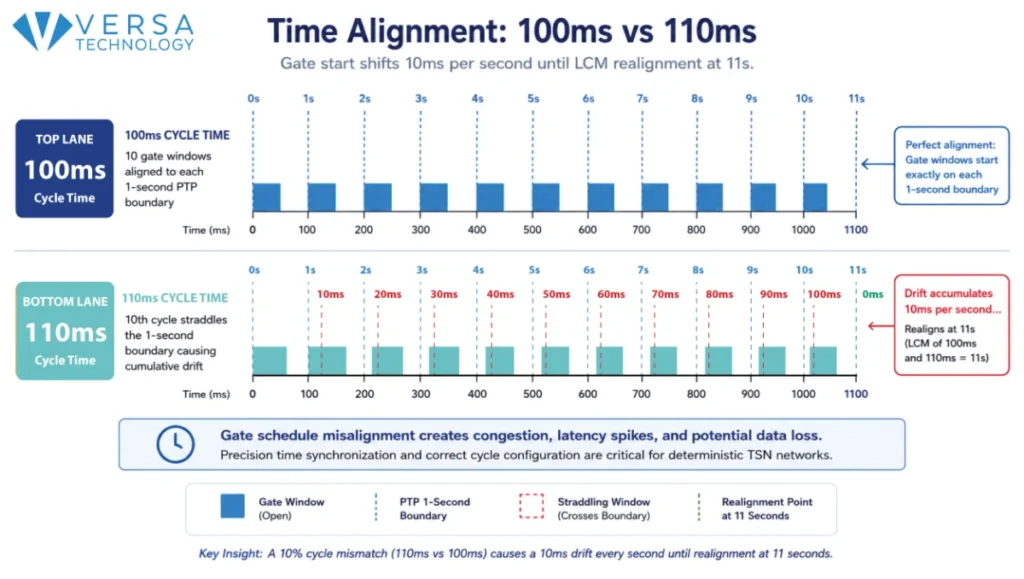
TAS is the "traffic cop" of the industrial network. By using a gate-control list, the chip opens and closes transmission windows at nanosecond intervals. When a high-priority packet is scheduled to move, the network effectively "clears the road," ensuring that the packet passes through without delay, even if a massive file transfer is occurring simultaneously.

Seamless Redundancy
One of the most critical requirements for autonomous factories is zero-millisecond recovery. TSN chips support frame replication and elimination. By sending two copies of the same packet over different physical paths simultaneously, the system ensures that if one cable is damaged, the other copy arrives instantly. The network continues to function without even a microsecond of downtime.
Implications for the AI-Driven Factory
The implications of this technology are profound. As AI models move from the cloud to the "Edge"—the actual machinery on the factory floor—the requirement for real-time, low-latency communication becomes the primary bottleneck.
Predictive Maintenance and Real-Time AI
AI systems require a constant stream of high-fidelity data from sensors to predict equipment failure. TSN enables this data to be transmitted alongside critical control data without causing interference. This allows for real-time "Digital Twin" modeling, where the physical machine and its virtual AI counterpart are perfectly synchronized.
Autonomous Mobility
AGVs and mobile robots (AMRs) rely on machine vision and LIDAR. These systems generate massive amounts of bandwidth-heavy traffic. TSN ensures that the steering and safety-critical commands for these vehicles are never delayed, regardless of how much sensor data is being offloaded for AI processing.
Supporting Data and Industry Adoption
Industry leaders in silicon manufacturing, such as Microchip, NXP, Renesas, and Texas Instruments, are aggressively expanding their TSN-capable product lines. This shift is not restricted to one sector; it is a horizontal evolution:
- Automotive: TSN is becoming the standard for In-Vehicle Networking (IVN), supporting everything from advanced driver-assistance systems (ADAS) to infotainment.
- Aerospace: High-reliability requirements in cockpit electronics are driving the adoption of deterministic Ethernet.
- Industrial Automation: Leading manufacturers are replacing legacy fieldbus systems with unified TSN-enabled Ethernet, drastically simplifying network management.
Official Perspectives: The Path Forward
Industry experts and standards bodies emphasize that TSN is not merely an "upgrade"—it is a fundamental reconfiguration of the relationship between silicon and the physical world.

"We are moving from a world where we hope data arrives on time to a world where we guarantee it," says one industry analyst. "For AI-driven operations, that shift is the difference between a successful autonomous workflow and a failed one."
While the transition to TSN involves an initial investment in hardware and network configuration, the long-term benefits—increased production speed, higher safety standards, and simplified network maintenance—provide a clear ROI. By leveraging existing Ethernet cabling while adding a layer of intelligent, time-aware silicon, organizations can bridge the gap between their current infrastructure and the demands of the AI-driven future.
Conclusion: Preparing for the Next Level
As we stand on the precipice of a new industrial revolution, the ability to master time is the new competitive advantage. TSN chips provide the necessary infrastructure to ensure that mission-critical data never waits in line.
For organizations currently navigating the complexities of AI integration, the choice of networking hardware is no longer a peripheral decision; it is a foundational one. Companies that prioritize deterministic, low-latency communication today will be the ones that define the autonomous manufacturing standards of tomorrow. Whether you are upgrading an existing assembly line or architecting a new smart facility, the future of connectivity is synchronous, deterministic, and precise.
For those looking to future-proof their operations, engaging with experts in industrial networking components is the necessary first step. As we move toward a more automated, AI-augmented world, ensuring that your network is built on the bedrock of Time-Sensitive Networking is the most reliable way to maintain operational excellence in an increasingly complex digital landscape.