





The morning of September 11, 2001, began as a routine Tuesday for thousands of construction professionals across New York City and Washington, D.C. They arrived at jobsites, checked blueprints, and coordinated material deliveries, unaware that the world was about to change irrevocably. By mid-morning, the deliberate terrorist attacks on the World Trade Center, the Pentagon, and the hijacked flight that crashed in Pennsylvania had not only claimed nearly 3,000 lives but had also fundamentally altered the trajectory of the global construction and engineering industry.
Twenty-five years later, the legacy of that day is etched not just into the memorial sites that define Lower Manhattan and Arlington, but into the very DNA of modern infrastructure, emergency management, and human resilience.
The Magnitude of Destruction and the Industrial Response
The economic and physical toll of the 9/11 attacks remains one of the most staggering figures in urban history. Estimates suggest that the total cost of damage, debris removal, and subsequent reconstruction reached approximately $75 billion. Beyond the financial impact, the structural collapse of the Twin Towers—a feat of engineering destruction that few experts had modeled for—left a debris field that defied conventional construction wisdom.
The cleanup effort was a masterclass in logistics and high-stakes engineering. To manage the chaos, the site was partitioned into four quadrants, each overseen by a powerhouse joint venture of contractors: AMEC Construction, Bovis Lend Lease, Tully Construction Co., and a partnership between Turner Construction and Plaza Construction. These firms were tasked with an unprecedented mission: clearing millions of tons of steel and concrete while ensuring the structural stability of surrounding skyscrapers that had been severely compromised.
Chronology of Crisis and Recovery
The immediate aftermath of the attacks saw the construction industry pivot from its role as a builder to that of a frontline responder.
- September 11, 2001: The collapse of the towers creates an environment of total devastation. Engineering firms begin mobilizing personnel to assess the stability of the remaining "bathtub" slurry wall, which prevented the Hudson River from flooding the site.
- Late 2001 – Early 2002: The primary phase of site cleanup transitions into intensive recovery operations. Thousands of union tradespeople work alongside first responders, navigating toxic air and unstable wreckage to assist in the search for remains.
- Winter/Spring 2002: Planning for the future begins in earnest. Developer Silverstein Properties launches plans for the new 7 World Trade Center, signaling a defiant commitment to the city’s economic rebound.
- 2003–2016: The multi-year reconstruction effort unfolds, culminating in the opening of the Oculus Transportation Hub in 2016—a symbol of connectivity that links New Jersey’s transit systems with the heartbeat of New York City’s subway lines.
The Engineering of Resilience: Insights from the Field
On September 10, 2026, the American Council of Engineering Companies (ACEC) New York hosted a commemorative program titled Engineering Resilience: 25 Years of Rebuilding, Remembrance and Renewal. The event served as a platform for industry veterans to discuss how their training was pushed to its absolute limit during the recovery.
Vicki Arbitrio, an associate partner at Gilsanz Murray Steficek and a former secretary of the Structural Engineers Association of New York, was a key panelist. At the time of the attacks, she helped coordinate more than 400 engineers tasked with monitoring the structural safety of the site.

"I’m surprised that I keep hearing new stories about amazing people who did things that no one expected to do," Arbitrio told ENR following the event. "Hearing the stories and sharing them is not really what engineers do. We’re numbers people, not storytellers. But I think it’s really important to help the public understand what we do."
Arbitrio reflected on the unique environment of the recovery site, where traditional bureaucracy was bypassed in favor of rapid, life-saving decision-making. "You didn’t always get the permit before you started the work," she noted. "But because so many were working toward the same goal, it worked."
The Human Cost: A Legacy of Sacrifice
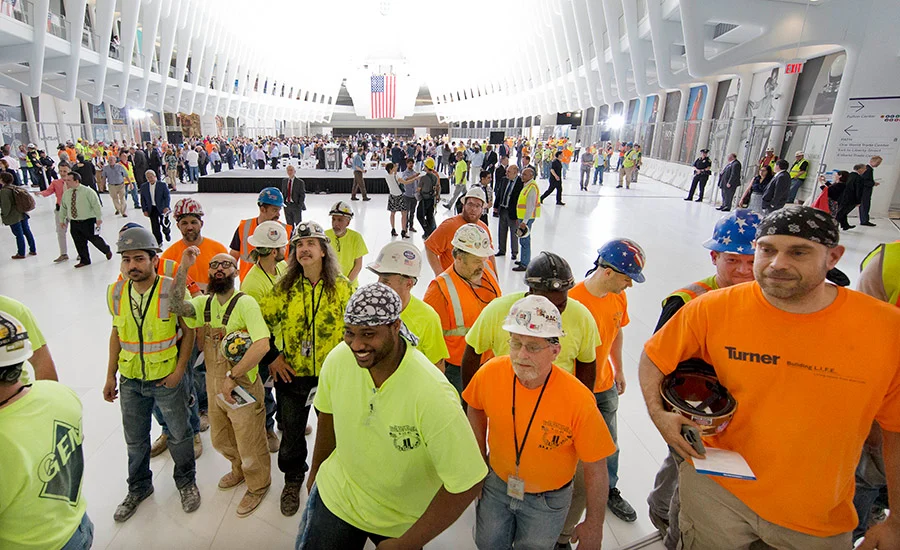
While the new skyline of Lower Manhattan stands as a testament to progress, the human cost of the cleanup continues to be felt. Gary LaBarbera, president of the Building and Construction Trades Council of Greater New York, has been vocal about the sacrifices made by the workforce.
"Thousands of union construction workers, alongside first responders, did not hesitate to step up to help this city rebuild, recover, and rekindle," LaBarbera said. "They navigated burning debris, twisted steel, and toxic air in an effort not only to clean up debris, but also to search for remains."
Many of these workers, who labored for months in the "pile," have suffered from 9/11-related illnesses in the years since. Their legacy is not only in the physical glass and steel of the new World Trade Center complex but in the heightened awareness of worker health, safety, and environmental protection that now dictates construction protocols worldwide.
Structural and Procedural Implications
Michael Burton, currently an executive vice president at LiRo-Hill, was in 2001 an engineer and manager for the New York City Dept. of Design and Construction. Tasked with the impossible role of Ground Zero cleanup manager, his experience provides a rare window into the transition from disaster response to permanent reconstruction.
"Everybody has a different story for what they did there," Burton remarked. "Even though I was responsible for the recovery, there’s so much I don’t know."

Burton challenged the misconception that reconstruction was an isolated phase that only began after the cleanup was complete. In reality, the integration of agencies—including the New York State Dept. of Transportation and the Port Authority of New York and New Jersey—began within weeks of the attacks. This level of inter-agency coordination became a blueprint for future disaster management in major urban centers.
"If you can get a bunch of smart people to work together, you can do anything," Burton stated in the ACEC video documentary.
Shaping the Future of the Profession
The 25-year milestone has prompted the industry to look forward as much as it looks back. A recurring theme in recent commemorations is the need to attract the next generation of engineers and builders by demonstrating the social value of the profession.
As practitioners like Arbitrio and Burton pass the torch, the lessons learned—that engineering is as much about human judgment, ethics, and community service as it is about physics and mathematics—remain paramount. The industry has evolved to prioritize building for resilience, understanding that the role of an engineer in the 21st century extends beyond designing static structures to ensuring the continuity of life in the face of unforeseen threats.
On September 15, 2026, a tribute at North Oculus Plaza will once again gather the industry to honor those who responded to the call. The funds raised will support HEART 9/11, a non-profit dedicated to immediate disaster response and community resilience, ensuring that the spirit of solidarity born in the dust of 2001 continues to protect the world in the years to come.
Through this quarter-century lens, it is clear that the destruction of the World Trade Center did not signal the end of the industry’s ambition. Instead, it catalyzed a profound transformation, forcing a re-evaluation of how we build, how we organize, and how we care for the people who make our cities possible. The skyline of New York today is not just a collection of buildings; it is a monument to the collaborative power of a profession that, when faced with the unimaginable, chose to build back better.