

By Barry Elliott, Director, Capitoline Ltd
The rapid ascent of Artificial Intelligence (AI) and High-Performance Computing (HPC) has fundamentally altered the landscape of data center design. As organizations rush to deploy dense GPU clusters—typified by the NVIDIA GB200/300 NVL72 architectures—industry observers are noting a transition from the era of "servers in racks" to a new reality: "data centers in cabinets."
While this evolution represents a technological triumph, it presents a significant challenge to established infrastructure standards. Traditional data center resilience models, such as the ANSI/TIA-942 standard, were designed for air-cooled racks typically consuming 5 to 15 kW. Today, GPU superpods demand power and cooling profiles that are orders of magnitude higher, forcing a re-evaluation of how we define uptime, redundancy, and availability in the age of AI.
The Evolution of the Data Center: From Racks to Superpods
For the past two decades, the data center industry has matured under the framework of the ANSI/TIA-942 standard. This standard provides a rigorous methodology for evaluating data center resilience, focusing on power, cooling, physical security, and telecommunications cabling across four availability ratings.
In a standard Rating 3 or 4 facility, "professional" grade reliability is achieved through redundant cooling loops, dual power feeds to every rack, and diverse cabling paths. These designs ensure that no single point of failure can lead to an outage, allowing for concurrent maintainability or full fault tolerance. However, the arrival of AI HPC "superpods" has rendered many of these conventional assumptions obsolete.
A Chronology of Density
- The Air-Cooled Era (2000–2015): The industry standard for rack density hovered between 5 kW and 15 kW. Air-cooling (CRAC/CRAH units) was sufficient to manage heat dissipation, and structured cabling followed predictable TIA-942 patterns.
- The Emergence of High-Density (2015–2022): Increased compute demands pushed densities toward 20–30 kW per rack, leading to the early adoption of immersion cooling and advanced containment strategies.
- The AI Superpod Paradigm (2023–Present): With the introduction of massive GPU clusters, power requirements have spiked to 132 kW per rack, with industry projections pointing toward 1 MW per rack in the near future. This shift necessitates a fundamental move from traditional air-cooling to Direct Liquid Cooling (DLC).
The Power Crisis: Managing Megawatts at the Cabinet Level
The power requirements of modern GPU clusters are staggering. To deliver 132 kW—and eventually 1 MW—per rack, the industry is moving away from traditional AC power distribution.
Current Power Architectures
In the current GPU-centric environment, compute units are powered by 48 V DC. This is typically delivered via a three-phase UPS system feeding an internal rack distribution bus. Within the rack, AC-DC power supply units convert the power to feed the compute nodes. While this system can technically incorporate N+1 redundancy for power supplies, it lacks the broader systemic redundancy seen in traditional facility designs.
The 800 V DC Transition
To reach the 1 MW threshold, NVIDIA and other innovators are proposing an 800 V DC distribution system. The logic is simple: higher voltage allows for significantly lower current, which in turn minimizes $I^2R$ (resistive) losses. Without this transition, the copper cabling required to deliver 1 MW of power would be physically impractical, if not impossible, to manage within the confines of a rack.
However, the implications for cost and resilience are severe. Duplicating such high-power infrastructure to achieve traditional "2N" redundancy would result in prohibitive capital expenditures, forcing operators to choose between extreme costs and lower availability targets.
Cooling: The Rise of Direct Liquid Cooling (DLC)
Perhaps the most significant departure from traditional data center norms is the cooling strategy. Air cooling is physically incapable of handling the heat flux generated by modern AI chips.
The Direct Liquid Cooling (DLC) Model
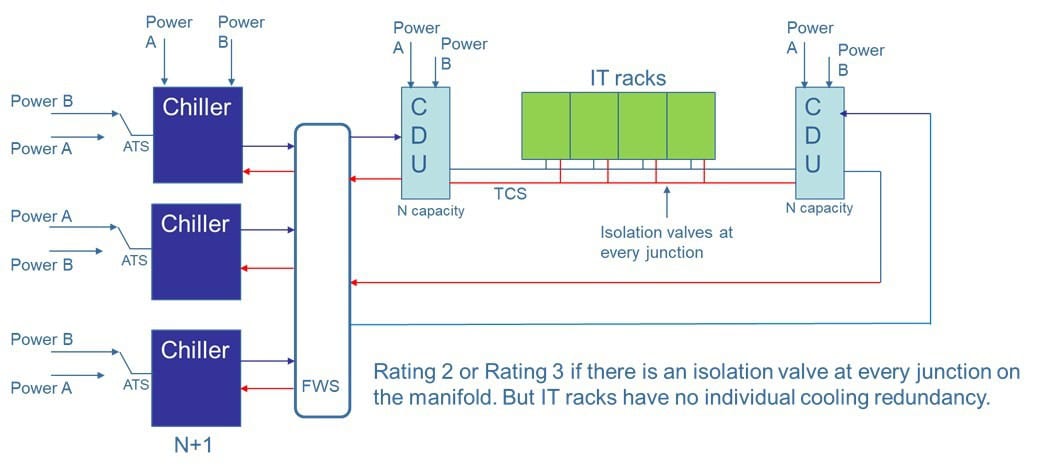
Modern compute units utilize DLC, where cooling fluid is delivered directly to the chip via internal plumbing. This system relies on a manifold at the rear of the rack that connects to a Cooling Distribution Unit (CDU). The CDU acts as the vital interface between the IT "Technology Cooling System" (TCS) and the building’s "Facilities Water System" (FWS).
Resilience Vulnerabilities
A critical concern in this architecture is the lack of redundancy at the point of delivery. Compute units often feature a single water feed pipe in and one out. The rack-level manifold is a single point of failure. If the manifold or the CDU fails, the entire pod loses cooling.
Furthermore, the stringent requirements for water purity—often necessitating filter changes every 1,000 hours—introduce the risk of "planned downtime." Under the ANSI/TIA-942 Rating 3 or 4 philosophy, maintenance should not result in downtime. Yet, in current AI pod configurations, changing a filter or servicing a manifold could lead to the loss of cooling for multiple compute units, fundamentally undermining the resilience of the installation.
Cabling: The Collapse of Structured Models
The TIA-942 standard is built upon the concept of structured cabling, where patch panels in every rack allow for universal connectivity. This model excels in general-purpose data centers, providing redundant routing and clear demarcation points.
In the AI supercluster world, this model breaks down. These systems rely on ultra-short (3–7 meter) direct-attached cables utilizing InfiniBand or ultra-Ethernet technologies to interlink hundreds of devices. A single twelve-rack superpod can contain over 131,000 individual cable links.
In such an environment, the traditional patch panel is physically impossible to implement. The density of connections leaves no room for the overhead of structured cabling or traditional redundancy. Instead, reliability is shifted from the physical layer to the logical layer, where networking equipment is programmed to route around faulty nodes. While this "software-defined" resilience is powerful, it creates a disconnect with the physical infrastructure standards that have long governed data center certifications.
Implications for the Future of Data Center Design
The mismatch between AI HPC infrastructure and existing standards creates a dilemma for data center operators. If they adhere strictly to ANSI/TIA-942 for their entire facility, they may find the costs of providing redundant power and cooling for 1 MW racks to be commercially unsustainable. If they ignore these standards, they risk building facilities that are prone to catastrophic failure.
A New Hybrid Approach
To reconcile these differences, we propose a two-tiered architectural strategy:
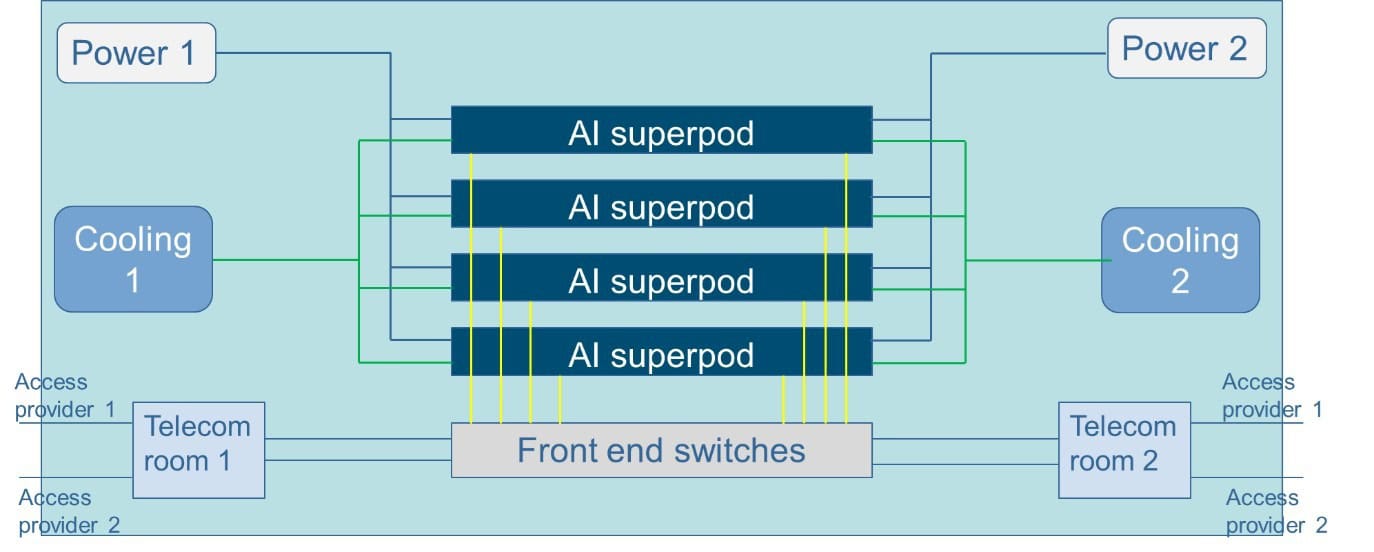
- The "Single Computer" Model: The GPU rack (or superpod) should be treated as a single, integrated computer. Its internal power, cooling, and cabling are part of the original manufacturer’s design. Redundancy at this level is best handled via logical failovers and software.
- Infrastructure Integration: The ANSI/TIA-942 Rating requirements should be applied at the interface of the pod. This means ensuring that the building infrastructure—dual power feeds, redundant FWS water supplies, and diverse telecommunications entry points—remains compliant with Rating 3 or 4 standards.
By isolating the "black box" of the AI pod while ensuring the underlying facility remains robust, operators can maintain the desired level of availability without requiring the impossible task of duplicating every internal manifold or cable link.
Official Responses and Moving Forward
The industry is not standing still. The TIA TR-42 committee, which oversees the ANSI/TIA-942 standard, is currently engaging with experts to develop new solutions for these HPC environments. The goal is to evolve the standard to recognize these new architectures, providing a roadmap for operators to achieve resilience in an era of extreme density.
As we move forward, the collaboration between hardware manufacturers, facility engineers, and standards bodies will be critical. The objective is clear: we must provide data center operators with the tools to choose their level of availability, ensuring that the AI revolution does not come at the cost of the stability and reliability that the digital economy depends upon.
Resources for Continued Learning
For those looking to deepen their understanding of these emerging challenges, several resources are available:
- TIA-942 Training: Capitoline Ltd offers specialized masterclasses on TIA-942 and facility design, available at www.capitolinetraining.com.
- Standard Certification: Information on achieving ANSI/TIA-942 certification can be found at tiaonline.org.
- Get Involved: Industry professionals are encouraged to join the TIA TR-42 committee to contribute to the next iteration of infrastructure standards.
Disclaimer: This article was developed by a member of the TIA Data Center Program Workgroup. The views expressed are those of the author and do not necessarily reflect the official position of the TIA or its member companies.