





In the rapidly evolving landscape of modern manufacturing, the margin for error is shrinking toward zero. As factories integrate artificial intelligence (AI), machine vision, and autonomous robotics, the traditional networking protocols that have powered the internet for decades are hitting a physical ceiling. The challenge is no longer just about how much data a system can move; it is about exactly when that data arrives. To bridge this gap, industry leaders are turning to Time-Sensitive Networking (TSN) chips—a fundamental reconfiguration of silicon that is transforming standard Ethernet from a passive pipe into a high-precision instrument.
The Physical Ceiling of Traditional Networking
For years, the standard "best effort" model of Ethernet was sufficient. In typical IT environments, if a packet of data is delayed by a few milliseconds, the user simply sees a momentary lag in a video stream or a slightly slower webpage load. However, in a modern, AI-driven manufacturing plant, such latency is not merely an inconvenience—it is a recipe for mechanical catastrophe.
Modern robotic assembly lines require multiple machines to execute synchronized movements within microseconds of one another. Automated guided vehicles (AGVs), high-speed machine vision systems, and industrial safety controls rely on deterministic communication to function safely. When a network relies on "best effort" delivery, packet arrival timing fluctuates based on network congestion. This jitter can cause a robotic arm to misfire, a sensor to misread, or an entire production line to stall, leading to costly downtime or physical damage to equipment.
Chronology: From General Connectivity to Deterministic Control
The evolution toward TSN was not instantaneous; it was a response to the growing divide between Operational Technology (OT) and Information Technology (IT).
- The Early 2000s: Industrial environments relied on a patchwork of proprietary fieldbus protocols to ensure deterministic timing. These systems were rigid, expensive, and isolated from the broader enterprise network.
- The Rise of Industrial Ethernet: As manufacturers sought to unify their networks, standard Ethernet began to replace fieldbus. While this increased bandwidth, it introduced the "best effort" latency issues mentioned previously.
- The IEEE 802.1 Standards (2012–Present): The IEEE 802.1 working group began formalizing TSN standards to bring determinism back to Ethernet. By creating a set of protocols that allowed for time-aware scheduling and traffic shaping, they provided a pathway for Ethernet to handle both high-bandwidth IT traffic and mission-critical OT control data on the same wire.
- The AI Integration Phase (2020–Present): With the arrival of edge AI, the need for real-time synchronization has reached a fever pitch. AI models at the edge now require constant, low-latency feedback from sensors to make split-second decisions, forcing a mass transition toward TSN-enabled hardware across manufacturing, automotive, and aerospace sectors.
The Architecture of Precision: What are TSN Chips?
TSN chips are specialized semiconductors designed to implement IEEE 802.1 standards at the hardware level. Unlike standard Ethernet ASICs (Application-Specific Integrated Circuits), which prioritize throughput, TSN chips prioritize the timeline.
Time-Aware Scheduling (TAS)
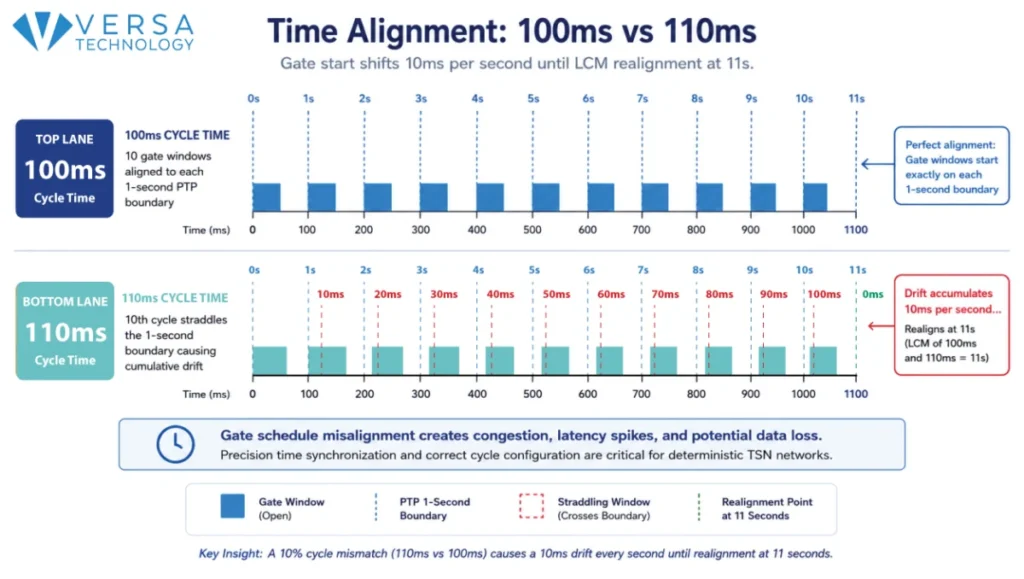
The crown jewel of TSN hardware is Time-Aware Scheduling. By utilizing a "gate-control list," the hardware opens and closes transmission windows at nanosecond intervals. This effectively creates a private lane for mission-critical traffic. Even if the network is flooded with non-essential data, the TSN chip ensures that the critical control packet is transmitted at the exact, pre-allocated moment.

High-Precision Synchronization
TSN chips utilize hardware-based timestamping to synchronize every device on the network to a "Grandmaster" clock. This ensures that every chip in a massive factory, whether it is a PLC, a camera, or a robotic controller, operates on the same microsecond-level timeline.
Seamless Redundancy
In an AI-driven factory, a network failure can be fatal. TSN chips support IEEE 802.1CB, which allows for packet replication and elimination. The chip sends a duplicate of the packet across two different physical paths simultaneously. The receiver accepts the first one to arrive and discards the duplicate. If one path fails, the other is already delivering the data, resulting in zero-millisecond recovery time.
Supporting Data: TSN vs. Standard Ethernet
The fundamental divide between standard Ethernet and TSN is summarized in the table below:
| Feature | Standard Ethernet | TSN-Enabled Ethernet |
|---|---|---|
| Delivery Model | Best Effort | Deterministic / Guaranteed |
| Jitter | Variable (High) | Minimized (Near Zero) |
| Traffic Handling | First-come, first-served | Time-aware prioritization |
| Synchronization | Software-based (NTP) | Hardware-based (IEEE 1588) |
| Primary Use | General IT / Web | Robotics, AI, Motion Control |
For a high-speed packaging facility, this difference is the difference between a seamless operation and a bottleneck. When an inspection camera spots a defect, the signal must reach the robotic ejector before the item passes. With TSN, this signal is guaranteed delivery, whereas, in a standard network, it could be delayed by a background firmware update or a large file transfer occurring elsewhere on the network.
Official Perspectives: The Industry Shift
Leading semiconductor manufacturers, including Microchip, NXP, and Intel, have identified TSN as a critical growth engine. Industry analysts and automation experts emphasize that the transition to TSN is not merely an "upgrade" but a "fundamental reconfiguration."
"The industry is moving toward a convergence where the factory floor is no longer an isolated island," notes a senior systems architect at a leading industrial automation firm. "By embedding logic that honors the microsecond, we are transforming Ethernet from a data pipe into a precision instrument. This is the definitive bridge to a truly autonomous, AI-driven future."

Furthermore, trade organizations like the Avnu Alliance have played a pivotal role in ensuring interoperability. Their certification programs provide a standard for manufacturers, ensuring that a TSN-enabled camera from one vendor can communicate seamlessly with a controller from another, mitigating the "vendor lock-in" that plagued older industrial protocols.
Implications for the Future of AI and Manufacturing
The integration of TSN chips has profound implications for the manufacturing sector. As we look toward 2030, the "Smart Factory" will rely on the following capabilities facilitated by TSN:
1. Unified Network Infrastructure
Manufacturers can finally move away from the "two-network" approach, where IT and OT systems are physically separated. By consolidating both on a single TSN infrastructure, companies reduce cabling costs, simplify maintenance, and gain the ability to run advanced AI analytics on the same network that controls the physical assembly line.
2. Edge AI Acceleration
AI models are only as good as the data they receive. In a high-speed environment, the input data must be "time-stamped" correctly. TSN provides the structural integrity for edge AI to perform real-time inferencing. For example, a predictive maintenance AI can analyze vibration data from a motor; if that data is jittery or out of sync, the AI’s conclusions will be flawed. TSN ensures the integrity of the data stream.
3. Safety and Autonomy
The shift toward autonomous mobile robots (AMRs) in warehouses and plants requires constant safety communication. If an AMR’s safety controller loses its deterministic link to the central system for even a fraction of a second, the system must trigger an emergency stop. TSN ensures that safety-critical communication remains constant, preventing unnecessary downtime and ensuring the safety of human workers operating alongside machines.
4. The Path to Digital Twins
A Digital Twin—a virtual replica of a physical production line—is only effective if it mirrors the physical world in real-time. TSN allows the physical machinery to stream data that is perfectly synchronized with the virtual model. This level of fidelity allows for "what-if" simulations and process optimizations that were previously impossible due to network lag.

Conclusion: Preparing for the Next Level of Connectivity
As AI continues to penetrate the manufacturing floor, the demand for deterministic communication will only intensify. Organizations that fail to address the limitations of their current networking hardware will likely find themselves hampered by production bottlenecks and an inability to scale their autonomous operations.
Adopting TSN is no longer a "future-proofing" exercise; it is an immediate requirement for competitiveness. By investing in TSN-capable switches, controllers, and sensors, manufacturers are laying the groundwork for a more efficient, reliable, and intelligent production environment.
For those navigating this transition, the roadmap is clear: prioritize hardware that supports IEEE 802.1 standards, evaluate the determinism of your current network, and begin the phased migration of mission-critical systems onto a unified, TSN-enabled backbone. As we move deeper into the era of industrial AI, the mastery of time will be the primary separator between the leaders of industry and those left behind. For further guidance on integrating these technologies into your specific operational environment, consulting with network infrastructure experts is the recommended next step to ensure a seamless and secure digital transformation.