





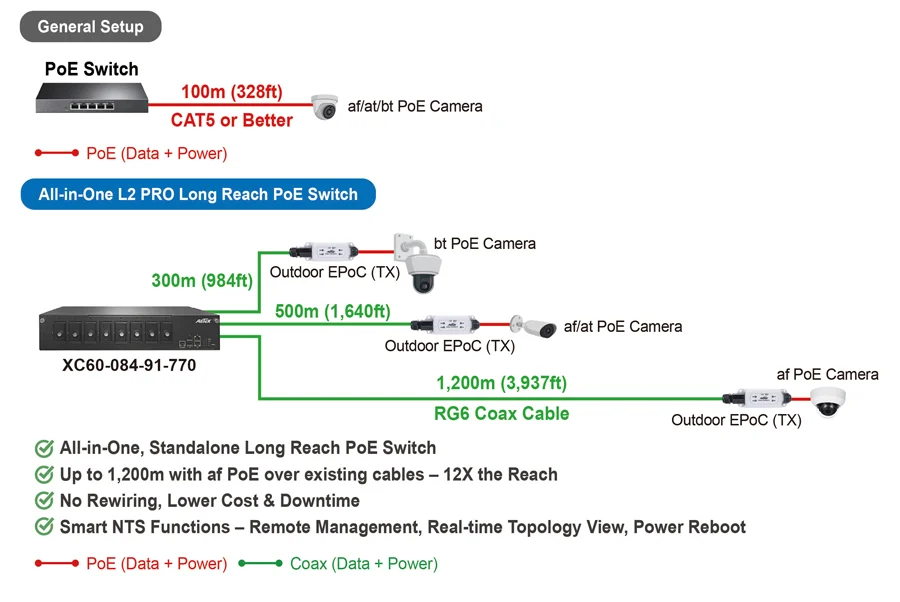
The rapid acceleration of Artificial Intelligence (AI) and edge computing is fundamentally altering the requirements of enterprise IT networks. As organizations rush to integrate high-resolution AI-powered surveillance, real-time edge inference, and dense IoT sensor arrays, the underlying physical layer of their networks is being pushed to its breaking point. For many sectors—including industrial manufacturing, transportation, and large-scale commercial real estate—this transition is hampered by a significant physical hurdle: the ubiquity of legacy coaxial cabling.
Replacing massive, entrenched coaxial networks with modern fiber-optic or Cat6/Cat6A cabling is often prohibitively expensive and logistically disruptive. However, a breakthrough technology known as Ethernet and Power over Coax (EPoC) is providing a lifeline. By enabling high-speed data transmission and high-wattage power delivery over existing 75-ohm coaxial lines, EPoC switches like the Versa Technology XC60-084-91-770 are allowing organizations to leapfrog into the AI era without the need for a total infrastructure rip-and-replace.
The Core Challenge: Why Legacy Systems Struggle with AI
The transition to AI is not merely a software evolution; it is a hardware-intensive shift that demands higher bandwidth, lower latency, and significantly more power at the network edge. Legacy systems, originally designed for analog video or basic low-bandwidth telemetry, simply cannot handle the throughput required by modern edge AI platforms.
The Network Bottleneck
Organizations today face a "modernization trap." To implement AI-driven security—such as facial recognition, automated license plate recognition, or predictive maintenance sensors—they must upgrade their endpoints. Standard Ethernet protocols are physically limited to 100 meters, a constraint that necessitates frequent mid-span switches or expensive fiber extensions. When thousands of feet of cabling are involved across a sprawling campus, the cost of labor and new materials can stall digital transformation projects indefinitely.

Chronology of the Infrastructure Evolution
The history of network infrastructure has long been defined by the tension between the "analog past" and the "digital future."
- The Analog Era (1980s–2000s): Coaxial cable became the industry standard for video surveillance and data transmission due to its durability and shielding capabilities. Millions of miles of RG59 and RG6 cable were installed globally.
- The IP Transition (2010s): The shift to IP-based cameras and sensors created a massive divide. Organizations were forced to choose between keeping their old, reliable coax or ripping it out to install high-speed Ethernet, leading to widespread "forklift upgrades."
- The AI/Edge Computing Dawn (2020s–Present): With the arrival of sophisticated edge AI, the demands on the network increased exponentially. Not only is bandwidth needed, but power requirements have surged to support high-performance processors embedded within cameras and sensors.
- The EPoC Solution: EPoC technology emerged as the "bridge" to allow the legacy coax installed in the 1990s to support the high-performance digital demands of the 2020s, marking the current phase of efficient, cost-effective modernization.
Supporting Data: Efficiency and ROI
The economic argument for EPoC technology is centered on the elimination of capital expenditure (CapEx) associated with civil engineering and electrical installation.
Performance Metrics
- Extended Range: While standard Ethernet reaches 100 meters, EPoC technology, such as the XC60-084-91-770, can maintain signal integrity and high-speed data up to 1,200 meters (nearly 4,000 feet). This twelve-fold increase in reach eliminates the need for intermediate distribution frames (IDFs) in remote areas of a facility.
- Power Density: The XC60-084-91-770 supports up to 90W per port (PoE++ 802.3bt). This is a critical metric because modern AI cameras with active cooling, high-intensity IR illumination, and onboard GPUs often require far more power than standard 15W or 30W PoE devices can provide.
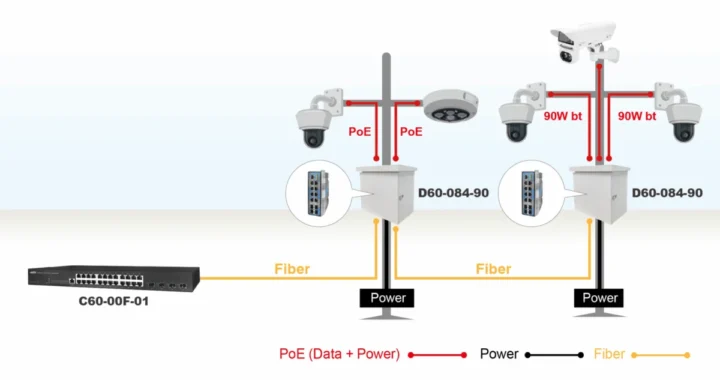
- Topology Flexibility: By supporting daisy-chain, peer-to-peer, and ring topologies, EPoC switches allow for network designs that are not just "replacements" for old layouts but are actually more resilient than the original analog configurations.
Official Perspective: The Role of Versa Technology
Versa Technology has positioned its XC60-084-91-770 switch as a response to the growing complexity of the "Intelligent Edge." According to engineering experts at the company, the primary goal of this hardware is to provide a "transparent migration path."
"We understand that for a facility manager in a transportation hub or a large manufacturing plant, the thought of pulling new cable through concrete or historical structures is a non-starter," notes the Versa technical team. "By focusing on EPoC, we allow the network to evolve at the speed of the software. If an organization wants to install AI cameras in a parking lot that has had the same coax for twenty years, we make that a one-day project rather than a six-month construction nightmare."

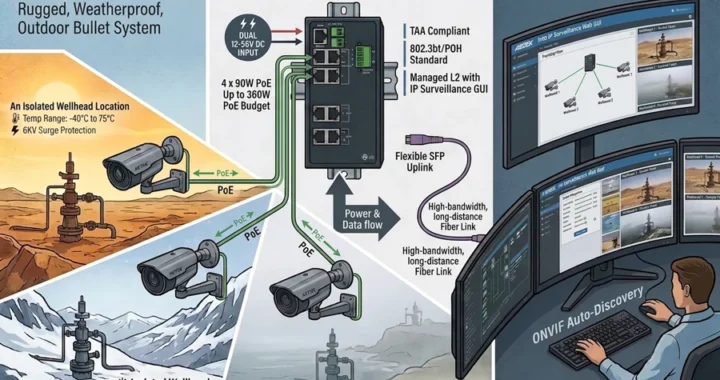
The company emphasizes that their managed switches are not just "dumb extenders." They include robust network management tools, such as automated ONVIF discovery and granular power consumption monitoring, which are essential for IT teams managing complex, multi-vendor AI deployments.
Implications for Modern Enterprises
The implications of adopting EPoC-based modernization are multi-faceted, affecting sustainability, operational speed, and long-term scalability.
1. Sustainability and ESG Goals
"Rip-and-replace" is inherently wasteful. The environmental cost of producing thousands of feet of new copper and the carbon footprint associated with construction and landfilling of old cable are significant. By repurposing existing infrastructure, organizations can significantly lower their environmental impact, aligning with modern Corporate Social Responsibility (CSR) and Environmental, Social, and Governance (ESG) initiatives.
2. Operational Resilience
EPoC systems enable a phased approach to migration. An organization can upgrade its most critical security zones (e.g., loading docks, main entrances) to AI-ready IP status while maintaining legacy analog systems on secondary lines. This minimizes the risk of total system failure during the transition and allows for budget allocation over multiple fiscal years rather than requiring a single, massive upfront investment.

3. Future-Proofing the Edge
As AI models evolve, the processing power required at the edge will only increase. By providing a high-bandwidth, high-power pipe to the edge, EPoC switches ensure that as organizations upgrade their cameras or sensors to more advanced versions, the underlying network infrastructure is already capable of supporting the next generation of hardware without further modifications.
Implementation Best Practices: A Strategic Audit
While EPoC is highly adaptable, successful deployment requires a systematic approach. Before installing an EPoC switch, IT managers should conduct a thorough physical audit:
- Cable Integrity: Ensure that existing coax is at least RG59 or RG6 grade. While EPoC is robust, damaged or heavily corroded shielding can cause packet loss at extreme distances.
- Power Budget Calculation: Calculate the total power load of all edge devices. The XC60-084-91-770 offers a 720W total budget, which must be partitioned correctly if multiple high-draw devices (like PTZ cameras or multi-sensor AI units) are used.
- Topology Mapping: Utilize the switch’s NTS (Network Topology System) to map out existing runs. Because EPoC supports daisy-chaining, it is possible to consolidate multiple edge runs into a single trunk line, reducing the amount of equipment needed at the headend.
- Environmental Monitoring: Leverage the switch’s onboard diagnostics to monitor the health of the cable runs continuously. Proactive alerts regarding voltage drops or signal degradation can prevent downtime before it occurs.
Conclusion: The Path Forward
The convergence of AI and legacy infrastructure is no longer an insurmountable barrier; it is an opportunity to optimize and modernize. Through the application of Ethernet and Power over Coax technology, organizations can extract maximum value from their existing physical assets while meeting the aggressive performance requirements of the modern era.
The Versa Technology XC60-084-91-770 represents more than just a switch—it represents a paradigm shift in how we think about network evolution. By prioritizing efficiency, sustainability, and technical robustness, businesses can ensure they remain at the forefront of the AI revolution, regardless of the limitations of their physical plant.

For those ready to move forward, the first step is to inventory existing infrastructure and reach out to specialists who can model the transition from analog to AI-ready. In the race to implement smarter, faster, and more responsive edge networks, EPoC technology is the quiet engine powering the next generation of digital infrastructure.