






The modern enterprise operates at the speed of the web browser. With employees conducting approximately 85% of their daily tasks within its confines, the browser has effectively become the de facto operating system for organizations worldwide. It’s the central nexus connecting applications, data interactions, and user identities. Yet, for Security Operations Center (SOC) teams, this critical digital gateway has long remained a frustrating and perilous "black box." This pervasive visibility gap, where traditional security solutions fall short, is now being addressed by a groundbreaking integration from Palo Alto Networks.
The Pervasive Blind Spot: Why Browsers Are a Critical Security Vulnerability
For years, Extended Detection and Response (XDR) platforms have excelled at monitoring endpoint hosts and their processes. However, they have largely treated the browser as a monolithic, opaque entity. This simplistic view creates a significant vulnerability, leaving a critical segment of enterprise activity invisible to security teams. Research from Unit 42, Palo Alto Networks’ threat intelligence arm, has consistently shown that over 90% of data breaches are preventable by addressing such visibility gaps. In today’s landscape, where employees increasingly access sophisticated AI tools and cloud-based applications directly through their browsers, the need for granular visibility into browser activity is paramount. Without it, SOCs are forced to combat modern, AI-driven workflows effectively blindfolded.
The operational fallout of these browser blind spots is substantial. SOC analysts frequently receive alerts for malicious endpoint processes but lack the precise telemetry to identify the exact web tab, malicious script, or user interaction that initiated the threat. This deficiency hampers incident responders, making it nearly impossible to detect and investigate sophisticated attack vectors such as rogue browser extensions, cross-origin attack chains, or compromised web applications. The ability to reconstruct a complete attack narrative is severely compromised, leaving organizations vulnerable to persistent threats.
A fragmented view of security operations, where browser activity is an unknown variable, can trigger a dangerous domino effect the moment an attack strikes. Recent analyses of Palo Alto Networks customer incidents have underscored the sheer scale of this problem, revealing a massive monthly volume of threat detections originating from siloed browser activity. This highlights a critical need for a more comprehensive approach to workspace security.
Palo Alto Networks Bridges the Gap: The Native Integration of Prisma Browser and Cortex XDR
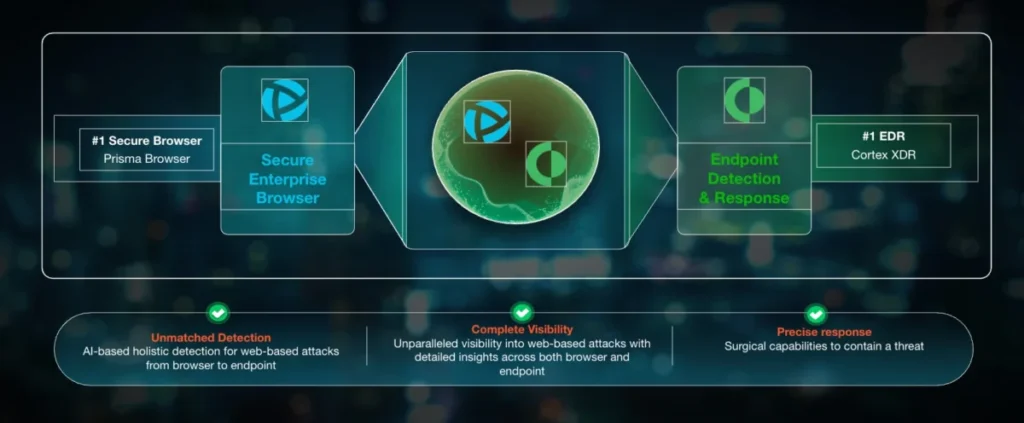
In response to this critical security challenge, Palo Alto Networks is proud to announce the native integration of Prisma Browser and Cortex XDR. This powerful union aims to transform the browser from an unmonitored process into an active and insightful security sensor, providing SOC teams with unparalleled visibility into the user’s primary workspace.
By unifying deep browser-level telemetry with industry-leading endpoint detection and response capabilities, this integration offers a solution that is both comprehensive and remarkably easy to adopt. Organizations can now harness the full benefits of this advanced security posture without the need for complex APIs or burdensome deployment overhead. Events captured by Prisma Browser, such as Data Loss Prevention (DLP) violations, browser tampering attempts, and unauthorized configuration updates, are automatically fed directly into the Cortex XDR tenant. This seamless flow of information significantly simplifies the adoption of this joint offering.
Furthermore, when Cortex XDR identifies a potential security issue, browser-based events are automatically correlated with the user’s malicious activity on the same endpoint. This provides crucial context, illuminating the possible starting point of an attack that originates within the browser environment. This correlation is key to understanding the full scope and origin of a threat.
What Makes the Palo Alto Networks Approach Different?
While many legacy vendors attempt to address browser security through brittle, easily bypassed browser extensions, Palo Alto Networks has taken a fundamentally different and more robust approach. Instead of relying on superficial visibility provided by extensions, Cortex XDR now integrates natively with Prisma Browser "under the hood." This deep integration ensures that both layers of security speak the same language, effectively transforming a significant blind spot into a rich engine of security telemetry. This provides comprehensive visibility into every user action, specific activities, and the device’s posture while executing those activities.
True workspace security, as championed by Palo Alto Networks, demands a unified defense system that understands the intricate relationship between web activity and host device compromise. This first-of-its-kind integration achieves this through three fundamental pillars:
Pillar 1: Find the Root Source of Attacks in Seconds
The integration of Prisma Browser with Cortex XDR creates a powerful synergy, connecting comprehensive endpoint visibility with deep web context. By seamlessly linking endpoint process execution directly to browser events and host execution, Cortex XDR provides an unprecedented unified data foundation. This allows SOC teams to analyze complete attack narratives, moving beyond isolated and disjointed security alerts to understand the full story of an incident.
Scenario: Unmasking Phishing and Malware Narratives
Consider a scenario where a malicious payload executes on an endpoint. Traditional security tools might flag the threat on the host, but they often leave security analysts guessing about the attack’s origin. The correlation between Prisma Browser events and Cortex XDR eliminates this guesswork. Analysts can effortlessly trace a malware alert back to the precise phishing URL, the original download source, or even hidden iFrame metadata. This allows for the rapid identification of the forensic root cause in mere seconds, while also enabling the swift dismissal of false positives.
This capability is crucial for modern threat hunting. When a user inadvertently clicks on a malicious link or downloads a compromised file through their browser, the integrated system provides an immediate and clear lineage. This not only speeds up the incident response process but also significantly reduces the time attackers have to operate within the network. The ability to pinpoint the exact entry point within the browser context is a game-changer for SOC efficiency and effectiveness.
Pillar 2: Respond Without Disrupting Business Operations
Traditional XDR tools often resort to isolating an entire device to mitigate a threat. While effective in preventing lateral movement, this approach can severely disrupt user productivity and bring business operations to a standstill. The integration of Prisma Browser and Cortex XDR introduces a new paradigm: granular, precision containment.
For instance, if a rogue browser extension attempts to compromise a web session, traditional tools might be forced to disconnect the entire device, taking the employee offline and halting their work. However, the integrated solution offers surgical containment. The threat is instantly neutralized and terminated solely at the browser layer. Simultaneously, Cortex XDR is alerted, allowing the employee’s laptop to remain fully online and productive. This is a critical differentiator in today’s always-on business environment.
This nuanced approach to threat response minimizes the business impact of security incidents. Instead of a blunt instrument, security teams can employ a scalpel, addressing the threat without causing unnecessary collateral damage to productivity. This capability is particularly valuable in remote and hybrid work environments, where maintaining employee uptime is a top priority.
Pillar 3: Detect Evasive Threats in Real Time
Prisma Browser employs a pioneering approach to analyze activity in real time, enabling the detection of threats as they unfold. This proactive stance ensures that even the most sophisticated and evasive threats, such as the subtle behavior of rogue extensions or the execution of malicious scripts, are identified and flagged in real-time within the Cortex XDR dashboard.
This real-time detection capability is essential for combating the evolving threat landscape. Attackers are constantly developing new techniques to evade traditional security measures. By providing continuous monitoring and analysis of browser activity, Prisma Browser ensures that SOC teams are alerted to emerging threats the moment they appear, rather than after they have caused significant damage. This "shift-left" approach to threat detection is fundamental to modern cybersecurity.
Securing Emerging Workflows: The Rise of Generative AI and Shadow IT
As organizations increasingly embrace the transformative potential of Generative AI (GenAI), new and complex security risks emerge. A common scenario involves engineers copying proprietary source code and pasting it into unapproved, public AI models to expedite bug fixes. From the perspective of traditional XDR solutions, this activity often appears as standard, benign web traffic.
Prisma Browser directly addresses this critical risk. By meticulously monitoring user behavior within the workspace, it can automatically detect and block Data Loss Prevention (DLP) violations in real time. Because Prisma Browser connects natively to the Cortex XDR tenant without the need for complex API integrations, "shadow AI" risks are instantly flagged in the SOC dashboard, preventing them from escalating into major compliance and data breach incidents.
This capability is vital for organizations navigating the rapid adoption of AI. The ease of use and accessibility of GenAI tools can inadvertently lead to the exfiltration of sensitive data. Prisma Browser acts as a crucial safeguard, providing visibility and control over these emerging workflows, ensuring that innovation does not come at the expense of security.
Future-Proofing Workspace Security: A Unified Defense System
In conclusion, the era of leaving the browser unmonitored is rapidly drawing to a close. The integration of Prisma Browser and Cortex XDR represents a significant leap forward in workspace security. By effectively bridging the gap between browser activity and endpoint events, this unified defense system accelerates investigation times, exposes hidden threats, and empowers SOC teams to respond with unprecedented precision and minimal business disruption.
This integration signifies a fundamental shift in how organizations approach cybersecurity. It acknowledges that the browser is no longer just a conduit for accessing information but a critical component of the enterprise attack surface. By providing deep, native visibility into this vital area, Palo Alto Networks is equipping organizations with the tools they need to defend against the complex and evolving threats of today and tomorrow. For organizations looking to enhance their security posture and gain comprehensive visibility into their digital workspace, this groundbreaking integration offers a compelling and essential solution.
For those new to Prisma Browser or seeking to understand its capabilities in greater detail, Palo Alto Networks encourages you to reach out to your account team or explore the detailed product information available.