




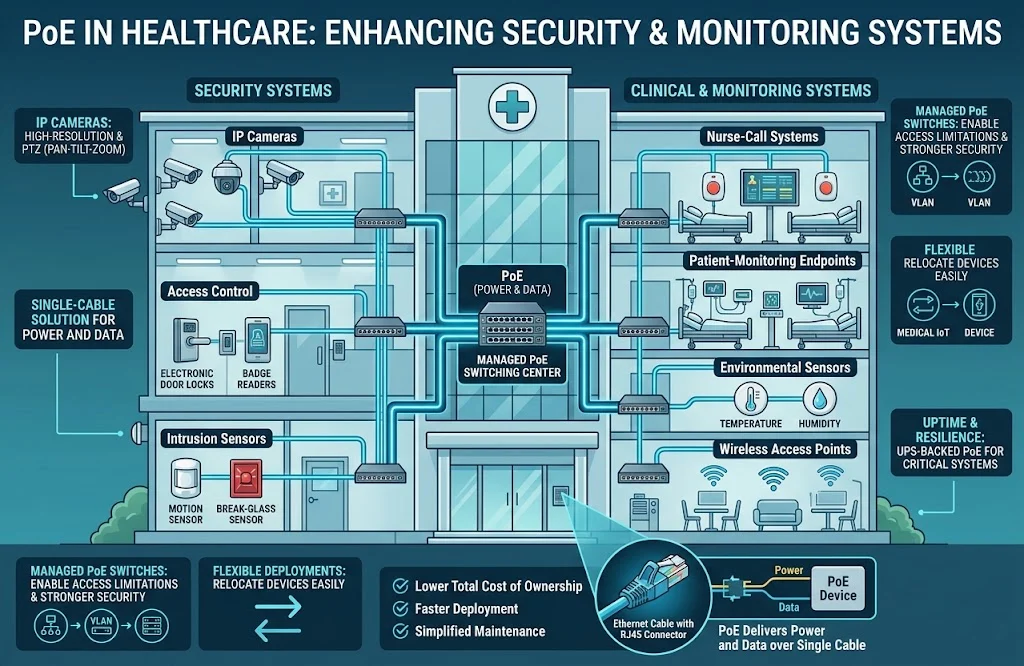
In the modern clinical environment, the boundary between physical patient care and digital infrastructure has effectively vanished. From the moment a patient checks in at a digital kiosk to the real-time monitoring of their vitals via connected sensors, the quality of care is intrinsically linked to the reliability of the underlying network. As hospitals and clinics evolve into "smart" facilities, Power over Ethernet (PoE) has emerged as the quiet powerhouse enabling this transition. By delivering both electrical power and data over a single Ethernet cable, PoE is solving the complex infrastructure puzzles that have long plagued healthcare facility managers.
Main Facts: The Intersection of Connectivity and Care
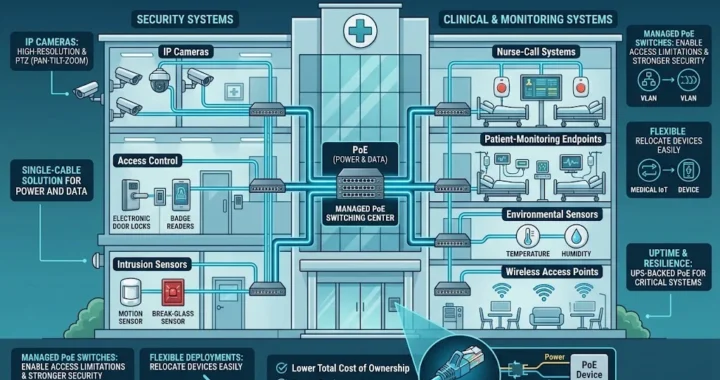
The fundamental premise of PoE in healthcare is the consolidation of utility and information. Traditionally, every connected device—be it a security camera, a wireless access point, or a sophisticated nurse-call system—required two distinct installations: one for data and one for high-voltage electricity. This duality increased labor costs, fire risks, and spatial constraints.
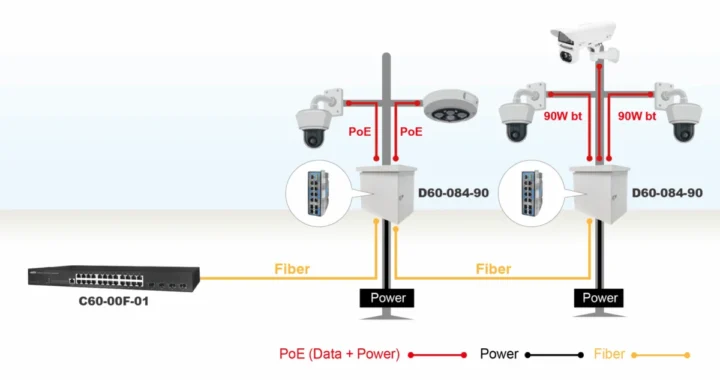
PoE eliminates this friction by leveraging standard Category 5e, 6, or 6A cabling to carry DC power alongside data packets. Under the latest IEEE 802.3bt standard, modern switches can deliver upwards of 90 watts per port. This capacity is transformative; it allows hospitals to power high-definition pan-tilt-zoom (PTZ) security cameras, medical-grade IoT devices, and even smart LED lighting systems without the need for an electrician to install a dedicated AC outlet at every endpoint.
The Chronology of Adoption: From VoIP to IoT
The integration of PoE into medical facilities did not happen overnight. Its adoption followed a distinct evolutionary path:
- The Early 2000s (The VoIP Era): Initially, PoE was adopted primarily for Voice over IP (VoIP) phones, allowing hospitals to move away from legacy analog systems.
- The 2010s (The Connectivity Shift): As Wi-Fi became critical for clinician mobility, healthcare facilities began using PoE to power Wireless Access Points (WAPs). This phase also saw the early adoption of IP-based security cameras for patient and staff safety.
- The 2020s (The IoT and Smart Hospital Era): The present day is characterized by the explosion of medical IoT (IoMT). Everything from environmental sensors that monitor temperature-sensitive pharmaceuticals to real-time location systems (RTLS) for tracking medical equipment is now PoE-enabled.
This trajectory reflects the broader shift in healthcare from reactive to proactive, data-driven environments where the network is now considered a utility as critical as electricity or water.
Supporting Data: Why PoE is a Financial and Operational Imperative
The shift toward PoE is backed by clear operational efficiencies. According to industry analyses, the "Total Cost of Ownership" (TCO) for a PoE-enabled device is significantly lower than that of traditional hardwired alternatives.

- Installation Speed: By avoiding the need for licensed electrical contractors to install AC outlets, installation timelines can be cut by 30% to 50%.
- Energy Efficiency: Managed PoE switches provide granular control over power consumption. IT teams can schedule power cycles for non-essential devices during off-peak hours, contributing to significant energy savings—a major goal for modern, sustainable hospital systems.
- The Power Budget Reality: A key consideration for IT departments is the "power budget." A switch may have 24 ports, but the total power available across those ports is finite. For example, a high-power device like a 90W PTZ camera consumes a larger slice of that budget than a simple badge reader. Planning for headroom is not just a best practice; it is a necessity to prevent system-wide outages during periods of peak demand.
Managed Switches: The Gatekeepers of Security
The most significant leap in PoE technology is the transition from "unmanaged" to "managed" switches. In a high-stakes environment like a hospital, where HIPAA compliance is non-negotiable, unmanaged switches are a liability. They lack the visibility required to secure the network.
Managed switches, such as the Versa Technology D60-084-90 (a L2 industrial PoE switch), offer the granular control necessary to segment networks. Through features like 802.1X port-based access control, MAC filtering, and Dynamic VLAN assignment, IT administrators can create a "zero-trust" environment. For instance, patient Wi-Fi traffic can be strictly isolated from the clinical network, ensuring that a compromised guest device cannot reach critical patient-monitoring systems.
Furthermore, managed switches act as the eyes and ears of the IT department. They provide real-time logging and alerting, allowing staff to detect unauthorized connection attempts or unusual power draws that could indicate a device has been tampered with or is malfunctioning.
Implications for Healthcare Strategy
The implications of this technological integration are profound. For hospital administration, the primary impact is resilience.
1. Adaptive Care Environments
Modern healthcare demands flexibility. During public health crises or seasonal surges, hospitals often need to transform general wards into intensive care units or temporary isolation zones. With PoE, these transformations can happen at the speed of software. Sensors and communication devices can be moved or added without extensive structural renovation.
2. Clinical Workflow Optimization
When clinicians are not tethered to fixed workstations, they spend more time at the bedside. PoE-powered wireless access points ensure that EHR (Electronic Health Record) systems are accessible anywhere in the facility, while PoE-powered nurse-call systems ensure that patients can reach care providers instantly, regardless of where those providers are located.

3. Compliance and Security
HIPAA mandates strict controls over the privacy and security of health information. By centralizing power and data control, hospitals can more easily apply security patches, monitor device status, and ensure that only authorized equipment gains access to the network. This simplifies the audit process and reduces the risk of data breaches.
Best Practices: Navigating the Challenges
While the benefits are clear, the path to a fully integrated PoE facility requires rigorous planning.
- Design for Heat: High-density deployments generate heat. IT teams must ensure that cabling is installed in environments with adequate airflow, particularly when using high-power 802.3bt standards.
- Standardization: Ensure that all PoE hardware is compatible with the existing network backbone. Attempting to mix legacy hardware with modern, high-power switches can lead to intermittent failures.
- Collaborative Design: The most successful deployments occur when IT, facilities management, and clinical engineering teams work in unison. A device that works perfectly in the lab may have unforeseen implications for the electrical load in a specific patient wing. Cross-departmental planning ensures that these risks are mitigated before deployment.
Conclusion: The Path Forward
As healthcare continues to digitize, the importance of a robust, secure, and flexible infrastructure cannot be overstated. PoE is no longer just a way to power a phone; it is the fundamental enabler of the modern, connected hospital.
For facilities looking to modernize, the advice is to start with a pilot program—perhaps focusing on security cameras or a new nurse-call system—to demonstrate the ROI and operational stability of a managed PoE environment. As the technology matures, it will continue to lower the barrier to entry for advanced clinical tools, ultimately leading to better outcomes for patients and a more efficient environment for the providers who care for them.
For those ready to transition their facilities, the journey begins with an audit of current power needs and a strategic investment in managed, high-power hardware designed for the rigors of the healthcare sector. By prioritizing smart, scalable infrastructure today, healthcare systems ensure they are prepared for the medical innovations of tomorrow.
For more information on selecting the right industrial PoE infrastructure for your healthcare facility, please contact Versa Technology or call us at 909-591-8891.