






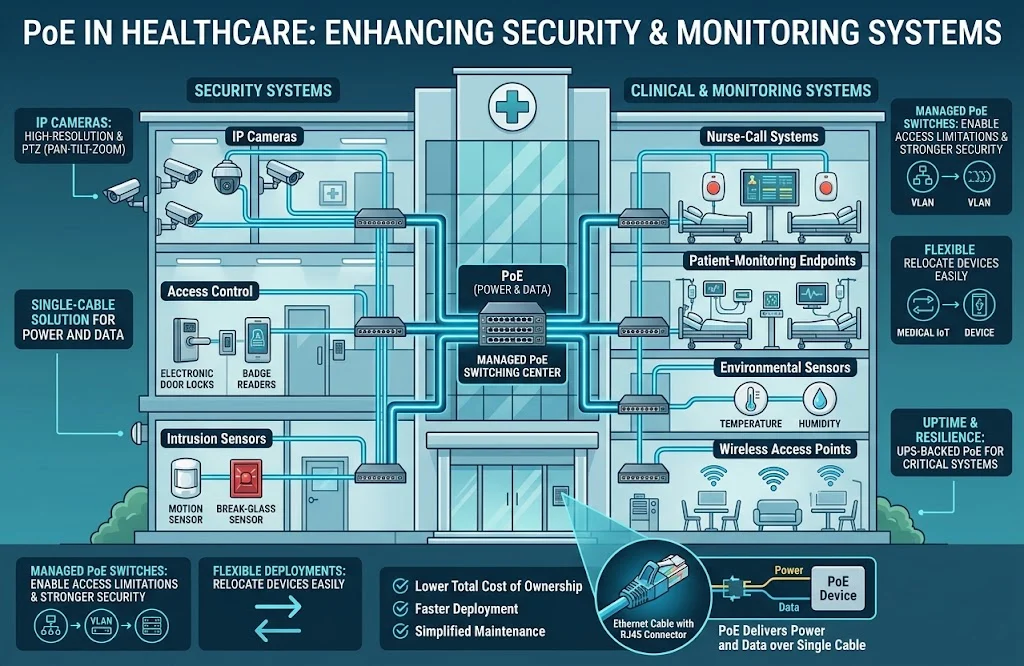
In the contemporary healthcare landscape, the line between clinical care and digital infrastructure has effectively vanished. From the moment a patient enters a facility, they are surrounded by a web of interconnected technology—patient monitors, high-definition security cameras, biometric badge readers, and life-critical nurse-call systems. At the heart of this silent, pulsing network lies a technology that has quietly become the lifeblood of hospital operations: Power over Ethernet (PoE).
As healthcare facilities face mounting pressure to comply with stringent HIPAA security standards, maintain 99.999% uptime, and scale rapidly to meet evolving care models, PoE has emerged as more than just a cabling convenience. It is a strategic imperative that allows hospitals to marry power and data transmission, simplifying the deployment of complex medical IoT (Internet of Things) devices while hardening the network against unauthorized intrusion.
The Core Facts: Defining PoE in Healthcare
At its simplest, Power over Ethernet allows electrical power to be transmitted over standard twisted-pair Ethernet cabling, such as Cat5e, Cat6, or higher, alongside the data signal. This eliminates the need for separate electrical outlets for devices, fundamentally changing the spatial planning of hospitals.
The technology is governed by IEEE standards that dictate power delivery limits:
- 802.3af (PoE): Delivers up to 15.4 watts per port.
- 802.3at (PoE+): Provides up to 30 watts, supporting more robust hardware like PTZ (pan-tilt-zoom) cameras.
- 802.3bt (PoE++): The cutting edge, delivering up to 90+ watts per port.
This power range is critical. It allows hospitals to power everything from basic IP phones and environmental sensors to high-performance wireless access points and even specialized medical lighting, all without needing an electrician to install a dedicated wall outlet at every endpoint.
Chronology of Adoption: From Utility to Strategic Asset
The integration of PoE in healthcare has moved through three distinct phases:
Phase I: The Connectivity Era (Early 2000s): Initially, PoE was used primarily for VoIP phones and basic wireless access points. It was viewed as a cost-saving measure to avoid the high expenses of running electrical conduit to office desks.

Phase II: The Integration Era (2010–2020): As IP cameras and digital signage became standard, facilities teams began to realize the utility of centralized power. During this period, the shift toward "smart buildings" pushed hospitals to integrate security and facility management into the IT stack.
Phase III: The Resilient Infrastructure Era (2020–Present): With the advent of the pandemic and the subsequent rise of telehealth and remote patient monitoring, the reliance on stable, secure, and flexible networks has reached an all-time high. Today, PoE is not just about powering a device; it is about managing an ecosystem that supports patient lives.
Supporting Data: Efficiency and Total Cost of Ownership
The economic argument for PoE in healthcare is built on the reduction of "Total Cost of Ownership" (TCO). In a hospital environment, the labor cost for a licensed electrician to install a new, code-compliant outlet in a patient care area can be ten times higher than the cost of a standard data drop.
- Deployment Velocity: Projects that once took weeks due to electrical permitting and installation can be completed in days.
- Power Density: Modern managed switches, such as the Versa Technology D60-084-90, now provide 90W per port. This density allows a single switch to power a suite of high-drain devices—like high-resolution medical displays or advanced telehealth endpoints—from a single, UPS-backed wiring closet.
- Energy Management: Managed switches offer granular control. IT teams can schedule power-cycling for devices during off-peak hours, contributing to overall facility sustainability goals and lowering energy waste.
Security Implications: The Role of Managed Switches
While unmanaged switches provide basic "plug-and-play" functionality, they represent a significant security vulnerability in a HIPAA-regulated environment. Unmanaged hardware lacks the intelligence to prevent unauthorized device spoofing or network lateral movement.
The Power of Granular Control
In contrast, managed switches act as the gatekeepers of the healthcare network. By implementing 802.1X port-based access control, IT teams ensure that only authorized medical devices can gain network access. If an unknown device is plugged into a wall jack, the port remains disabled.
Furthermore, Dynamic VLAN Assignment allows for the segmentation of traffic. For example, a hospital’s guest Wi-Fi, the security camera network, and the critical patient-monitoring systems can exist on the same physical infrastructure without ever communicating with one another. This "least-privilege" access model ensures that if a guest device is compromised, the attacker cannot pivot to the clinical systems where patient data resides.
Monitoring and Alerting
Managed switches provide real-time visibility. If an environmental sensor or a nurse-call button suddenly draws an unusual amount of power—a potential sign of a hardware malfunction or a malicious hardware implant—the switch can trigger an automatic alert to the IT security operations center (SOC). This proactive stance is essential for maintaining the integrity of life-critical systems.

Operational Impact: Scalability and Flexibility
The ability to pivot quickly is perhaps the most significant operational advantage of PoE. Healthcare environments are rarely static; they are in a constant state of renovation and adaptation.
Rapid Response to Clinical Needs
When a facility needs to create a temporary isolation unit or a pop-up vaccination clinic, the traditional approach of "pulling electrical" is often too slow. With PoE, a facility can deploy cameras, monitors, and access points in hours. The infrastructure adapts to the patient, rather than forcing the patient to adapt to the infrastructure.
Resilience and Uptime
Uptime in a hospital is not a luxury; it is a clinical requirement. By centralizing power delivery in the data closet, facilities can connect their PoE switches to industrial-grade Uninterruptible Power Supplies (UPS). This means that even if the facility’s primary power fluctuates, critical life-safety devices—such as nurse-call systems and security sensors—remain operational.
Best Practices for Healthcare IT Teams
To successfully implement a robust PoE infrastructure, healthcare organizations should adhere to a structured framework:
- Comprehensive Power Budgeting: Never assume a switch can power every device to its maximum capacity. IT teams must calculate the total "power budget" of a switch, accounting for potential future growth. Always build in a 20-30% buffer to avoid brownouts during peak usage.
- Cross-Departmental Collaboration: Decisions about cabling and switch deployment should involve clinical engineering, security, and facilities management. A camera placed for security might interfere with a wireless sensor used for patient tracking; coordination prevents these conflicts.
- Cable Quality Matters: High-power applications (like 802.3bt) generate heat. Using high-quality, properly rated cabling (e.g., Cat6A) is essential to prevent signal degradation and ensure fire safety in cable bundles.
- Security Integration: Ensure that managed switches are integrated into the hospital’s Security Information and Event Management (SIEM) tools. A device is only as secure as the visibility the team has over it.
- Pilot Programs: Before a facility-wide rollout, implement PoE solutions in a high-impact but contained area, such as a new wing or a specific security node. Use this pilot to demonstrate the reduction in maintenance calls and the increase in operational uptime to stakeholders.
Conclusion: The Path Forward
As healthcare continues to digitize, the reliance on high-performance, secure networks will only grow. The integration of PoE and managed switches represents the intersection of electrical engineering and network intelligence, providing the agility that modern hospitals require.
By moving away from siloed power and data systems, healthcare organizations can create an adaptable, secure, and resilient foundation. The investment in robust, managed PoE infrastructure is an investment in the quality of care itself. When the network is invisible, reliable, and secure, clinicians are free to focus on what matters most: the patient.
For more information on how industrial-grade PoE solutions can support your facility’s unique requirements, reach out to the experts at Versa Technology or call 909-591-8891 to discuss a tailored infrastructure strategy.