





In the competitive landscape of construction technology, where software integration is the lifeblood of operational efficiency, a legal firestorm has erupted between two industry giants. Oracle, the global enterprise software powerhouse, is currently embroiled in a high-profile intellectual property lawsuit against Procore Technologies. At the center of the dispute is the migration of proprietary trade secrets allegedly taken by a former executive during his transition between the two firms.
The case, which has been working its way through the U.S. District Court for the Northern District of California since 2024, centers on the actions of Mark Mariano, a former key executive at Textura—a specialized construction payment management platform acquired by Oracle in 2016. As the litigation advances, newly unsealed evidence and deposition transcripts have peeled back the layers of a corporate poaching saga that could have far-reaching implications for how software vendors handle intellectual property in the era of cloud-based integration.
The Core Allegations: Proprietary Secrets in Transit
Oracle’s complaint is rooted in the assertion that Mariano, who served as a leader in the development of Textura’s sophisticated payment systems, acted as a conduit for sensitive intellectual property when he defected to Procore in 2021. The integration of payment platforms like Textura with construction management software like Procore is a highly sought-after capability in the AEC (Architecture, Engineering, and Construction) sector. Contractors prioritize these integrations to streamline workflows, but they require complex, proprietary data-sharing agreements and technical architecture to function.
Oracle alleges that Mariano did not leave his institutional knowledge at the door. Instead, the company claims he systematically downloaded proprietary files from Oracle’s servers to personal devices and cloud storage accounts in the weeks leading up to his departure. According to court filings, these files contained deep insights into Textura’s architecture and its integration with other industry-standard platforms, such as CMiC.
Chronology: A Timeline of Digital Footprints
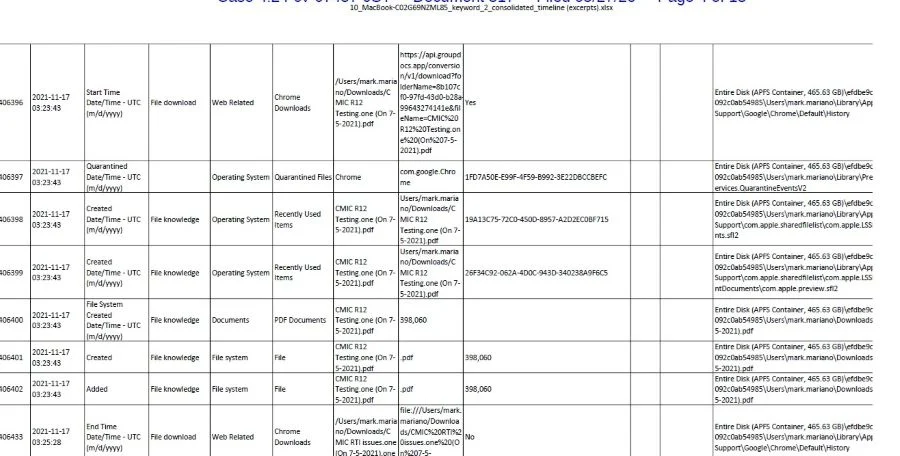
The court record has been bolstered by a series of exhibits detailing the digital activity associated with devices in Mariano’s possession between 2021 and 2023. The timeline provided by Oracle presents a compelling, if contested, narrative of data movement.
2016–2021: The Textura Integration Era
Mariano served as a primary architect for Oracle’s payment management systems. Following the 2016 acquisition of Textura, he held significant influence over the platform’s roadmap, positioning him as a high-value target for competitors in the construction tech space.
July–October 2021: The Transition Window
Oracle’s records indicate that in the months leading up to his resignation in October 2021, Mariano’s personal devices began interacting with Oracle’s corporate data in unusual ways. Exhibits show that files were downloaded from Oracle servers to a laptop in his possession.
A pivotal point in the investigation involves October 15, 2021—just two days after Mariano interviewed with Procore. According to questioning by Oracle’s attorney, Michael de Vries of Kirkland & Ellis, a significant upload of files to an iCloud account occurred on that date. This was shortly followed by a factory reset of Mariano’s Oracle-issued MacBook, an action that Oracle suggests was an attempt to scrub evidence of unauthorized data movement.
2021–2023: The Discovery Phase
Following his move to Procore, Mariano’s professional correspondence became a focal point of the discovery process. Exhibits entered into the court record reveal a dense web of communications between Mariano and several Procore executives, including Geoff Lewis, Jeanine Chiu, John MacVarish, Erica Heaverlo, Adam Hegedus, and Simone Sterling. The frequency and content of these messages are being scrutinized to determine whether Procore knowingly received or utilized Oracle’s trade secrets to accelerate their own software development.
Supporting Data: Evidence of Unauthorized Access
The evidentiary record, which has survived multiple attempts by Procore to dismiss the lawsuit, includes forensic data recovered from digital logs.
One of the most damning pieces of evidence presented in court is a record of downloads to devices held by Mariano during his final months at Oracle. These logs detail the movement of technical specifications and integration blueprints regarding Textura’s software. Furthermore, the partial transcript of a video-recorded deposition from March 2026 captures a tense exchange between attorney Michael de Vries and Mariano regarding his personal Google Drive account.

When pressed on whether he uploaded Oracle files to his personal cloud storage, Mariano maintained a defense of "unintentional synchronization."
"I would say that there was no intentional movement of files there," Mariano stated during the deposition. "I think there were some things that synced to those drives that you may have seen. I don’t know. But there was nothing that I was intentionally using that Google Drive for after that transition to laptops."
Regarding the factory reset of his company-issued MacBook, Mariano denied that the action was a calculated move to hide his tracks, asserting, "No, I was not," when asked if he planned the reset in conjunction with his data migration to iCloud.
Official Responses and Litigation Status
As the case continues, both companies have remained largely tight-lipped regarding the specifics of the ongoing litigation. Oracle, known for its aggressive defense of its intellectual property, has declined to provide comments to the press, preferring to let the court documents speak for themselves. Procore has similarly offered no immediate response to requests for clarification on the specific allegations involving their internal hiring and integration processes.
The Northern District of California court remains the primary theater for this conflict. Having survived Procore’s initial motion to dismiss, the case is now entering a deeper phase of evidentiary review, where the veracity of the forensic logs and the interpretation of "accidental syncing" will be tested against expert testimony.
Broader Implications: Intellectual Property in the Cloud Era
The Oracle-Procore dispute is emblematic of a broader challenge facing the construction technology industry. As the sector matures and moves toward highly integrated cloud ecosystems, the boundary between "transferable professional skill" and "proprietary intellectual property" is becoming increasingly blurred.
1. The Cost of Integration
In the pursuit of seamless data flow, software vendors often engage in collaborative integration agreements. When a key developer moves from one vendor to another, the risk of "IP bleed"—where proprietary secrets are transferred without formal authorization—is high. This lawsuit serves as a warning to both firms and individual employees that digital footprints are increasingly difficult to erase.
2. Forensic Accountability
The reliance on forensic data, such as iCloud sync logs and factory reset timestamps, highlights the evolution of corporate litigation. Companies are no longer relying on simple non-compete agreements; they are employing sophisticated data-forensic experts to reconstruct the digital history of departing employees.
3. Impact on Hiring Practices
For executives in the construction tech space, this case may necessitate a change in how talent transitions are handled. Moving forward, firms may implement stricter "clean room" protocols for incoming executives, ensuring that their devices and cloud accounts are audited upon arrival to prevent the accidental or intentional introduction of competitor IP.
As the case in San Francisco proceeds, the construction industry will be watching closely. Whether this ends in a high-value settlement or a landmark court ruling, the outcome will undoubtedly reshape the ethical and legal standards for talent acquisition and competitive intelligence in the specialized world of construction software. For now, the files in question—and the truth behind their migration—remain a contested centerpiece in one of the most significant IP battles in recent construction tech history.