






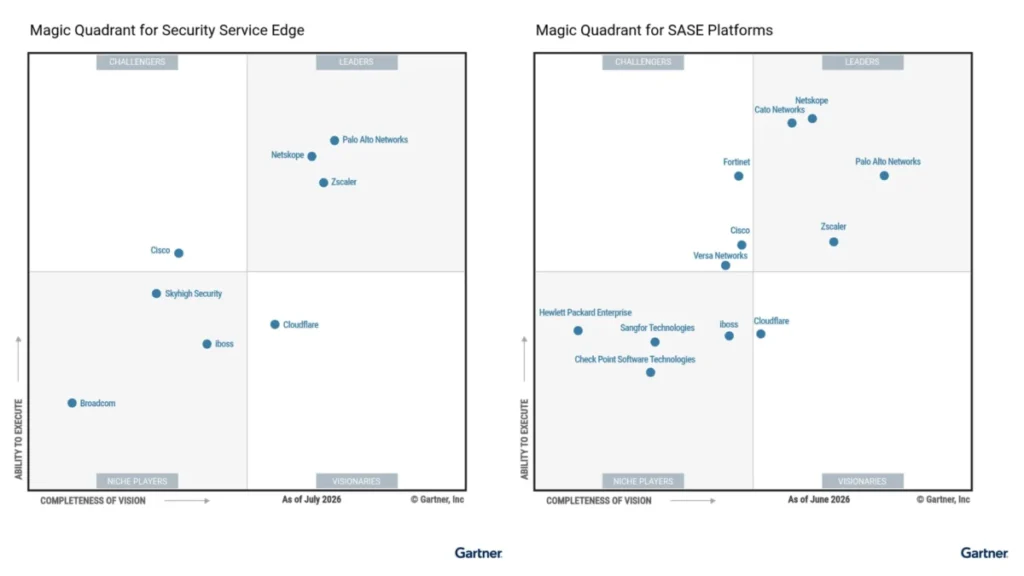
San Jose, CA – August 29, 2026 – In a landmark achievement for the cybersecurity industry, Palo Alto Networks today announced its consistent recognition as a Leader in Gartner’s 2026 Magic Quadrant reports for both Security Service Edge (SSE) and Secure Access Service Edge (SASE) Platforms. This marks the fourth consecutive year the company has secured this dual leadership position, a testament to its unwavering commitment to innovation, customer-centric execution, and a visionary approach to securing the evolving digital landscape. The recognition arrives at a critical juncture, as organizations grapple with the accelerating deployment of agentic AI and the emergent threats posed by advanced AI capabilities.
The cybersecurity arena is undergoing a seismic shift, driven by the rapid proliferation of Artificial Intelligence. As organizations increasingly embrace agentic AI – AI systems capable of autonomous action – traditional network security solutions are proving woefully inadequate. These legacy systems, designed for a pre-AI era, are struggling to keep pace, forcing painful productivity compromises and leaving significant security gaps. Simultaneously, the emergence of "Frontier AI" is amplifying these risks, with the potential to autonomously discover vulnerabilities and craft sophisticated exploits in real-time. Navigating this paradigm shift demands more than mere incremental upgrades; it requires a bold, market-defining vision, underpinned by relentless customer focus and execution. Palo Alto Networks’ sustained leadership in both SSE and SASE reports, as recognized by Gartner, underscores its success in meeting this challenge head-on.
A Legacy of Leadership: Consistent Recognition in a Dynamic Market
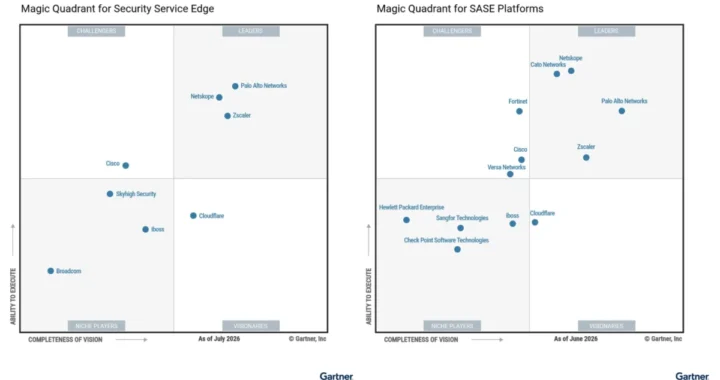
Palo Alto Networks has achieved a unique distinction, being the sole security vendor to be named a Leader in both the Gartner Magic Quadrant for Security Service Edge and the Gartner Magic Quadrant for SASE Platforms for four consecutive years. This sustained leadership underscores the company’s profound understanding of the evolving security needs of enterprises and its ability to deliver comprehensive, forward-looking solutions.
In the 2026 Magic Quadrant for SSE, Palo Alto Networks’ Prisma Access was placed highest in "Ability to Execute" and furthest in "Completeness of Vision." This dual recognition highlights not only the robust and reliable performance of its SSE offering but also its strategic foresight in anticipating future security requirements. Similarly, its strong positioning in the SASE Platforms report signifies its comprehensive approach to integrating networking and security functions into a unified, cloud-delivered architecture.
The company attributes this consistent success to a foundational philosophy: an unyielding focus on understanding customer needs and translating that understanding into tangible product value. Palo Alto Networks’ product strategy is not reactive; it is proactively designed to align with the future trajectory of customer environments and security imperatives, rather than merely addressing current challenges.
The AI Imperative: Visionary Leadership in a Transformative Era
The cybersecurity landscape is being fundamentally reshaped by Artificial Intelligence, and this transformation is accelerating at an unprecedented pace. Generative AI (GenAI) and agentic AI are introducing entirely new categories of risk for enterprises. These include sophisticated threats such as prompt injection attacks, where malicious inputs can manipulate AI models to behave unexpectedly or reveal sensitive information; the exploitation of over-privileged agents that possess excessive access to organizational resources; and the insidious threat of poisoned models, where AI systems are compromised with corrupted data, leading to flawed or malicious outputs.
Compounding these challenges, Frontier AI is dramatically accelerating the discovery of vulnerabilities and the development of exploits. Recent industry reports, including insights from Palo Alto Networks’ Unit 42 threat research team, indicate that attack timelines are being compressed by an astounding 95%. This means that the window of opportunity for attackers is shrinking, demanding an equally rapid and sophisticated defense.
Gartner’s projections paint a clear picture of this accelerating AI integration. By the end of 2026, it is anticipated that 40% of enterprise applications will feature embedded task-specific AI agents, a significant leap from less than 5% today. Furthermore, by 2028, an estimated 60% of brands are expected to leverage agentic AI for streamlined, one-to-one customer interactions. Operating a business in this new reality necessitates a security architecture engineered to anticipate threats that have not yet emerged. Success cannot be achieved by retrofitting legacy products with AI infrastructure support. Instead, it demands a unified, future-ready foundation that natively secures users, applications, sensitive data, and even non-human identities across every touchpoint. The platform an enterprise adopts today will ultimately determine its preparedness for the threats of tomorrow.
Palo Alto Networks views its dual Gartner Magic Quadrant leadership recognition as a powerful validation of its strategic product capabilities and its role in shaping the future of cybersecurity. The company’s innovative approach, particularly in securing AI traffic flows and implementing agent management solutions that simplify SASE operations, is seen as pivotal in addressing the complex challenges presented by the AI era.
Vision Backed by Relentless Execution: Translating Innovation into Enterprise Reality
While visionary strategy is crucial, its true value lies in the ability to execute and deliver tangible benefits to customers. Palo Alto Networks emphasizes that its placement as highest in execution and furthest in vision is only meaningful if it can be translated into real-world value. The company points to its impressive financial milestones as evidence of this execution prowess.
Recently, Palo Alto Networks surpassed the significant $1.6 billion Annual Recurring Revenue (ARR) mark for its Prisma SASE solutions, while simultaneously achieving a remarkable 40% year-over-year growth rate. This financial success reflects the profound trust that customers place in the company’s ability to deliver on its promises. Over 6,800 organizations, including more than one-third of the Fortune 500, rely on Palo Alto Networks, a testament to its consistent track record of transforming market-defining innovations into enterprise-grade, deployable realities.
This execution leadership is built upon a robust foundation, characterized by:
- Integrated Security Architecture: A unified platform that seamlessly integrates networking and security functions, eliminating complexity and reducing the attack surface.
- Cloud-Native Design: Solutions built from the ground up for the cloud, ensuring scalability, agility, and efficient delivery of security services.
- AI-Powered Threat Prevention: Advanced AI capabilities embedded across its portfolio to detect and prevent sophisticated threats at machine speed.
- Customer-Centric Innovation: A continuous feedback loop with customers to drive product development and ensure solutions meet evolving real-world needs.
Building for Tomorrow: Setting the Trajectory for the Agentic Enterprise
The rules of cybersecurity are being rewritten in real-time, and leading the market requires more than simply following existing trends; it demands setting the trajectory for future security paradigms. Palo Alto Networks is committed to continuously being at the forefront of defining the future of cybersecurity, empowering what it terms the "agentic enterprise of tomorrow."
Protecting with AI: Proactive Defense at the Speed of Intelligence
Palo Alto Networks is actively investing in AI-driven capabilities to ensure enterprises remain secure at the speed of AI. Its Precision AI security service is already blocking over 30 billion threats daily, effectively neutralizing sophisticated and highly evasive attack tactics. When integrated with its virtual patching and IP defense security services, organizations gain proactive defense mechanisms that secure their environments at the speed of Frontier AI, offering flexible enforcement and consistent protection across all touchpoints. This comprehensive security approach extends across network, edge, and cloud infrastructure, effectively stopping hidden threats that often elude traditional network security solutions.
This AI-powered "defense in depth" strategy operates across the entire attack lifecycle, enabling proactive protection that shifts enterprise security postures from a reactive incident response model to a preemptive, forward-looking defense.
Securing AI: Mitigating Risks in the Age of Autonomous Agents
The widespread adoption of AI tools and agents by employees presents unique security challenges. Enterprises must grapple with the risks of data leaks, intellectual property exposure, and compliance violations. Palo Alto Networks’ Prisma SASE and Prisma Access are designed to address these critical concerns. They achieve this by:
- Discovering All AI Usage: Providing comprehensive visibility into all AI tool usage and agentic actions within the enterprise.
- Enforcing Granular Least Privilege: Implementing precise access controls for both human and non-human identities, ensuring that agents only have the permissions they strictly require.
- Preventing Risky Data Exposure: Safeguarding sensitive data from being exposed to AI models and agents that could inadvertently leak or misuse it.
Through its innovative AI Access Security offerings, Prisma SASE delivers unified data security across the entire AI lifecycle. This includes GenAI application visibility and control, real-time prompt analysis to detect malicious or risky prompts, shadow data discovery to identify unsecured sensitive information, and robust protection on endpoints. Furthermore, Prisma Browser provides a secure AI workspace, safeguarding both human and autonomous agent workflows across any Large Language Model (LLM) by defending against data leaks, prompt injections, and agent hijacking.
To support the rapid enterprise adoption of AI agents, Prisma Access will feature native integration with the Prisma AIRS AI Gateway. This integration will provide a unified gateway for LLMs, Machine Control Panels (MCPs), and Application-to-Application (A2A) communications, offering security teams a single pane of glass for AI observability, cost governance, and runtime inspection. This represents a significant evolution from traditional device and user-centric security fabrics to an agent-aware platform, capable of securing AI for the enterprise of tomorrow, today.
Operating with AI: Enhancing Efficiency and Reducing TCO
Beyond protection and securing AI, Palo Alto Networks is also investing heavily in capabilities that make its platforms more proactive, efficient, and user-friendly through AI. New deployment agents are enabling customers to onboard their SSE or SASE environments more efficiently, significantly reducing their time to value and boosting productivity.
Once onboarded, autonomous AI agents within Strata Cloud Manager continuously monitor network and security posture. These agents proactively identify configuration drift, performance degradation, and security policy gaps. By uncovering potential disruptions before they impact users or expose the organization to risk, Palo Alto Networks has created automated systems capable of identifying and remediating issues. This remediation can be tailored to the administrator’s comfort level, ranging from guided recommendations to full autonomy, with human oversight calibrated appropriately.
The practical outcome of these AI-driven operational enhancements is a dramatic reduction in Mean Time To Resolution (MTTR) and a measurable decrease in Total Cost of Ownership (TCO). Simultaneously, administrative burdens are significantly reduced, making Palo Alto Networks products easier to maintain and operate.
Conclusion: A Future-Ready Security Partner
The cybersecurity landscape is undergoing its most significant transformation in decades. Palo Alto Networks’ sustained recognition as a Leader in both the Gartner Magic Quadrant for SSE and SASE Platforms for four consecutive years is a powerful endorsement of its visionary approach and its relentless execution. This recognition validates the company’s ability to serve the world’s largest enterprises and underscores its strategic product capabilities in shaping the future of cybersecurity. Through industry-leading innovation, Palo Alto Networks is empowering organizations to navigate the complexities of the AI era, ensuring they are equipped to protect themselves, secure their AI initiatives, and operate with unprecedented efficiency.
Organizations seeking to understand the evolving landscape of SASE and SSE and how to best position themselves for future security challenges are encouraged to download complimentary copies of the 2026 Gartner® Magic Quadrant™ reports.
About Palo Alto Networks:
Palo Alto Networks is the global cybersecurity leader, transforming the way organizations protect themselves from cyber threats. Its commitment to innovation, customer focus, and a visionary approach to security are driving the industry forward, particularly in the rapidly evolving realm of Artificial Intelligence.
Gartner Disclaimers:
Gartner, Magic Quadrant for Security Service Edge, 29 July 2026, John Watts Et Al.
Gartner, Magic Quadrant for SASE Platforms, 28 July 2026, By Jonathan Forest Et Al.
Gartner does not endorse any company, vendor, product or service depicted in its research publications, and does not advise technology users to select only those vendors with the highest ratings or other designation. Gartner publications consist of the opinions of Gartner’s research organization and should not be construed as statements of fact. Gartner disclaims all warranties, expressed or implied, with respect to this research, including any warranties of merchantability or fitness for a particular purpose.
Gartner and Magic Quadrant are trademarks of Gartner, Inc. and/or its affiliates. This graphic was published by Gartner, Inc. as part of a larger research document and should be evaluated in the context of the entire document. The Gartner document is available upon request from Palo Alto Networks.