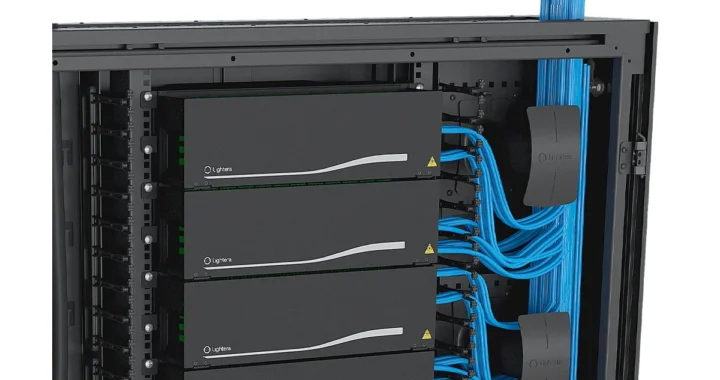








The meteoric rise of Artificial Intelligence (AI) has fundamentally altered the landscape of digital infrastructure. While headlines often focus on the raw computational power of GPUs, TPUs, and advanced transceivers, a quieter, yet arguably more critical revolution is unfolding within the physical architecture of modern data centers. To support the unprecedented demands of 400G, 800G, and nascent 1.6T bps transmission speeds, the passive layer—cables, connectors, and cabinets—has shifted from a support utility to a strategic, high-performance enabler.
In this era of AI-driven compute, the physical foundation of the data center must evolve with unprecedented speed, emphasizing densification, installation agility, and extreme scalability to keep pace with the massive data streams required for machine learning and real-time processing.
Main Facts: The Paradigm Shift in Connectivity
The core challenge of the AI era is the sheer volume of data transit required to sustain distributed computing clusters. As AI models grow in complexity, the need for low-latency, high-bandwidth interconnects has outpaced traditional cabling methods.
Passive infrastructure is no longer a "set-and-forget" component. Today, it serves as the backbone that dictates the overall efficiency of the facility. To achieve the required throughput, data centers are moving toward:
- Rollable Ribbon Fiber: Enabling higher fiber density in smaller diameters.
- Ultra-Dense Cabinets: Consolidating thousands of fibers within single, space-optimized structures.
- VSFF (Very Small Form Factor) Connectors: Tripling connection density compared to legacy interfaces.
- Modular Architecture: Ensuring that physical upgrades do not require a "rip-and-replace" cycle, thereby protecting long-term capital investments.
A Chronological Evolution of Data Center Infrastructure
The evolution of data center connectivity can be viewed through three distinct phases:
The Legacy Era (Pre-2015)
In the early days of high-speed networking, data centers primarily utilized standard LC duplex connectors and conventional loose-tube cabling. Cabling was managed manually, and density was rarely a primary constraint. The focus was on basic connectivity rather than the hyper-optimized optical paths required today.
The Scaling Era (2015–2022)
As cloud computing and big data matured, the demand for MPO (Multi-fiber Push-On) connectors rose. This period introduced the necessity for "plug-and-play" systems, where pre-terminated fiber assemblies began to replace field-spliced connections. The goal was to reduce installation time and human error, setting the stage for the high-density requirements that were to follow.
The AI-Native Era (2023–Present)
We are currently in a phase where AI workloads dictate the physical requirements. The shift to 800G and 1.6T bps has pushed the limits of signal integrity. Current designs now prioritize "Low Loss" connectivity to manage the strict optical loss budget, alongside the adoption of Rollable Ribbon technology, which allows for thousands of fibers to be packed into conduits that were previously only capable of housing hundreds.
Supporting Data: Engineering the Limits of Physics
The technical requirements for modern data centers are driven by precise mathematical constraints.
The Geometry of Density
The shift to Rollable Ribbon cables is a direct response to spatial constraints. By utilizing 12-fiber ribbons that can fold into a compact core, engineers can drastically reduce the interstice between fibers. This allows for cables with fiber counts in the thousands, yet with diameters significantly smaller than traditional designs. For a data center facility, where every square meter is monetized, this translates to massive operational gains.
Modern ultra-dense cabinets are now capable of managing up to 3,456 optical fibers within a single rack structure. This concentration is a prerequisite for AI clusters, where hundreds of high-performance servers must be interconnected with minimal latency and physical footprint.
The Precision of Connectivity
The transition from standard connectors to VSFF (Very Small Form Factor) connectors represents a massive leap in port density. By reducing the size of the interface, operators can triple the number of connections in the same footprint. However, this miniaturization comes with a caveat: the necessity for rigorous polarity management.
In high-speed, multi-fiber environments, accidental fiber inversion leads to immediate, catastrophic link failure. Modern standards now mandate strict mapping of polarity methods, often supported by field-adjustable connectors that allow technicians to reconfigure gender (pinning) and polarity without exposing delicate fiber ends to contamination.
Official Industry Perspectives: The Case for Modularity
Industry leaders and network architects emphasize that the financial viability of a modern data center rests on its modularity. The goal is to design an infrastructure that can support 10G or 40G today, while remaining compatible with 800G or 1.6T in the future.
"Preserving the investment is not just a financial goal; it is an operational necessity," notes a senior systems architect in the sector. By utilizing modular chassis and interchangeable cassettes, operators can upgrade their transceivers and active equipment without having to re-cable the entire facility. This modular approach is the only way to avoid the "stranded capacity" that often plagued older data center designs.
Furthermore, the industry is increasingly moving toward factory-tested, pre-terminated "plug-and-play" solutions. The rationale is clear: manual fusion splicing in a live data center environment is a recipe for high attenuation and downtime. Factory-controlled environments ensure that every connector meets the stringent "Low Loss" specifications required by the latest high-speed transmission protocols.
Implications for the Future of AI
The implications of these developments are profound. The ability of an AI model to process data in real-time is no longer just a function of processor speed; it is limited by the "optical budget" of the physical link.
1. The Operational Readiness Factor
The integration of high-density cabinets and advanced cabling reduces the "time-to-market" for new compute clusters. When an organization can deploy or scale a data center floor with plug-and-play simplicity, they gain a competitive advantage in the AI race.
2. The Risk of Infrastructure Debt
Organizations that ignore the passive layer risk incurring significant "infrastructure debt." If the physical layer is not designed with scalability in mind, the cost of future upgrades will be exponential, potentially stalling AI development efforts when the facility can no longer support the next generation of hardware.
3. Sustainability and Resource Management
Efficient use of space and materials is a form of sustainability. By maximizing the density of optical fiber, operators use less physical material (cables, cable trays, floor space) to achieve the same, or better, performance. This leads to lower cooling requirements and a more energy-efficient facility overall.
Conclusion: A Well-Designed Foundation
The digital revolution is often painted in abstract terms of code and algorithms, yet its heartbeat remains tethered to the physical world. The robustness of AI, its ability to scale, and its impact on society rely entirely on the resilience of the optical infrastructure that carries its data.
The transition toward high-count, rollable ribbon fiber, ultra-dense cabinets, and VSFF connectivity is not a mere trend; it is an essential engineering response to the demands of a high-speed, data-hungry world. By treating the passive connectivity layer as a strategic pillar—rather than an afterthought—data center operators can ensure that their facilities are not only ready for today’s AI models but are also prepared for the unknown innovations of tomorrow.
In the final analysis, the physical foundation of the data center is the ultimate constraint on the speed of progress. By mastering the passive layer, the industry is building a future where data moves with the speed of thought, unencumbered by the limits of the past.