








In the rapidly evolving landscape of network infrastructure, the backbone of modern connectivity remains fiber optic technology. Whether for high-speed enterprise networking, robust security surveillance systems, or immersive audio/video distribution, the fundamental choice between single mode and multimode fiber remains a pivotal decision for system integrators. As demand for higher resolution and lower latency surges, understanding the physics, economics, and practical deployment considerations of these two cable types is no longer optional—it is a professional necessity.
The Core Distinction: Understanding Fiber Physics
To understand the difference between single mode and multimode fiber, one must first look at the "pipe" through which light travels.
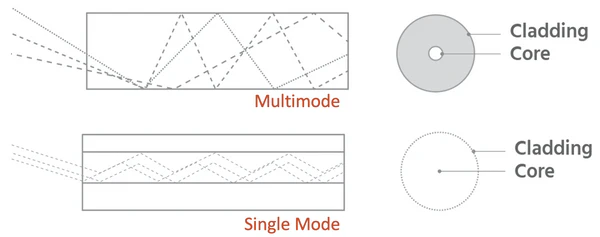
Single mode fiber is engineered with a microscopic optical core—typically around 9µm in diameter. Because the core is so narrow, it forces light to travel in a single, direct path (mode). This eliminates "modal dispersion," a phenomenon where light rays bounce off the walls of the fiber and arrive at the receiver at slightly different times, causing signal degradation. By constraining light to a single path, single mode fiber achieves incredible signal stability, allowing it to carry data over vast distances with virtually unlimited bandwidth potential.
Multimode fiber, by contrast, features a much wider core—usually 50µm in modern iterations (though legacy systems may still use 62.5µm OM1 cable). This larger aperture allows multiple modes of light to propagate through the cable simultaneously. While this makes it easier to inject light into the fiber—allowing for the use of cheaper, less precise light sources like LEDs or Vertical-Cavity Surface-Emitting Lasers (VCSELs)—it introduces modal dispersion. As the light pulses bounce at different angles, they spread out over distance, ultimately limiting how far the signal can travel before it becomes unrecognizable.

A Chronological Perspective: From Legacy to Future-Proofing
The evolution of fiber optics is a testament to the relentless push for data capacity.
- 1970s–1980s (The Rise of Multimode): Early fiber deployments relied heavily on multimode fiber. Because the electronics of the era were expensive and imprecise, the wider core of multimode fiber was a design advantage, making it easier to align light sources with the fiber core.
- 1990s–2000s (The Single Mode Shift): As the telecommunications industry began building long-haul networks across oceans and continents, single mode fiber became the global standard. Its ability to support higher speeds over tens of kilometers rendered it the only viable choice for the "backbone" of the internet.
- 2010s–Present (The Convergence): Today, the lines have blurred. With the cost of single mode electronics dropping and the demand for high-bandwidth applications (like 4K/8K video and AI-driven data centers) increasing, many integrators are bypassing multimode entirely for new building prewires, choosing the "future-proof" nature of single mode for both short and long-distance runs.
Supporting Data: Performance Metrics at a Glance
When selecting a cable, engineers must balance bandwidth requirements against distance limitations. The following table summarizes the operational differences:
| Feature | Single Mode (OS2) | Multimode (OM3/OM4/OM5) |
|---|---|---|
| Core Size | 9µm | 50µm |
| Light Source | Laser | LED/VCSEL |
| Distance | 10km+ | 300m – 550m |
| Bandwidth | Virtually Unlimited | Limited by modal dispersion |
| Manufacturing Cost | Lower | Higher |
| Electronics Cost | Higher | Lower |
The physics of these cables dictates their performance. Because single mode fiber has a smaller core, it exhibits significantly lower attenuation (signal loss). This is why single mode is the only logical choice for campus-wide links or any run exceeding 500 meters. Conversely, the cost-benefit analysis of multimode hinges on the "electronics tax." While the cable itself is more expensive to produce due to the precision required to manufacture a larger, uniform core, the transceivers required to drive multimode fiber are significantly cheaper than the high-precision laser transceivers needed for single mode.
Official Industry Perspectives: When to Choose Which?
Product experts at NSI Industries note that the "simple" answer—that single mode is for the modem and multimode is for everything else—is becoming outdated.

"We are seeing a massive shift in the industry," says an NSI Network Infrastructure Product Expert. "Integrators are realizing that the 30% price premium on single mode electronics is often offset by the long-term benefit of having a cable plant that will never need to be ripped out as bandwidth demands increase."
However, there remain specific use cases where multimode continues to shine. In high-density data centers, where tens of thousands of short-range connections are required, the lower power consumption and lower cost of multimode transceivers can result in significant CapEx savings. For these "intra-rack" or "inter-rack" connections, multimode remains a valid and efficient design choice.
Practical Implications for the Integrator
For the professional contractor, the choice between fiber types carries several downstream implications that go beyond the initial purchase order:
1. The Compatibility Trap
One of the most common errors in the field is the attempt to "marry" the two cable types. Because the core sizes are mismatched (9µm vs. 50µm), direct physical connection—such as trying to use a patch cable to bridge a single mode run to a multimode device—will result in catastrophic optical loss. The signal will essentially hit a "brick wall" where the light cannot transition from the small core to the large one without significant scattering. If a conversion is necessary, active media converters or SFP-based switches must be used to perform an electrical-to-optical-to-electrical handoff.
2. Termination and Testing
Modern toolkits are designed to be agnostic. Whether you are stripping and cleaving single mode or multimode, the physical labor remains largely the same. However, the testing equipment must be calibrated to the specific fiber type. Using a multimode light source/power meter on a single mode run will produce invalid results, and vice versa. Always ensure that your OTDR (Optical Time-Domain Reflectometer) settings match the cable plant you are certifying.
3. The Future-Proofing Strategy
For residential and commercial building prewires, the trend is overwhelmingly toward single mode. When a contractor installs fiber inside the walls of a building, they are investing in the infrastructure for the next 20 to 30 years. Installing single mode fiber today ensures that if the owner decides to upgrade from a 1Gbps connection to 10Gbps, 40Gbps, or 100Gbps in the future, the physical cable will not need to be replaced. Only the transceivers at the endpoints will need to be swapped.
Conclusion: Making the Final Decision
Choosing between single mode and multimode fiber is no longer just a technical exercise; it is a strategic business decision.
If your project involves long-distance runs, outdoor campus links, or a desire for future-proofed bandwidth, single mode is the superior choice. Its lower cost per foot and near-infinite bandwidth potential make it the gold standard for modern infrastructure.

If you are working within a controlled environment like a data center or an enterprise server room where high-density, short-range connectivity is required, multimode fiber offers a cost-effective solution that leverages lower-cost electronics to maintain performance.
Regardless of your choice, the golden rule of fiber optics remains: consistency is key. Keep your cable types, your connectors, and your testing protocols uniform throughout the project. When in doubt, consult with your infrastructure partner or the technical support teams provided by your manufacturers. By understanding the physics, respecting the limitations, and planning for the future, you ensure that the networks you build today remain the backbone of the technologies of tomorrow.