





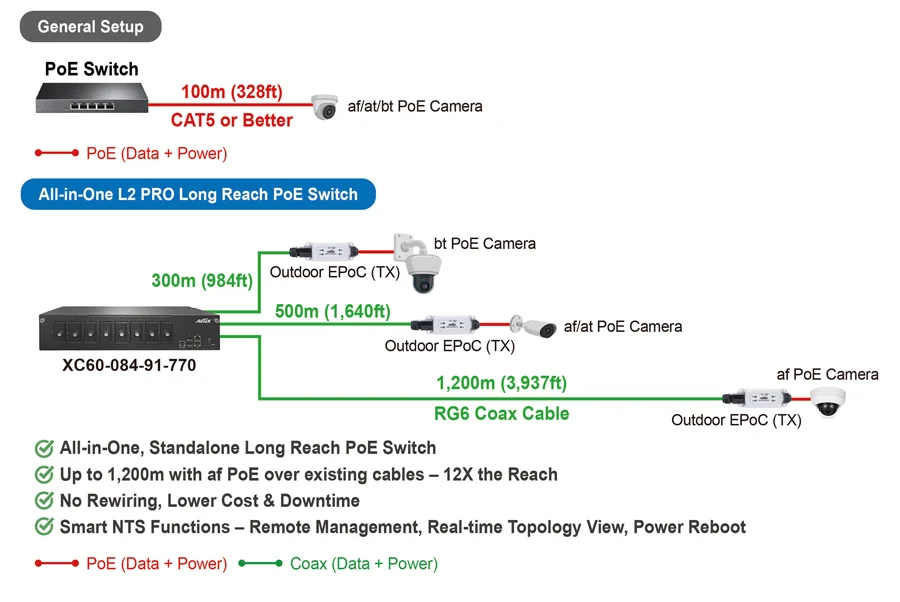
In the rapidly evolving landscape of enterprise technology, Artificial Intelligence (AI) has shifted from a theoretical advantage to an operational necessity. From high-definition, AI-powered security surveillance and automated industrial sensors to localized edge computing inference engines, modern applications demand unprecedented levels of bandwidth, power, and low-latency connectivity.
However, a significant architectural bottleneck remains: the vast, global deployment of legacy coaxial cabling. While modern AI applications rely on sophisticated IP-based infrastructure, thousands of organizations—spanning transportation hubs, industrial manufacturing plants, and sprawling commercial real estate—remain tethered to older copper-based coaxial systems. Replacing this infrastructure with modern fiber or Cat6 cabling is often prohibitively expensive, physically disruptive, and logistically complex.
Enter Ethernet and Power over Coax (EPoC) technology. By allowing organizations to repurpose existing 75-ohm coaxial cabling to carry high-speed data and high-wattage power, EPoC provides a strategic bridge between legacy constraints and the demands of the AI revolution.
The Physical Shift: Why AI Demands a Network Overhaul
The rise of edge AI is fundamentally a story about data distribution. Previously, centralized data centers processed information; today, the intelligence has moved to the “edge.” AI-enabled cameras and sensors perform real-time analytics, facial recognition, and anomaly detection at the point of capture.

This transition creates a trifecta of network requirements:
- Extended Reach: Many AI nodes are located in remote corners of large facilities, far beyond the 100-meter limit of standard Ethernet.
- High-Density Power Delivery: Advanced edge devices, such as pan-tilt-zoom (PTZ) cameras and multisensor arrays, require consistent, high-wattage power to operate their internal processing units.
- Resilience and Bandwidth: Real-time inference models cannot tolerate jitter, latency, or packet loss, requiring a robust physical layer that can maintain high throughput.
The EPoC Solution: An Engineering Breakthrough
EPoC (Ethernet and Power over Coax) is designed to solve the "last mile" problem of infrastructure. The technology utilizes the high-quality, shielded copper core of standard RG59 or RG6 cables to transmit digital Ethernet signals and low-voltage electricity simultaneously.
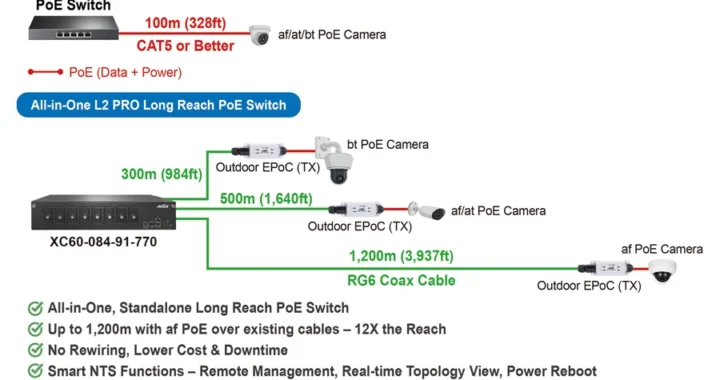
The XC60-084-91-770 managed RX switch by Versa Technology represents the current state-of-the-art in this domain. Designed to support flexible network topologies—including daisy-chain, peer-to-peer, and ring configurations—the XC60-084-91-770 allows facility managers to extend IP connectivity up to 1,200 meters (roughly 3,937 feet). This represents a twelve-fold increase over standard Ethernet, effectively eliminating the distance barriers that previously mandated expensive fiber-optic installs in large-scale environments.
Technical Specifications and Capabilities
The XC60-084-91-770 is not merely a conduit; it is an intelligent management node. Key technical specifications include:

- Port Configuration: Eight 75-ohm (Ω) BNC ports for coax connection, two Gigabit Ethernet (GbE) ports, and two SFP (Small Form-factor Pluggable) ports for high-speed fiber uplinks.
- Power Budget: A robust 720W total power budget, delivering up to 90W per port (PoE++ 802.3bt), which is more than sufficient for the most power-hungry industrial sensors.
- Topology Versatility: The switch is built to adapt to existing cable runs, whether they follow a linear daisy-chain, a resilient ring, or a star topology.
Chronology: The Evolution of Network Infrastructure
To understand why EPoC is such a timely innovation, one must look at the progression of site connectivity:
- Phase 1: The Analog Era (1980s–2000s): Buildings were wired with coaxial cable for CCTV and radio frequency communications. This was the gold standard for long-distance analog signal transmission.
- Phase 2: The Ethernet Shift (2005–2015): The industry shifted toward IP-based networking. Organizations faced a "fork in the road": rip out the coax and install new Cat5e/Cat6 cabling, or abandon the prospect of upgrading to IP altogether.
- Phase 3: The AI and IoT Explosion (2016–Present): The arrival of edge computing made the limitations of legacy coax more apparent. The need for smart, connected devices that can "think" on the spot has forced a re-evaluation of how we utilize existing copper assets.
- Phase 4: The EPoC Integration: EPoC provides a middle path, enabling the deployment of AI-ready infrastructure without the massive capital expenditure (CapEx) of a total site overhaul.
Implications for Corporate Strategy and Sustainability
The decision to utilize EPoC technology carries significant implications for a firm’s bottom line and environmental, social, and governance (ESG) goals.
Reducing Capital Expenditure (CapEx)
Replacing thousands of feet of cable involves not just the cost of materials, but the immense cost of labor. Trenching, ceiling installation, and the environmental disposal of legacy cables can balloon a project budget by 40% to 60%. By leveraging existing coax, these costs are essentially neutralized, allowing those funds to be reallocated toward better cameras, faster processors, and more sophisticated AI software.
Sustainability and Environmental Impact
Sustainability is now a core business metric. "Rip-and-replace" strategies are inherently wasteful, generating tons of plastic and copper waste. Reusing existing infrastructure reduces the carbon footprint of an IT upgrade project significantly, aligning with modern corporate mandates for circular economy practices.

Phased Migration Strategies
EPoC facilitates a "phased migration," which is critical for organizations that cannot afford downtime. In a high-security environment, for instance, a facility can replace one sector of analog cameras with AI-enabled IP cameras using the existing coax, testing the performance of the EPoC link before rolling the technology out to the entire facility. This modularity reduces operational risk and allows for a smooth transition to AI.
Official Perspectives on Network Management
Modern network management is no longer just about ensuring connectivity; it is about visibility. The integration of Network Topology Systems (NTS) into the XC60-084-91-770 switch is a response to the growing complexity of edge networks.
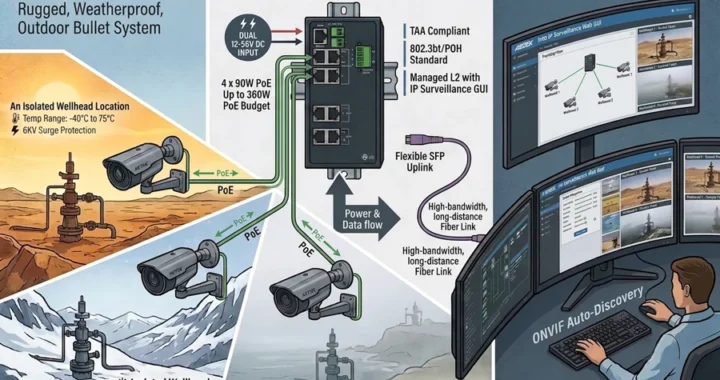
By providing a graphical view of the network, including integrated floor maps, IT administrators can pinpoint faults in seconds. The inclusion of ONVIF auto-discovery ensures that AI-enabled cameras are recognized and configured instantly upon connection. Furthermore, port-level power diagnostics allow administrators to track energy consumption in real-time—a critical feature for organizations looking to optimize their power costs in a high-inflation, high-energy-cost environment.
Implementation Best Practices
For organizations ready to modernize, a strategic approach is essential:

- The Physical Audit: Before purchasing, conduct an audit of existing coax. Ensure the cable is high-quality 75-ohm copper. Check for excessive splices or damaged connectors that could degrade the signal or power transmission.
- Power Load Assessment: Calculate the total wattage requirements for the intended AI endpoints. While the XC60-084-91-770 supports up to 90W per port, ensuring the total system load stays within the 720W budget is key to maintaining 24/7 reliability.
- Environmental Shielding: While coax is inherently well-shielded, verify that the cable paths do not run parallel to high-voltage power lines to prevent electromagnetic interference (EMI) that could disrupt high-frequency AI data traffic.
- Security Integration: Utilize the managed features of the switch to segment traffic. AI-powered surveillance data should be isolated via VLANs to ensure that security traffic is prioritized over less critical data streams.
Conclusion: The Path Forward
The transition to AI-driven networks is inevitable. However, the path taken to reach that future should not be dictated by the rigid requirements of legacy infrastructure. EPoC technology provides the flexibility, power, and distance required for the modern intelligent edge, turning existing liabilities into future-proof assets.
As organizations like Versa Technology continue to refine these solutions, the barrier to entry for AI-driven surveillance and industrial automation is dropping. By choosing to extend the value of their current investments, businesses are not only saving capital but are building a more resilient, scalable, and sustainable foundation for the next decade of technological advancement.
For those ready to bridge the gap between their current systems and the AI-powered future, the XC60-084-91-770 serves as more than just a piece of hardware; it is a strategic investment in long-term connectivity. To learn more about how to optimize your network for the AI era, contact the specialists at Versa Technology to schedule a demonstration or receive a customized infrastructure assessment.