




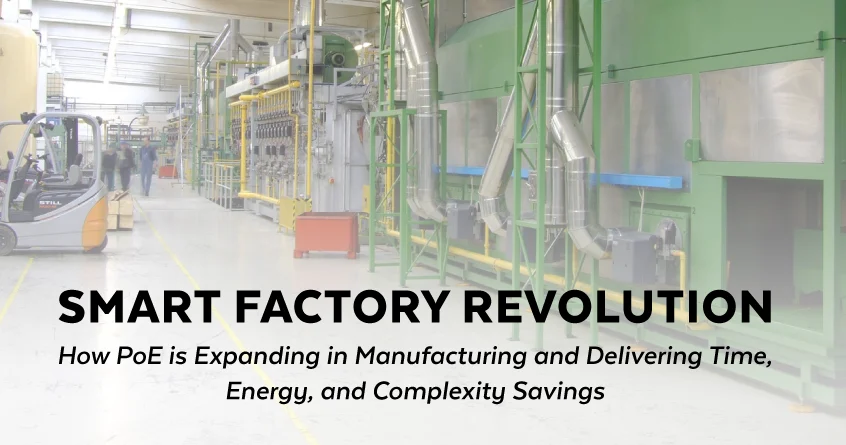
For decades, the manufacturing plant floor has been defined by a chaotic aesthetic: a tangled "spaghetti" of high-voltage conduits, bulky power bricks, and daisy-chained extension cords snaking across concrete floors. This traditional approach to facility power is more than just an eyesore—it is a significant operational liability. Whenever a plant manager seeks to introduce a new sensor, camera, or automated terminal, they are often forced to hire licensed electricians to run expensive, custom electrical conduit.
This archaic model of power delivery creates a bottleneck for innovation, driving up labor costs and forcing extended periods of costly downtime. However, a silent revolution is sweeping through the industrial sector. Power over Ethernet (PoE)—once a niche office technology—has matured into the backbone of the smart factory. By consolidating power and data delivery into a single, streamlined cable, PoE is effectively acting as the nervous system of Industry 4.0, providing the agility, efficiency, and intelligence required for modern manufacturing.
The Core Facts: What is PoE and Why Now?
At its most fundamental level, Power over Ethernet (PoE) is the technology that transmits both electrical power and data packets over a single Category 6a (or higher) Ethernet cable. Originally designed in the late 1990s and early 2000s to power VoIP phones and basic security cameras in corporate offices, PoE has undergone a radical metamorphosis. Today’s industrial-grade PoE standards support high-power devices, including advanced robotics, machine vision systems, and edge computing nodes.
The recent surge in adoption is not merely a preference for tidiness; it is a response to the rapid growth of the Industrial Internet of Things (IIoT). As factories become denser with sensors and data-gathering devices, the need for low-latency, secure, and easily deployed power has become paramount. With a projected Compound Annual Growth Rate (CAGR) of 17% through 2034, the market for PoE solutions is moving from the periphery of factory planning to the very center of capital expenditure (CAPEX) strategies.
Chronology of PoE Evolution: From Office Niche to Factory Essential
The journey of PoE is defined by the Institute of Electrical and Electronics Engineers (IEEE) standards, which have steadily increased the power budget available to end devices:
- IEEE 802.3af (2003): The "PoE" standard, delivering up to 15.4W of DC power. This was sufficient for basic static cameras and VoIP phones.
- IEEE 802.3at (2009): Known as "PoE+," this expanded the capability to 30W, enabling the use of pan-tilt-zoom (PTZ) cameras and basic wireless access points.
- IEEE 802.3bt (2018): Often referred to as "PoE++" or 4PPoE, this standard pushed limits to 60W and even 90W. This was the watershed moment for manufacturing, as it allowed high-draw devices like industrial lighting, LED displays, and sophisticated sensors to be powered over a single data cable.
Today, we are witnessing the era of "Smart PoE," where the power source—the industrial switch—functions as an intelligent controller that monitors the health and energy consumption of every connected device on the factory floor.
Supporting Data: The Case for Industrial Efficiency
The transition to PoE is backed by compelling economic and operational metrics. In a standard factory environment, the "Total Cost of Ownership" (TCO) for a device is often inflated by the need for localized AC outlets. By eliminating the need for AC wiring at every device endpoint, companies report massive savings.

1. The Energy Efficiency Dividend
AI-driven PoE switches do more than just conduct electricity; they optimize it. By utilizing centralized power management, facility managers can:
- Reduce "Always-On" Waste: Intelligent switches can cut power to inactive devices or schedule power cycles during off-hours, resulting in up to a 25% reduction in energy bills for device networks.
- Minimize Heat Dissipation: Fewer cables and higher-efficiency power delivery result in less thermal buildup, which is critical in climate-controlled cleanrooms or high-density server environments.
2. Scaling at the Speed of Software
The "plug-and-play" nature of PoE allows for rapid scaling. When a production line needs to be reconfigured to accommodate a new product, the wiring does not need to be ripped out. Devices can be moved and re-connected in minutes. This agility is the key to achieving "Zero-Downtime" retooling, a holy grail for automotive and electronics manufacturers.
Official Industry Perspectives
Industry leaders and technical alliances, such as the Ethernet Alliance, emphasize that PoE is no longer an optional upgrade; it is a foundational requirement for digital transformation.
"The modern factory is becoming an intelligent organism," says a spokesperson for Versa Technology, a leader in industrial networking solutions. "When you remove the dependency on rigid, high-voltage infrastructure, you enable a level of modularity that was impossible ten years ago. We are seeing clients bridge the gap between IT and OT (Operational Technology) networks, allowing real-time, data-driven decisions to happen at the machine level rather than just in the corporate office."
The consensus among engineers is that the shift to Ethernet-based power is as significant as the shift from analog to digital controls in the 1980s. It simplifies the physical layer, making the factory floor as programmable as the software that runs it.
Implications for the Future of Manufacturing
The implications of this shift extend far beyond just cable management. As we look toward the next decade, the role of PoE will continue to expand into several critical areas:
Convergence of IT and OT
Traditionally, IT networks (office, email, cloud) and OT networks (PLC, machine control, robotics) have existed in silos. PoE serves as the "great bridge" between these two worlds. By using standard Ethernet protocols for both power and data, manufacturers can create a unified, secure, and manageable network that allows for remote diagnostics and predictive maintenance.

Predictive Maintenance via Power Monitoring
The next generation of industrial PoE switches are evolving into diagnostic tools. Because the switch monitors the power draw of every device, it can identify anomalies. For example, a motor drawing slightly more current than usual can signal mechanical wear or bearing friction long before a catastrophic failure occurs. The switch, acting as a sensor, can trigger an automated maintenance alert, preventing costly production halts.
The Era of Multi-Gigabit and SPE
As AI integration tightens, the demand for bandwidth is exploding. We are entering the era of 10G+ multi-gigabit PoE. Simultaneously, Single Pair Ethernet (SPE) is emerging as a technology to reduce cable bulk even further, allowing IP connectivity to penetrate the deepest, most rugged, and space-constrained levels of the factory floor.
Sustainability and Green Manufacturing
Material usage is a significant aspect of ESG (Environmental, Social, and Governance) reporting for large manufacturers. PoE reduces the amount of copper and plastic required for electrical cabling, as well as the amount of concrete and metal required for conduit. This aligns with the global push for "Green Manufacturing," where every watt of energy and every meter of cabling is optimized for maximum efficiency.
Conclusion: A Foundational Requirement
The clutter of the traditional factory floor is a relic of an era that lacked the connectivity and intelligence required for modern competitiveness. By adopting PoE, manufacturers are not just cleaning up their cables; they are building a resilient, scalable, and software-defined infrastructure.
With standards now supporting speeds up to 1.6 Tbps and power delivery capable of handling high-draw robotics, the ceiling for what can be achieved on the factory floor has been lifted. For manufacturers, the choice is clear: continue to wrestle with the rigid, expensive, and complex power systems of the past, or embrace the unified, intelligent, and agile future that Power over Ethernet provides. As the industry races toward full AI integration, those who have invested in a PoE-enabled nervous system will find themselves in a position of significant competitive advantage.