




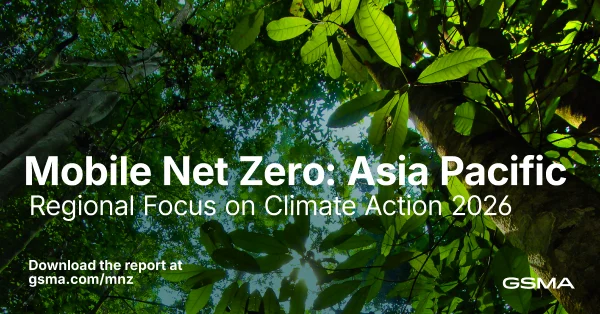
KUALA LUMPUR, 10th September 2026 – As the Asia-Pacific region cements its status as the global engine of digital growth, a troubling paradox has emerged: the very infrastructure powering this transformation is becoming an environmental hurdle. A major new report from the GSMA, Mobile Net Zero: Asia Pacific – Regional Focus on Climate Action 2026, unveiled today at M360 ASEAN, reveals that while mobile operators have significantly ramped up their climate pledges, the rapid surge in demand for connectivity is outpacing the transition to clean energy, particularly in emerging markets.
The report paints a complex picture of a region divided by its energy transition. While advanced economies like Japan and Australia are successfully decoupling growth from emissions, Southeast Asia and other emerging markets are grappling with a sharp increase in their carbon footprints.
The Core Challenge: Connectivity vs. Carbon
The data is stark: between 2019 and 2024, mobile data traffic across the Asia-Pacific (APAC) region skyrocketed by 350%, while mobile connections grew by 6%. This digital explosion has mandated a massive expansion of network infrastructure, including thousands of new base stations and data centers.
While operators are undeniably more efficient than they were five years ago, the sheer volume of data traffic has forced total operational emissions in the region to climb by 6%. However, this aggregate figure masks a deeper regional divide. In Southeast Asian nations—including Malaysia—operator emissions have spiked by more than 20% since 2019. In contrast, operators in Japan and Oceania have managed to slash their emissions by over 30% during the same period, providing a blueprint for what is possible when policy, technology, and renewable energy infrastructure align.
A Chronology of the Transition (2019–2026)
To understand the current state of the industry, it is essential to view the last seven years through the lens of the "Green Connectivity" timeline:
- 2019 (The Baseline): Mobile operators in the APAC region sourced a meager 1% of their electricity from renewable sources. At this stage, the industry was focused almost exclusively on network rollouts and 5G deployment, with climate commitments often viewed as secondary to coverage expansion.
- 2021–2022 (The Commitment Phase): Recognizing the climate crisis, the majority of the regional industry began aligning with international climate frameworks. Near-term science-based targets were established, and the first wave of operators pledged to achieve net-zero status.
- 2024 (The Milestone Year): The industry reached a significant, albeit insufficient, milestone. Mobile operators purchased or generated 7 TWh of renewable electricity—representing 15% of their total consumption. While this is a 1,400% increase from 2019, it remains significantly below the global industry average of 24%.
- 2026 (The Reality Check): As reported at M360 ASEAN, the industry faces a crossroads. Despite 21 operators representing 55% of the region’s mobile connections having validated near-term science-based targets, the physical reality of grid dependency in emerging markets is creating a "green ceiling." Without urgent regulatory reform, the goal of net-zero by 2040 appears increasingly precarious for many operators.
Supporting Data: The Green Divide
The disparity between markets is not merely a matter of corporate willpower; it is a matter of market structure and energy accessibility.
Renewable Energy Adoption Rates:
- Japan and Australia: These markets have led the charge, with operators successfully sourcing over 50% of their electricity from renewable assets.
- Southeast Asia: The picture is far bleaker. Operators in this region currently source only 4% of their electricity from renewables.
- Malaysia: Currently sitting at 5%, the nation reflects the broader regional struggle, where high costs and limited regulatory frameworks for off-site renewable procurement hinder the adoption of green power.
Despite the systemic barriers, pockets of excellence exist. Globe Telecom (Philippines) has demonstrated significant initiative, meeting one-third of its electricity needs via renewables in 2025. Similarly, Telekom Malaysia and Thailand’s True have both crossed the 20% threshold, proving that internal corporate strategy can move the needle even in challenging environments.
Official Responses: The Call for Policy Reform
The GSMA has been clear in its assessment: the industry cannot achieve its goals in a vacuum. Governments hold the keys to unlocking the next phase of the energy transition.
"Mobile operators across Asia Pacific are strengthening their climate commitments and investing in more efficient networks to meet growing demand," said Steven Moore, Head of Climate Action at the GSMA. "But progress on reducing emissions will be difficult without greater access to renewable electricity."
Moore emphasizes that the issue is not just about the availability of green power, but the mechanisms of access. "Operators need access to renewable energy across the markets where they operate, including mechanisms that work for distributed infrastructure such as mobile towers. Policymakers play a critical role in creating the conditions for investment in renewable energy and modern grids."
The GSMA’s advocacy, particularly in Malaysia and other high-growth markets, focuses on three pillars:
- Market Reform: Moving away from state-dominated energy monopolies to allow for more flexible Power Purchase Agreements (PPAs).
- Infrastructure Support: Recognizing mobile networks as "critical infrastructure" in climate resilience planning, which would streamline the permitting process for clean energy installations.
- Cross-Sector Collaboration: Working with tower companies and energy suppliers to ensure that the entire digital supply chain is aligned with net-zero pathways.
Implications: A Future at Risk
The implications of failing to bridge this gap are twofold: economic and existential.
The Economic Cost
For operators, energy is one of the highest operational expenditures. As carbon taxes are introduced across the region and energy prices become more volatile, reliance on coal-heavy grids will become a massive financial liability. Renewable energy is no longer just a CSR initiative; it is a long-term strategy for cost management and energy security.
The Climate Vulnerability
The Asia-Pacific region is the most climate-vulnerable in the world. From intensifying typhoons in the Philippines to sea-level rise threatening low-lying coastal cities and island states, the industry is already seeing the physical impacts of climate change on its own assets. If the mobile sector fails to decarbonize, it inadvertently contributes to the very environmental instability that threatens the longevity of its network infrastructure.
The Path Forward: Recommendations for Stakeholders
The 2026 GSMA report provides a roadmap for stakeholders to navigate this transition:
- For Operators: The focus must shift from simply setting targets to active procurement and energy efficiency. This includes retiring legacy 2G/3G networks that consume disproportionate amounts of energy and integrating "ecodesign" into hardware procurement to ensure circularity.
- For Suppliers and Tower Companies: These entities, which form the backbone of the mobile ecosystem, must be held to the same standards as operators. Increased climate disclosure, validated science-based targets, and a commitment to renewable energy are non-negotiable for future partnerships.
- For Governments: The report urges the acceleration of coal phase-outs and the creation of "aggregation mechanisms." Because mobile towers are distributed across vast geographies, individual towers often cannot access green power markets. Aggregation allows operators to pool their demand, making renewable energy procurement viable for these small, remote assets.
Conclusion: Connectivity as a Climate Enabler
Despite the daunting statistics, the message from Kuala Lumpur is one of guarded optimism. Mobile technology remains the most powerful tool for societal development and economic inclusion in the Asia-Pacific region. However, the industry’s "license to operate" in the coming decades will be contingent upon its ability to reconcile the demand for data with the necessity of a sustainable planet.
By pivoting from a growth-at-any-cost model to a sustainable, renewable-first architecture, the mobile industry has the potential to lead the region’s broader energy transition. The technology is ready; the policy framework is the final piece of the puzzle. As the GSMA moves forward with its advocacy and support, the eyes of the world remain fixed on the Asia-Pacific to see if it can successfully navigate the digital-green nexus.
For more information on the findings, including specific market-by-market breakdowns and the full strategy for achieving net-zero by 2040, visit the GSMA website.