





As the global manufacturing sector pivots toward a future defined by artificial intelligence, machine learning, and autonomous robotics, the silent backbone of the factory floor—the Ethernet network—is facing an existential crisis. For decades, traditional Ethernet has served as the workhorse of industrial connectivity. However, in the era of microsecond-precision synchronization, "best effort" data delivery is no longer sufficient. To meet the demands of modern AI-driven operations, industry leaders are turning to Time-Sensitive Networking (TSN), a technology that transforms standard data pipes into deterministic, precision-timed instruments.
Main Facts: The Deterministic Shift
At its core, the transition to TSN is a move away from the stochastic nature of standard networking. In a conventional Ethernet environment, data packets travel through a network much like cars in heavy traffic; they arrive when the "road" allows, often subject to congestion and unpredictable delays. While acceptable for checking emails or transferring files, this latency is catastrophic for robotic assembly lines where machines must execute synchronized movements within microseconds of one another.
TSN chips are specialized semiconductors designed to uphold the IEEE 802.1 standards, ensuring that data arrives within a pre-determined, precise window of time. By embedding logic that honors the microsecond, these chips allow for the convergence of Operational Technology (OT) and Information Technology (IT) onto a single, unified infrastructure. This is not merely an upgrade in throughput; it is a fundamental reconfiguration of how silicon interacts with the physical world.
The Chronology of Industrial Connectivity
The evolution of industrial networking can be viewed through three distinct eras:
- The Analog/Fieldbus Era (1980s–2000s): Manufacturing relied on proprietary fieldbus protocols. These were highly deterministic but siloed, expensive to scale, and lacked the bandwidth required for the digital transformation.
- The Standard Ethernet Era (2000s–2020s): Factories moved toward standard Ethernet to increase bandwidth and leverage IT economies of scale. However, this introduced "jitter"—the variation in packet arrival time—which necessitated complex workarounds and separate networks for safety-critical tasks.
- The TSN/AI Era (2025 and beyond): We are currently witnessing the integration of TSN into the hardware layer. This era is defined by the demand for "hard real-time" capabilities where AI-driven robots, high-speed vision systems, and predictive maintenance sensors operate in perfect synchronization over the same cable, effectively ending the era of network congestion as a barrier to production.
Supporting Data: Standard vs. TSN Performance
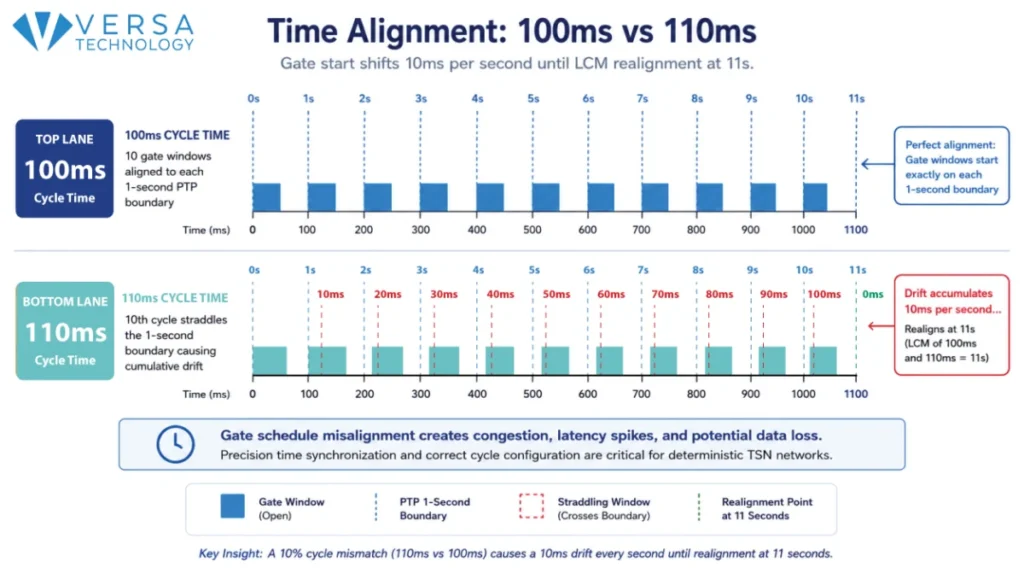
The technological divide between standard Ethernet chips and TSN-enabled chips is stark. A standard Ethernet chip operates on a "first-come, first-served" basis, where all packets are treated with equal priority. Under heavy network loads, this results in significant jitter, making it impossible to guarantee the sub-microsecond latency required for high-speed motion control.

Conversely, TSN chips utilize Time-Aware Scheduling (TAS). Through a gate-control list, these chips open and close transmission windows at nanosecond intervals. This ensures that critical control data is granted a "clear lane," while non-critical traffic—such as large-scale data analytics uploads or firmware updates—is buffered or scheduled around these high-priority windows.
In a high-speed packaging facility, for instance, this allows for the seamless orchestration of conveyor belts, robotic arms, and high-resolution inspection cameras. When these systems share a standard network, a spike in diagnostic traffic could delay a "stop" command, potentially causing mechanical failure. With TSN, that "stop" command is guaranteed, regardless of the volume of background data being transmitted.
Official Perspectives: The Silicon Imperative
Industry experts and hardware manufacturers, including major players like Microchip, NXP, and Intel, emphasize that TSN is the "definitive bridge" to a reliable, AI-driven future. The industry consensus is that as factories adopt "Digital Twin" technology and real-time AI inference, the network must evolve to become an active participant in the mechanical process.
"The challenge is no longer just moving data; it is mastering time," says a senior engineer at a leading industrial networking firm. "If you are running an AI model that adjusts a robotic arm’s trajectory based on a camera feed, that data must arrive within a strict, predictable interval. If the packet arrives late, the AI’s decision is obsolete before it is even executed. TSN is the only way to make the laws of physics and the laws of digital logic work in tandem."
Implications for the Factory of the Future
The adoption of TSN chips has far-reaching implications for the manufacturing sector, particularly in terms of efficiency, safety, and operational overhead.

1. Consolidation of Infrastructure
One of the most immediate benefits is the ability to collapse disparate network layers. Previously, manufacturers were forced to maintain separate, complex networks for OT (machine control) and IT (data reporting). TSN allows these to exist on the same wire, reducing cable clutter, decreasing maintenance complexity, and lowering total cost of ownership (TCO).
2. Zero-Millisecond Recovery
TSN chips offer advanced redundancy features. They can replicate a single packet and transmit it simultaneously across two different paths. The receiving device processes the first packet to arrive and instantly discards the second. If one path fails, the other is already delivering the data, ensuring zero-millisecond recovery. In an environment where an unexpected stoppage can cost thousands of dollars per minute, this resilience is a critical business asset.
3. Enabling Autonomous Operations
Autonomous Guided Vehicles (AGVs) and mobile robots are becoming common in modern logistics and manufacturing. These machines require constant, low-latency communication with the central management system to avoid collisions and optimize routing. TSN provides the deterministic foundation necessary to scale these fleets. Without the jitter-free environment provided by TSN, as the number of AGVs increases, the likelihood of packet collisions and network congestion rises, threatening the very autonomy the system is designed to provide.
4. The AI Feedback Loop
AI in manufacturing is only as good as the data it receives. Real-time predictive maintenance requires high-frequency sensor data to be synchronized across thousands of points in a facility. By providing a synchronized timeline—where every device on the network operates on the exact same microsecond-level clock (via IEEE 802.1AS)—TSN ensures that the data fed into AI models is temporally accurate. This allows for more precise anomaly detection and higher-quality manufacturing outputs.
Conclusion: Preparing for the Next Level
The transition to TSN is not a fleeting trend; it is the necessary evolution of industrial Ethernet. As the demand for AI-driven automation accelerates, organizations that cling to traditional "best effort" networking will inevitably find themselves throttled by the limitations of their own infrastructure.

For manufacturers, the path forward involves auditing existing systems, evaluating the necessity of deterministic communication, and integrating TSN-enabled switches and controllers. By shifting the focus from throughput to precision timing, businesses can ensure their networks are not just conduits for information, but robust, high-performance engines capable of supporting the next generation of industrial innovation.
As the industry moves toward a fully autonomous, data-centric model, the ability to "honour the microsecond" will become the primary differentiator between market leaders and those left behind. Navigating this transition requires a strategic approach to network design, starting with the very chips that connect the silicon to the shop floor.