





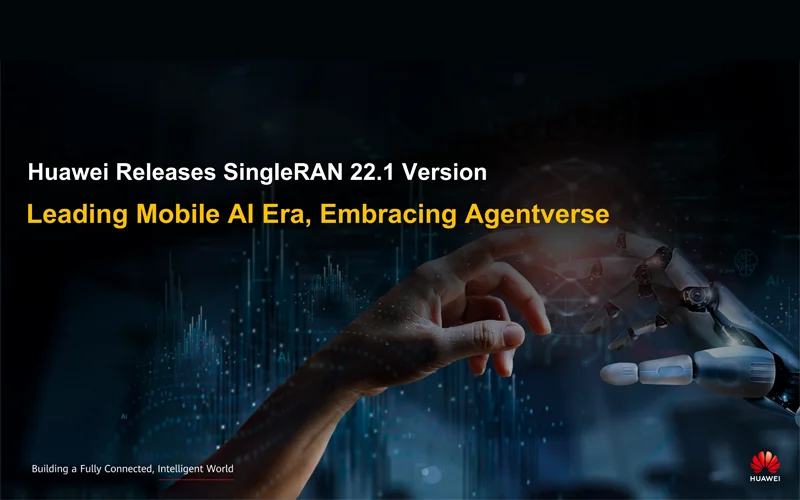
The telecommunications industry is currently standing at the precipice of its most significant transformation since the transition from analog to digital. As artificial intelligence (AI) evolves from a centralized cloud-based tool into a decentralized, mobile-first ecosystem of autonomous agents, the underlying infrastructure of the world’s wireless networks is facing an existential challenge. To meet this demand, Huawei has unveiled its latest software innovation, SingleRAN 22.1, a commercial release specifically engineered to serve as the foundational architecture for the "Mobile AI" era.
Launched in Shanghai, SingleRAN 22.1 represents more than a mere incremental update; it is a fundamental reconstruction of how Radio Access Networks (RAN) function. By shifting the focus from traditional downlink-centric "best-effort" connectivity to a multidimensional, deterministic, and uplink-heavy model, Huawei aims to enable what industry experts are calling the "Agentverse"—an interconnected global ecosystem where billions of AI agents collaborate in real-time.
Main Facts: A New Blueprint for the Intelligence Era
At its core, SingleRAN 22.1 is Huawei’s first commercial software release purpose-built to handle the unique traffic patterns of AI agents. Traditional mobile traffic has historically been dominated by video streaming and web browsing, which rely heavily on high-speed download (downlink) capabilities. However, AI agents—autonomous software entities capable of perceiving, reasoning, and acting—operate under a completely different set of requirements.
The software introduces six key technical advancements designed to resolve the foundational bottlenecks of current 5G and 4G networks. These features focus on massive uplink capacity, deterministic low latency, and the intelligent orchestration of network resources. Furthermore, SingleRAN 22.1 is the first software version to support Huawei’s next-generation UBBPi series baseband boards, creating a powerful synergy between high-performance hardware and AI-optimized algorithms.
The scale of deployment is already significant. Huawei’s SingleRAN 22.1 has been commercially deployed at 35 operator sites across 23 countries, including major markets in Asia, Europe, and the Middle East. With over 100 operators expected to complete deployment by the end of 2024, the transition to Mobile AI-ready networks is moving from a theoretical concept to a global reality.
Chronology: From Human Connectivity to Machine Intelligence
The evolution of wireless networks can be categorized into three distinct eras, each defined by the primary user of the data.
The Era of Connectivity (2G/3G/4G)
For the better part of three decades, mobile networks were designed for humans. The goal was to provide voice services and, eventually, high-speed mobile internet. The success of these networks was measured by coverage and the ability to deliver "best-effort" data for activities like social media and video consumption. In this era, the network was largely a passive pipe for data.
The Era of 5G and the IoT (2019–2023)
The introduction of 5G brought the promise of the Internet of Things (IoT). Networks began to differentiate between human users and machine-type communication (MTC). While 5G introduced lower latency and higher capacity, the traffic remained largely predictable and focused on connecting static sensors or providing high-speed broadband to smartphones.
The Mobile AI Era (2024 and Beyond)
We have now entered the third era. The catalyst for this shift was the breakthrough in Large Language Models (LLMs) and generative AI in 2023. As these models moved from data centers to the "edge" (devices like smartphones, AI glasses, and autonomous vehicles), the industry realized that existing network architectures were ill-equipped for the "Agentverse."
The launch of SingleRAN 22.1 in early 2024 marks the official start of the industry’s systematic overhaul. Huawei’s decision to reconstruct its software stack reflects a realization that the "best-effort" model is obsolete. Networks must now provide "guaranteed" performance to ensure that an AI agent controlling a vehicle or a surgical robot does not experience a momentary drop in connectivity.
Supporting Data: The Explosion of the AI Agent Market
The urgency behind Huawei’s new software is underscored by staggering market forecasts from leading analysts and technology visionaries.
The Billion-Agent Forecast
According to the International Data Corporation (IDC), the adoption of AI agents is set to reach an inflection point. IDC forecasts that there will be more than 1 billion actively deployed AI agents by 2029, a number expected to more than double to 2.2 billion by 2030. This represents a compound annual growth rate that far exceeds any previous technology adoption cycle, including the smartphone itself.
Huawei’s 2035 Vision
Huawei’s own "Intelligent World 2035" report offers an even more bullish outlook. The report predicts that 900 billion AI agents will be active globally by 2035. Crucially, the report estimates that 90% of these agents will operate in mobile scenarios. This means that the vast majority of AI processing and interaction will happen over wireless networks, rather than fixed-line fiber connections.
The "100 Agents Per Person" Paradigm
NVIDIA CEO Jensen Huang has popularized the concept of the AI-supported workforce. Huang envisages a future where every human employee is supported by over 100 AI agents, each specializing in different tasks—from scheduling and data analysis to creative design and real-time translation. In such a scenario, the volume of background data exchange (machine-to-machine) would dwarf human-generated traffic by several orders of magnitude.
Technical Requirements: The Uplink Crisis
Current networks are typically designed with a 10:1 ratio in favor of downlink. However, AI agents require continuous multimodal data transmission—sending high-definition video, audio, and sensor data up to the cloud or other agents for processing. This necessitates a radical shift toward uplink-centric broadband communication (UCBC), which SingleRAN 22.1 is designed to provide.
Official Responses: A Paradigm Shift for the Industry
The leadership at Huawei views SingleRAN 22.1 not just as a product, but as a manifesto for the future of telecommunications.
He Yunru, Vice President of Huawei Wireless Network Solutions, emphasized that this transition represents a fundamental departure from traditional service upgrades. “Mobile AI is not a service upgrade—it is a paradigm shift for the industry,” He stated during the launch. “As the first commercial version for the Mobile AI era, SingleRAN 22.1 comprehensively reconstructs network capabilities, empowering operators to seize new opportunities in the Token economy.”
The mention of the "Token economy" is particularly significant. In the world of AI, data is often processed in "tokens." By optimizing the network for token-based traffic, Huawei is helping operators move away from selling simple "data buckets" (gigabytes) and toward selling "intelligence units" or guaranteed performance levels for AI services. This allows operators to monetize the high-value traffic generated by autonomous systems and enterprise AI applications.
Industry analysts have noted that Huawei’s move places significant pressure on other infrastructure providers like Ericsson and Nokia to accelerate their own AI-native network strategies. The consensus among telecom experts is that the "Agentverse" will require a level of network "self-awareness," where the RAN uses AI to manage the AI traffic it carries—a concept Huawei refers to as "Intelligent RAN."
Implications: Building the Foundation for a Post-Human Network
The deployment of SingleRAN 22.1 and the rise of the Agentverse have profound implications for the global economy, network architecture, and the nature of digital interaction.
1. From "Best-Effort" to Deterministic Connectivity
For decades, mobile users have accepted that connection speeds might fluctuate based on location or congestion. In the Agentverse, this is no longer acceptable. AI agents requiring real-time interaction and multi-agent collaboration need deterministic low latency. If two AI agents are collaborating on a high-speed financial trade or a coordinated drone delivery, a 50-millisecond lag could result in failure. SingleRAN 22.1’s ability to guarantee service levels marks the transition to a "utility-grade" wireless network.
2. The Rise of Multimodal Interaction
Unlike the text-based bots of the past, tomorrow’s AI agents will be multimodal. They will "see" through cameras, "hear" through microphones, and "feel" through haptic sensors. This requires a network that can handle diverse data types simultaneously with varying priority levels. Huawei’s systematic redesign allows the network to orchestrate resources dynamically, ensuring that a critical "vision" stream from an AI agent receives priority over a background software update.
3. Energy Efficiency and Sustainability
With 900 billion agents predicted by 2035, the energy consumption of wireless networks could skyrocket. A key implication of the SingleRAN 22.1 update is the integration of "Green AI" algorithms. By using AI to optimize the power consumption of baseband boards (like the UBBPi series) and sleeping radio units during micro-gaps in traffic, Huawei is attempting to decouple the growth of AI traffic from the growth of carbon emissions.
4. Reshaping the Global Token Economy
As operators deploy SingleRAN 22.1, the business model of telecommunications will likely shift. We may see the emergence of "AI-specific" data plans where enterprises pay for the number of tokens processed or the number of agents supported. This "Token economy" could provide a much-needed revenue boost for operators who have struggled to monetize the massive investments made in 5G infrastructure.
5. Bridging the Digital Intelligence Divide
The rapid deployment of this technology across 23 countries suggests that the "Intelligence Era" will not be confined to a few wealthy nations. However, the requirement for advanced hardware like the UBBPi series means that the gap between "AI-ready" nations and those on legacy infrastructure could widen. The global rollout of SingleRAN 22.1 is a race to ensure that the infrastructure of the future is ready before the billions of predicted AI agents arrive.
In conclusion, Huawei’s SingleRAN 22.1 is more than a software update; it is the first brick in the wall of a new digital civilization. By preparing the world’s wireless networks for the "Agentverse," Huawei is ensuring that the intelligence of the future will be omnipotent, omnipresent, and, most importantly, perpetually connected.