






In the electrical contracting industry, a project is rarely judged solely by the power flowing through the wires. Instead, the true testament to an electrician’s craftsmanship is revealed the moment a panel cover is removed or a server room door is opened. Every cable run, every bend, and every termination serves as a permanent signature of the installer’s dedication to quality. As industry standards evolve and the complexity of building technology increases, cable management has transitioned from a "neatness preference" to a critical component of safety, efficiency, and professional longevity.
NSI Industries, a leader in electrical supply solutions, emphasizes that the job you leave behind is the job your customer will remember. This article explores the vital importance of cable management, the technical best practices for implementation, and the long-term implications of maintaining an orderly workspace.
The Foundation of Professionalism: Why Organization Matters
For the uninitiated, cable management might seem like an aesthetic choice—a way to make a job look "clean" for the final walkthrough. However, experienced professionals know that a tidy installation is the bedrock of operational reliability. The benefits of a disciplined approach to wire management are far-reaching, impacting everything from troubleshooting speed to the mitigation of catastrophic fire risks.
Troubleshooting Efficiency
Time is the most valuable commodity on any job site. When a system malfunctions or a circuit requires modification, an organized panel or conduit run allows an electrician to identify, trace, and disconnect wires with surgical precision. Conversely, a "rat’s nest" of unlabeled, tangled cables turns a simple 15-minute maintenance task into a multi-hour investigation. Organization simplifies the diagnostic process, allowing for faster repairs and lower labor costs for the end client.
Safety and Compliance
Beyond efficiency, the physical safety of the installation is paramount. Loose, dangling, or unmanaged cables present immediate trip hazards, especially in industrial or utility spaces. More insidiously, poor cable management leads to physical stress on the conductors. Cables that are coiled, knotted, or forced into tight bends beyond their rated radius can develop "hot spots." These concentrated points of resistance can lead to insulation breakdown, electrical failure, and, in extreme cases, electrical fires. By adhering to proper routing and securing protocols, an installer protects not only the equipment but the lives of those who occupy the space.
The Installer’s Reputation
A professional and tidy job site is a living portfolio. When an inspector or a client looks at a clean, well-labeled, and logically organized installation, they immediately perceive competence and care. An organized job reflects the skill of the installer, creating a competitive advantage that often leads to repeat business and industry referrals.
The NSI Toolbox: Engineering Orderly Installations
NSI Industries provides a comprehensive ecosystem of products designed to turn the chaos of raw wiring into a disciplined installation. Understanding which tool to use—and when—is the hallmark of a master electrician. Their current portfolio includes:
- Cable Ties and Mounts: The industry standard for securing wire bundles. When used with consistent spacing and tension, these provide a uniform look and structural integrity.
- Spiral Wrap: Essential for protecting smaller cable runs. Its unique design allows for branching, making it the perfect solution for dynamic environments where cables may need to enter or exit a bundle at various points.
- Wire Marking Products: In complex builds, labeling is non-negotiable. NSI’s marking solutions ensure that even years down the line, a technician can identify the purpose of every conductor.
- Cable Stackers: Products like the Easy-Stack™ Cable Stacker allow for rapid installation against studs, keeping cables elevated and organized without the need for cumbersome fasteners.
Strategic Planning: From Vision to Execution
Wanting to keep cables organized is the first step; knowing how to execute that vision across varying scales of projects requires a strategic approach. Whether you are managing a small residential renovation or a massive industrial facility, the following principles apply.
The Principle of Consistent Design
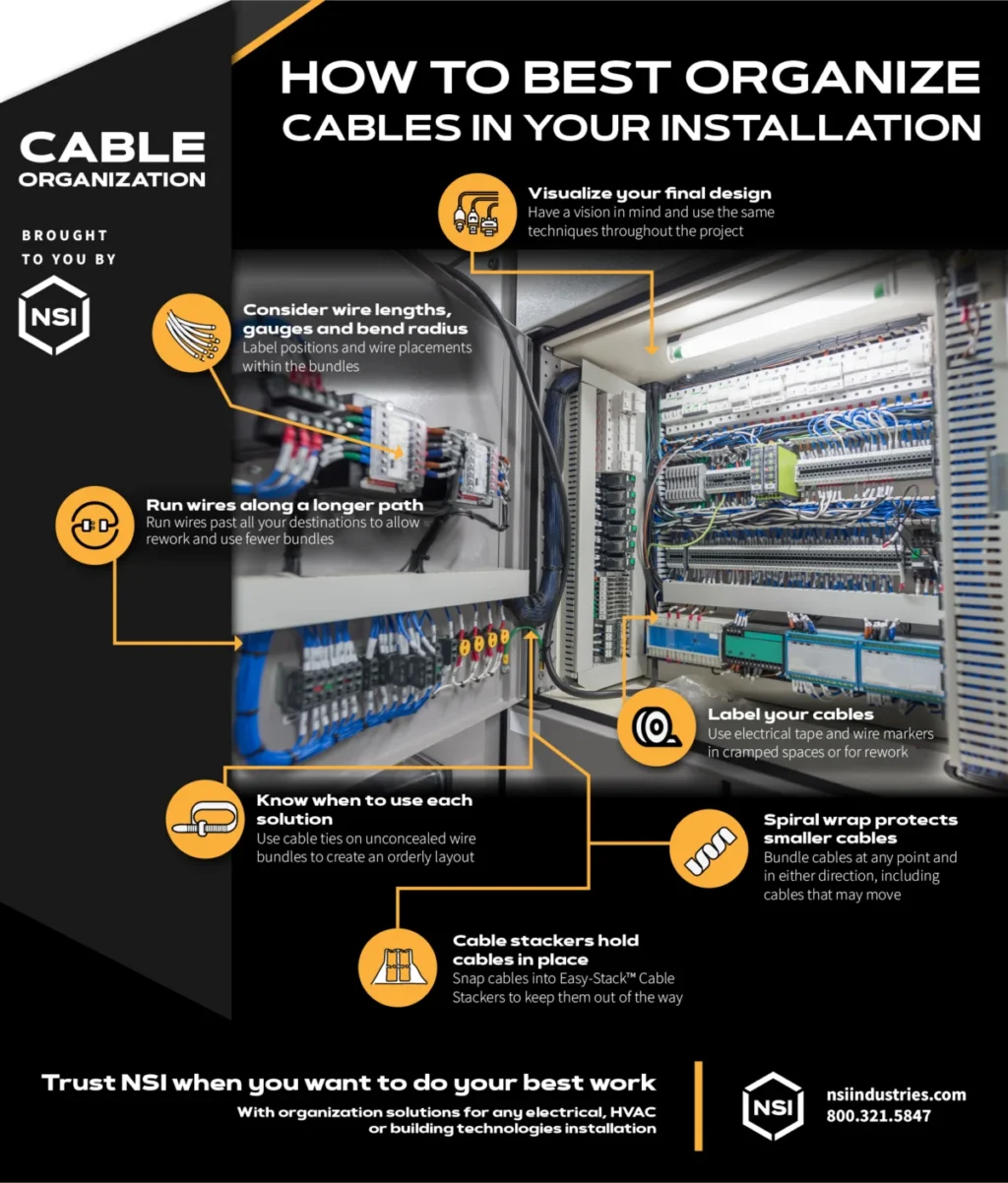
Begin by visualizing the final product. A haphazard approach to cable routing usually results in a haphazard result. Establish a "design language" for your project: define how you will route cables, where you will place your bundles, and how you will label them. Consistency is key. If you begin a project with one routing technique and abandon it halfway through, the final installation will lack the professional cohesion that clients demand.
Bend Radius and Gauge Considerations
Planning should always account for the physical limits of the wire. Every cable has a specific bend radius; forcing it beyond this limit risks damaging the internal structure of the conductor. Additionally, when planning your routes, always consider the gauge of the wire. Heavier gauge cables require different support systems than low-voltage data cables. Integrating these considerations into your initial planning prevents rework and ensures long-term system stability.
The "Long-Path" Strategy
It is often tempting to take the shortest route between two points. While this saves on wire length, it is frequently a strategic error. By opting for a slightly longer path, you gain the ability to rework the connection in the future. Should a terminal end become damaged or a component need to be replaced, having a little extra "slack" or "service loop" allows you to trim and re-terminate without having to pull entirely new wire. Furthermore, planning longer routes that follow established paths creates fewer, more organized bundles rather than a web of individual wires crossing each other.
Technical Application: Selecting the Right Solution
Knowing when to use specific management solutions is a skill that distinguishes the expert from the apprentice.
Cable Ties vs. Mounts
Cable ties are the workhorses of the industry, but their effectiveness depends on their application. For bundles that remain exposed, ties should be spaced at uniform intervals. Over-tightening, however, is a common pitfall that can crush the cable jacket. When using mounts, ensure the mounting surface is clean to guarantee that the weight of the bundle doesn’t cause the mount to fail over time.
The Versatility of Spiral Wrap
Spiral wrap is the preferred choice for areas where cables need to remain flexible. Because the wrap is cut in a spiral pattern, it allows for individual cables to be pulled out at any point along the run. This is particularly useful in HVAC control panels or server racks where the number of wires in a bundle may decrease as you move away from the primary distribution point.
The Role of Labeling
"Guesswork" is the enemy of the electrician. Electrical tape, color-coding, and dedicated wire markers should be utilized at every termination point and junction box. In large-scale industrial projects, a clear labeling scheme—backed by a comprehensive "as-built" drawing—is the difference between a successful maintenance cycle and a system-wide failure.
Implications for the Future of Building Technology
As we move further into an era of "smart" buildings, the density of cabling is increasing exponentially. We are no longer just running power; we are running data, automation controls, and low-voltage sensing lines alongside traditional electrical circuits. This increased complexity makes the need for rigorous cable management more critical than ever.
Regulatory and Insurance Impacts
Insurance companies and building inspectors are becoming increasingly stringent regarding electrical installations. Poorly managed, cluttered, or heat-trapping wire bundles are now more likely to be flagged as code violations. By utilizing high-quality management solutions, contractors can ensure that their work not only meets but exceeds local and national building codes, protecting themselves from liability and ensuring a smooth inspection process.
The Sustainability Factor
Professional cable management is also a sustainability issue. Installations that are easy to maintain last longer. When a system is modular and organized, individual components can be upgraded or replaced without replacing the entire infrastructure. This reduces material waste and extends the lifecycle of the building’s electrical systems.
Conclusion: Trusting the Best for Your Reputation
Ultimately, an organized workspace is a reflection of the installer’s professional identity. It is a visual promise to the client that the work was done correctly, safely, and with an eye toward the future. When you choose to invest in high-quality cable management solutions, you are investing in the longevity of your work and the strength of your professional reputation.
NSI Industries continues to support the industry by providing the tools that make this level of excellence achievable. Whether you are dealing with the rigors of an industrial facility or the precise requirements of a custom residential build, the right organization strategy is waiting to be implemented. By adopting these best practices, you ensure that your work stands the test of time—not just as a functioning electrical system, but as a standard-bearer for quality in the industry.
When you are ready to perform at the highest level, remember that the smallest details often have the largest impact. Keep it organized, keep it professional, and keep it safe. For all your cable management needs, NSI remains your partner in precision.