

By Barry Elliott, Director, Capitoline Ltd
The architecture of the modern data center is undergoing its most radical transformation since the dawn of the cloud computing era. As we witness the rapid proliferation of Artificial Intelligence High Performance Computing (AI HPC) models—exemplified by NVIDIA’s GB200/300 NVL72 architectures—the industry is moving away from the traditional concept of "servers in racks" toward the reality of "data centers in cabinets." This shift presents a fundamental challenge to established resilience standards, specifically the ANSI/TIA-942 model, which has served as the bedrock of data center reliability for two decades.
Main Facts: The Transition to High-Density Compute
For the past twenty years, the data center industry has operated on a relatively stable baseline. Air-cooled racks, typically supporting 5 kW to 15 kW, have been the standard. These environments were designed to comply with ANSI/TIA-942, which utilizes four distinct availability ratings to ensure uptime through redundant power, cooling, and structured cabling.
However, the rise of AI HPC "superpods" has shattered these assumptions. We are no longer dealing with modular, discrete servers. Instead, we are looking at massive, tightly coupled GPU clusters that demand 132 kW per rack today, with industry roadmaps pointing toward 1 MW per rack in the near future. This jump in power and heat density renders traditional air cooling obsolete and necessitates a complete re-evaluation of how we define "resilience" in the age of AI.
Chronology: From Air-Cooled Racks to Liquid-Cooled Superpods
The evolution of data center design can be viewed through a chronological lens of cooling and power progression:
- 2000s – Early 2010s: The era of air-cooled, low-density racks. Data centers were built around raised floors and CRAC (Computer Room Air Conditioning) units. Reliability was managed through N+1 or 2N power and cooling redundancy.
- Mid-2010s: The emergence of immersion cooling techniques. While effective for niche HPC applications, widespread adoption remained limited due to operational complexity.
- 2020 – 2024: The "GPU Explosion." The massive compute requirements of Large Language Models (LLMs) necessitated a shift toward GPU-centric architecture. We saw the rise of the "Superpod" concept, where thousands of GPUs are interconnected via ultra-high-speed networks.
- 2025 and Beyond: The current transition toward Direct Liquid Cooling (DLC). As power densities reach 132 kW and beyond, chipmakers have taken the lead in engineering cooling directly into the silicon, signaling a shift where the "data center" must now be designed around the requirements of the individual compute unit.
Supporting Data: The Physics of High-Performance Infrastructure
The Power Challenge
The transition to 132 kW and potentially 1 MW per rack forces a rethink of power delivery. Current systems often utilize a 48V DC distribution bus within the rack to feed compute units. However, as we scale toward 1 MW, the current required would necessitate prohibitively large copper conductors, leading to massive $I^2R$ (resistive) power losses.
To mitigate this, NVIDIA and other industry leaders are proposing a shift to 800V DC distribution. By increasing the voltage, we drastically reduce the current, allowing for smaller cabling and significantly improved efficiency. Yet, this introduces a new dilemma: how do we maintain the "concurrently maintainable" philosophy of a Tier 3 or 4 data center when the rack itself is essentially a singular, monolithic computer?
The Cooling Constraint
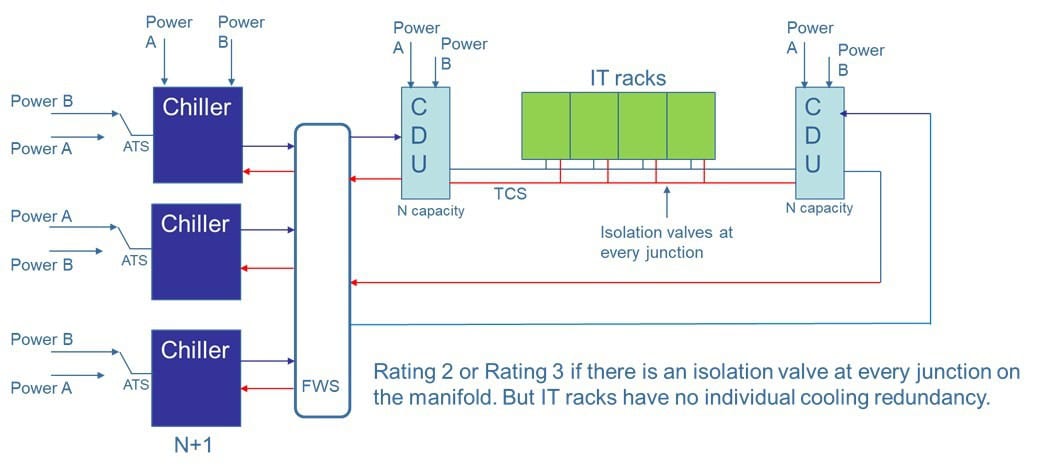
Cooling at these densities is no longer about moving air; it is about managing fluid dynamics at the chip level. Direct Liquid Cooling (DLC) is now the industry standard for high-density AI clusters. A single manifold at the rear of the rack feeds water to multiple chips.
The concern here is the lack of redundancy. A failure in the manifold or the cooling loop can effectively take down the entire rack. Furthermore, because these channels are microscopic, water purity is paramount. Some manufacturers recommend filter changes every 1,000 hours—or approximately every 42 days. In a traditional data center, such frequent, planned downtime would be considered an operational failure; in the AI HPC world, it is currently accepted as a technical necessity.
The Cabling Conundrum
Traditional structured cabling, as outlined in TIA-942, focuses on patch panels and redundant routing to ensure connectivity. In an AI HPC superpod, this model breaks down. We are seeing thousands of direct-attached copper or optical cables, often 3 to 7 meters in length, using InfiniBand or Ultra-Ethernet to interlink hundreds of nodes. A twelve-rack deployment can contain upwards of 130,000 individual cable links. Physical redundancy in this environment is a spatial impossibility. Instead, the industry is shifting toward logical redundancy, where networking protocols reroute traffic around failed nodes.
Implications: Reconciling AI with ANSI/TIA-942
The core issue is that AI HPC infrastructure is currently being deployed in a way that ignores the ANSI/TIA-942 resilience model. The standard was designed for discrete equipment, not for the "monolithic computer" architecture of a GPU pod.
The "Single Computer" Hypothesis
We propose that the industry should treat AI compute racks not as "racks" in the traditional sense, but as single, integrated computers. This change in perspective allows us to apply the TIA-942 standard at the pod level rather than the rack level.
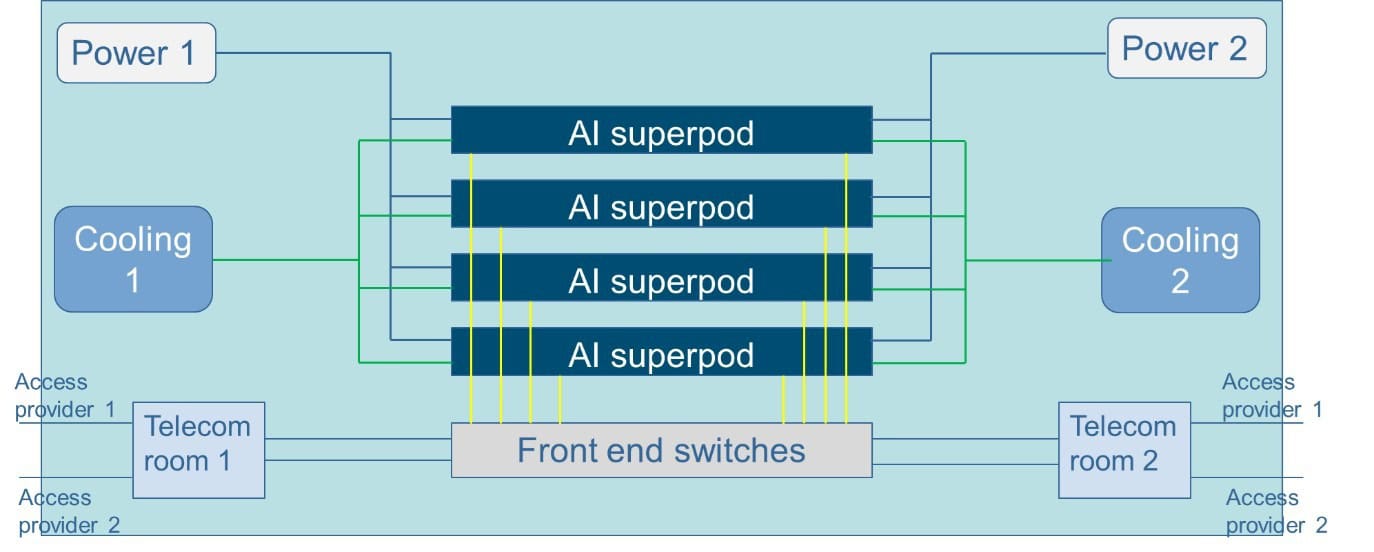
By ensuring that the facility-wide infrastructure—the power feeds, the cooling distribution units (CDUs), and the front-end network cabling—adheres to Tier 3 or 4 requirements, we can provide the necessary foundation for AI pods. While the internal architecture of the pod may remain "non-redundant" due to physical and technical constraints, the surrounding "wrapper" of the facility can provide the requisite resilience.
Official Responses and Future Directions
The TIA (Telecommunications Industry Association) is acutely aware of these challenges. Through the TR-42 committee, which oversees the ANSI/TIA-942 standard, efforts are underway to address the AI HPC gap.
The goal is to draft new guidelines that specifically address the unique requirements of high-density AI clusters. This includes:
- Defining "Facility" Resilience: Standardizing how redundant cooling (using multiple CDUs and isolated loops) can be integrated into high-density environments.
- Addressing Maintenance Cycles: Developing protocols that allow for the "planned downtime" required for filter changes or chip maintenance without violating the spirit of high-availability ratings.
- Logical vs. Physical Redundancy: Establishing a framework where logical network resilience is recognized as a valid component of the overall availability model.
Working with the Committee
The Capitoline team is actively participating in this workgroup. We believe that the data center industry must move toward a hybrid approach. We cannot force AI HPC to fit the old, air-cooled, patch-panel-centric model of 2005. Conversely, we cannot allow the industry to abandon the rigor of resilience standards in the name of raw performance.
By defining clear "zones of responsibility"—where the facility provides the high-availability foundation and the pod provides the high-density compute—we can create a sustainable path forward.
Conclusion: A New Standard for a New Era
The shift to AI HPC is not merely a change in hardware; it is a fundamental shift in the definition of a data center. As we move toward 1 MW per rack, the lines between IT equipment and facilities infrastructure will continue to blur.
For data center operators, the takeaway is clear: the future belongs to those who can harmonize the extreme requirements of AI hardware with the proven, time-tested resilience models of TIA-942. We are at a crossroads where infrastructure engineering must catch up with silicon innovation. By working together through standards bodies like the TIA, we can ensure that the next generation of AI-ready data centers is as reliable as it is powerful.
Resources and Further Engagement
For professionals seeking to master these new challenges, Capitoline offers a suite of training and certification programs.
- Masterclass Courses: For detailed insights into TIA-942 and its application in modern environments, visit Capitoline Training.
- Standard Certification: To learn more about getting your facility certified under the latest TIA standards, visit TIA Online.
- Get Involved: We encourage all stakeholders in the data center ecosystem to join the TIA TR-42 committee. Your participation is essential to shaping the standards that will govern the next decade of infrastructure design. Contact [email protected] to participate in the Data Center Program Workgroup.
Disclaimer: The ideas and views expressed in this article are those of the author and do not necessarily reflect those of TIA or its member companies.