





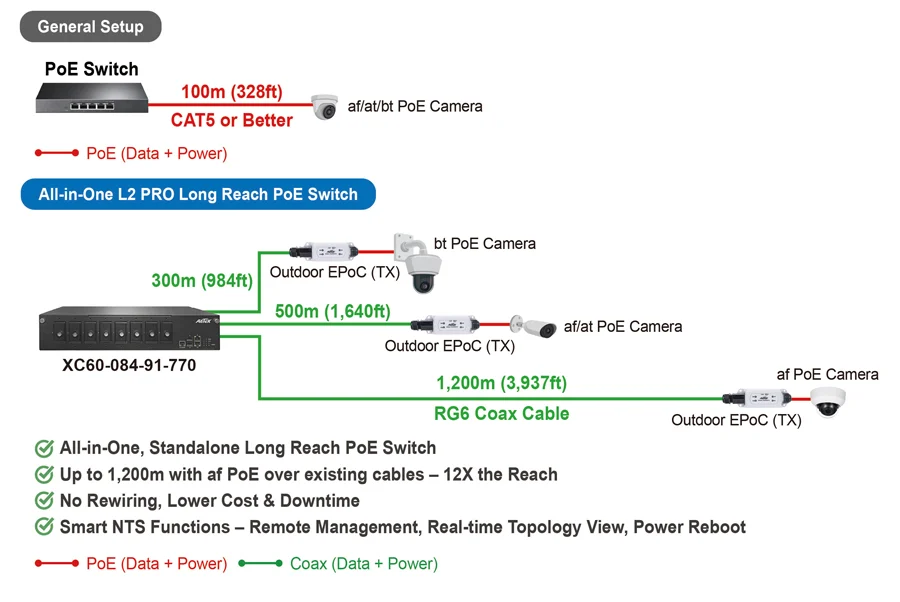
The rapid ascent of Artificial Intelligence (AI) is fundamentally altering the architecture of modern enterprise networks. As organizations shift from centralized data centers to edge-based intelligence, the demand for higher bandwidth, robust power delivery, and ultra-reliable connectivity has reached a critical inflection point. However, a significant barrier remains for many industries: the reliance on aging, legacy coaxial infrastructure. For sectors such as transportation, manufacturing, and large-scale security, the cost and disruption of replacing miles of legacy cabling with fiber optics are often prohibitive.
Enter Ethernet and Power over Coax (EPoC) technology. By allowing organizations to repurpose existing 75-ohm coaxial cabling to transmit high-speed digital data and significant electrical power, EPoC is emerging as the bridge between the analog past and the AI-driven future. The Versa Technology XC60-084-91-770 managed RX switch represents the vanguard of this transition, offering a scalable, cost-effective pathway to modernization.
The Chronology of Network Evolution: From Analog to Edge AI
To understand the necessity of EPoC, one must trace the evolution of the modern facility. Two decades ago, coaxial cable was the gold standard for video surveillance and basic connectivity. As the world moved toward the Internet Protocol (IP) era, Ethernet (Cat5/6) became the standard, requiring a massive "rip-and-replace" effort that many older facilities simply deferred.
Today, the AI revolution is creating a third, even more demanding phase. Unlike traditional IP cameras, AI-enabled edge devices—such as multi-sensor panoramic cameras and localized inference engines—require significantly more power and data throughput.

- The Legacy Era: Reliance on analog cameras and DVR systems connected via coaxial cable.
- The IP Transition: The move toward digital cameras and centralized servers, often constrained by the 100-meter limitation of standard copper Ethernet.
- The AI-Edge Era: The current state, where localized data processing requires "always-on" high-speed connectivity and PoE++ power levels, often exceeding the capabilities of existing infrastructure.
Organizations currently find themselves caught in this third phase, needing to upgrade their "eyes and ears" to support AI analytics without the massive capital expenditure required to tear open walls and ceilings to install new fiber or Cat6 cabling.
Supporting Data: Why AI Demands More
The technical requirements for AI-enabled surveillance and sensor arrays are substantially higher than those of legacy systems. An AI-ready network must handle:
- Extended Distance: Standard Ethernet is strictly limited to 100 meters. Many industrial sites, parking garages, and campus environments require runs of 300 to 1,000 meters.
- High-Density Power: Modern AI edge devices often require up to 90W of power (PoE++). Legacy systems, if they provide power at all, rarely support the 802.3bt standard.
- Bandwidth Stability: AI inference engines at the edge perform continuous, high-speed data transfers. Fluctuations or packet loss can lead to inaccurate AI detection and missed events.
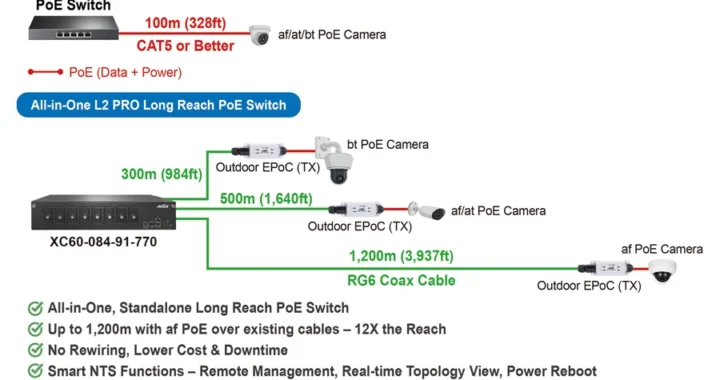
Versa Technology’s XC60-084-91-770 addresses these metrics head-on. By utilizing the heavy shielding and copper core of RG59 or RG6 coaxial cable, the switch can transmit data and power over distances up to 1,200 meters (3,937 ft.). This effectively expands the reach of the network by 12 times compared to standard copper-based switches.
EPoC Technology: The Technical Foundation
EPoC (Ethernet and Power over Coax) functions by modulating Ethernet signals onto the existing coaxial medium. The XC60-084-91-770 acts as the central hub, managing eight 75-ohm BNC ports.

The switch is engineered with:
- High PoE Budget: A total power budget of 720W, with up to 90W per individual port.
- Flexible Uplinks: Two Gigabit Ethernet (GbE) ports and two Small Form-factor Pluggable (SFP) ports, allowing for seamless integration into high-speed fiber backbones.
- Topology Versatility: Support for daisy-chain, peer-to-peer, and ring topologies, which provides engineers with the flexibility to design networks that conform to the physical layout of the building rather than forcing the building to conform to the network.
Official Perspectives: The Value of "Infrastructure Extension"
Industry experts and network architects have increasingly advocated for "infrastructure extension" rather than "infrastructure replacement."
"The goal for the modern enterprise should be total modernization with minimal disruption," says the product engineering team at Versa Technology. "When you look at the total cost of ownership (TCO) for a large-scale AI deployment, the cabling is often the largest hidden cost. By utilizing EPoC, we shift the budget from labor and material destruction to high-end AI processing power."
This strategy of "phased migration" is a key implementation best practice. Organizations do not need to upgrade the entire facility at once. By placing an EPoC switch in a server closet, IT managers can upgrade critical perimeter security or high-traffic zones first, while legacy equipment continues to operate on the same, or adjacent, coaxial lines without interference.

Implications for Future-Proofing
The implications of adopting EPoC-based architectures are profound, impacting both the bottom line and operational capabilities.
1. Operational Sustainability
Sustainability is no longer just a buzzword; it is a corporate mandate. Replacing thousands of feet of cable generates significant construction waste. Reusing existing infrastructure reduces the carbon footprint of a digital transformation project significantly. Furthermore, the intelligent power management features of the XC60-084-91-770 ensure that power is only allocated to active nodes, reducing wasted electricity compared to older, "always-on" power injectors.
2. Enhanced Network Resilience
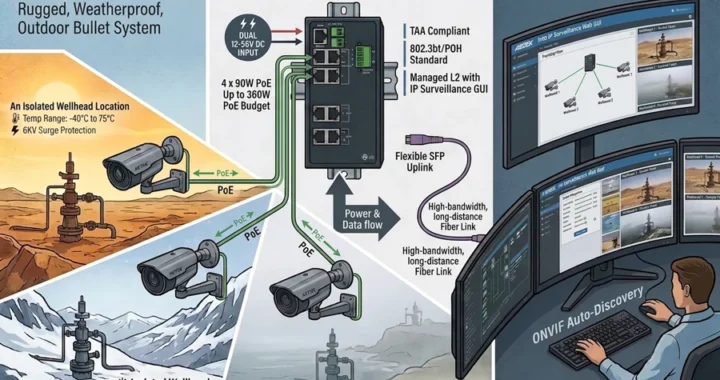
AI workloads require high availability. Through Network Topology Systems (NTS), the XC60 switch provides administrators with granular control. Features like auto-discovery via ONVIF and real-time cable diagnostics mean that if a fault occurs, the system can pinpoint the location, reducing Mean Time to Repair (MTTR). This level of insight is critical when AI models rely on a continuous, uninterrupted stream of data.
3. Scalability
As AI models evolve, the density of edge devices will likely increase. An EPoC-managed system allows for a "plug-and-play" growth strategy. Because the cabling is already in place, adding a new AI-enabled thermal camera or a motion-tracking sensor is as simple as connecting the device to the EPoC transmitter. This agility allows organizations to adapt to security threats or operational changes in days rather than months.

Best Practices for Implementation
For organizations considering an EPoC upgrade, the following roadmap is recommended:
- Physical Audit: Conduct a thorough sweep of the existing coaxial runs. Verify the condition of the cable; while RG59/RG6 is standard, ensuring the integrity of connectors and shielding is vital for high-power (90W) delivery.
- Mapping Power Demands: Calculate the peak power consumption of the planned AI edge devices. The XC60’s 720W budget is substantial, but proper planning ensures optimal performance across all eight ports.
- Topology Planning: Determine if the site benefits from a daisy-chain approach (ideal for long corridors or tunnels) or a star topology (ideal for centralized monitoring rooms).
- Integration Testing: Utilize the XC60’s management interface to monitor signal-to-noise ratios during the initial rollout to ensure that the legacy cable is performing within the necessary tolerances for high-speed Ethernet data.
Conclusion: The Partner for an AI-Ready Future
The transition to AI is an inevitability, but the path to getting there is a choice. Organizations that choose the "rip-and-replace" route face significant budgetary risks and operational downtime. Those who leverage EPoC technology choose a path of efficiency, sustainability, and rapid deployment.
The Versa Technology XC60-084-91-770 EPoC switch serves as the backbone for this transition, offering the necessary power, distance, and management features to turn legacy coax into a high-performance engine for AI. By bridging the gap between yesterday’s infrastructure and tomorrow’s intelligence, Versa Technology empowers organizations to stay ahead of the curve without breaking their existing foundations.
For those ready to modernize their facilities and tap into the potential of edge AI, the next step is clear: evaluate the existing infrastructure, identify the high-priority zones for AI, and implement a solution that turns legacy copper into a competitive advantage. To learn more about how EPoC can catalyze your AI transition, contact the experts at Versa Technology for a custom network assessment or a product demonstration.