




In the modern retail landscape, the physical store is undergoing a profound metamorphosis. While e-commerce continues to capture a significant share of global consumer spending, the brick-and-mortar storefront remains the heartbeat of the customer experience. Today’s consumers are not looking for a binary choice between online and offline shopping; they are demanding a seamless integration of both. They crave the tactile experience of seeing and touching products, the immediate gratification of a direct purchase, and the social engagement that only a physical space can provide.
However, this "Storefront of the Future" relies on a complex, invisible foundation: a robust, high-bandwidth, and intelligent network infrastructure. As retailers integrate everything from self-service kiosks and digital signage to advanced loss-prevention sensors and real-time inventory tracking, the demand for reliable power and data connectivity has never been higher. Power over Ethernet (PoE) has emerged as the linchpin technology enabling this transition, providing a scalable, efficient, and cost-effective method to power the connected retail ecosystem.
Main Facts: The PoE Advantage
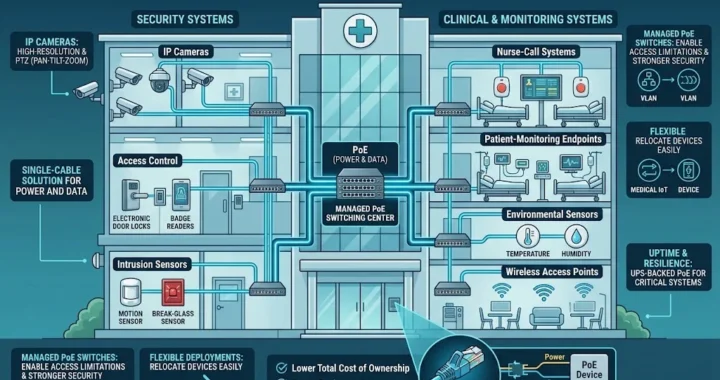
At its core, Power over Ethernet (PoE) is a technology that allows network cables to carry both electrical power and data simultaneously. By utilizing existing Ethernet cabling, retailers can eliminate the need for cumbersome, localized electrical wiring for every individual device.
The Technical Evolution
The leap from standard networking to high-wattage PoE (specifically the IEEE 802.3bt standard) has been transformative. Modern PoE switches can now deliver up to 90 watts of power to a single endpoint. This capability allows for the deployment of power-hungry devices—such as sophisticated Pan-Tilt-Zoom (PTZ) security cameras, digital kiosks, and integrated Point-of-Sale (POS) systems—without the need for an electrician to install new outlets at every location.
Key Benefits for Retailers
- Reduced Installation Costs: By eliminating the need for AC power drops, retailers significantly cut labor and material costs during store fit-outs.
- Operational Flexibility: As store layouts change to accommodate seasonal promotions or shifts in traffic flow, PoE devices can be relocated with minimal effort.
- Centralized Management: Because devices are powered and connected via the network switch, IT teams can monitor, reboot, or update firmware remotely, reducing the need for on-site maintenance.
Chronology: The Transformation of Retail Infrastructure
The evolution of retail technology has moved in distinct phases, each defined by the increasing demand for connectivity.

- Phase 1: The Analog Era (Pre-2010): Retail environments relied on standalone power and disconnected legacy systems. Security cameras were analog, and inventory was tracked manually.
- Phase 2: The Digital Integration (2010–2018): The rise of Wi-Fi and basic POS integration began. Retailers started connecting devices to central servers, though power requirements were still mostly handled by traditional electrical grids.
- Phase 3: The PoE Revolution (2018–Present): The introduction of high-wattage PoE (802.3bt) allowed for the "Smart Store" concept. This era saw the proliferation of IoT sensors, high-definition security, and interactive kiosks that serve as both sales associates and data collectors.
- Phase 4: The Intelligent Future (Future-Facing): The industry is moving toward AI-driven environments where edge computing, environmental sensing, and automated loss prevention operate on a unified, resilient PoE backbone.
Supporting Data: The Case for Efficiency
The pressure on retailers to modernize is driven by tight margins and changing consumer behavior.
Profitability and Market Realities
- Retail Warehouses: With profit margins often hovering below 3%, every operational efficiency counts. Large-format stores, averaging 146,000 square feet, face massive logistical challenges. PoE-enabled smart shelving and environmental sensors ensure that temperature-sensitive products are protected, preventing inventory loss that would otherwise erode already thin margins.
- Grocery Store Security: According to industry reports, nearly 38% of shoppers have witnessed a crime in a grocery setting, and over 70% of those consumers report avoiding stores where they feel unsafe. By leveraging PoE for high-density security surveillance and license plate recognition, retailers are creating "safe zones" that protect both assets and customer loyalty.
- Convenience Store Risks: Data from the FBI suggests that 15% of all robberies occur in 24-hour convenience stores and gas stations. Implementing rapid-response PoE security systems acts as a critical deterrent, providing real-time data to law enforcement and staff.
Official Perspectives and Industry Implications
Industry experts and infrastructure providers, such as the team at Versa Technology, emphasize that "future-proofing" is no longer an optional strategy—it is a survival requirement.
"The retail environment is no longer static," says a representative from Versa Technology. "When a store shifts its layout to highlight a holiday display, the cameras and sensors must move with it. If that move requires an electrician, the retailer loses money and time. If it’s a PoE-based system, the move is a simple plug-and-play operation."
Strategic Implications
- Resiliency Through UPS: By connecting industrial-grade PoE switches to an Uninterruptible Power Supply (UPS), retailers can ensure that security cameras and POS systems remain operational even during a grid failure. This prevents "blind spots" during power outages—a common target for retail theft.
- Scalability: As retailers explore AI-driven customer analytics, the network must handle massive data throughput. Industrial switches designed for high-heat and high-surge environments provide the hardware reliability needed for 24/7 operations.
- Customer Satisfaction: The data is clear: shoppers want speed. Whether it is an employee with a tablet checking stock levels or a self-checkout terminal functioning without a glitch, PoE ensures that the "digital friction" is removed from the shopping journey.
Future-Proofing: Building for the Next Decade
As we look toward the future, the integration of 5G, AI, and edge computing will require even greater density of connected devices. The storefront of the future will be a "sensing store"—a place that knows how many people have entered, where they are browsing, which products they pick up, and whether they need assistance.
The Role of Industrial-Grade PoE
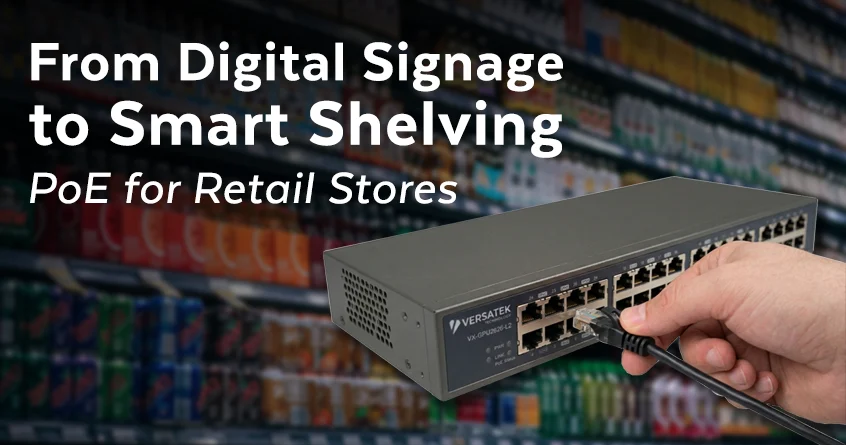
Retailers must move away from consumer-grade networking equipment. Industrial-grade managed switches, like the Versa Technology D60-044 series, are built to handle the environmental stressors of retail—dust, fluctuating temperatures, and the constant power surges inherent in large-scale commercial facilities.

These switches support fiber uplinks and high-wattage power delivery, ensuring that even as new, more sophisticated devices enter the market, the underlying infrastructure remains relevant. By investing in a high-performance PoE backbone today, retailers are not just buying cables and switches; they are investing in the agility to adapt to the next decade of retail disruption.
Final Assessment
The retail industry is currently at a crossroads. The stores that thrive will be those that view their physical space as an extension of their digital strategy. By leveraging the power of PoE, retailers can create an environment that is secure, data-rich, and remarkably flexible.
For those looking to secure their future, the path is clear: build a network that is as smart as the customers who walk through the doors. The technology is here, the standards are set, and the ROI is proven. The only remaining question is how quickly retailers will move to bridge the gap between the traditional storefront and the intelligent retail hub of the future.
For more information on designing a scalable, high-performance retail network, retailers are encouraged to explore advanced industrial connectivity solutions that prioritize both physical security and digital efficiency. The storefront of tomorrow is being built today—one cable at a time.