



By Annemarie Mannion, ENR Midwest Editor
The construction industry is once again grappling with the stark realities of work-zone hazards following a devastating incident on July 28 in Saline County, Kansas. A routine infrastructure improvement project turned fatal when a pickup truck veered off Interstate 135, careening through a safety barrier and striking five construction workers. The accident has left one man dead, two others critically injured, and the broader engineering and construction community searching for answers regarding safety protocols in high-traffic corridors.
The incident, which occurred just south of Salina, has prompted a multi-agency investigation led by the Kansas Highway Patrol (KHP). As officials piece together the mechanical and human factors that led to the tragedy, the event serves as a grim reminder of the persistent dangers facing those who maintain the nation’s transportation infrastructure.
The Incident: A Routine Morning Turns Fatal
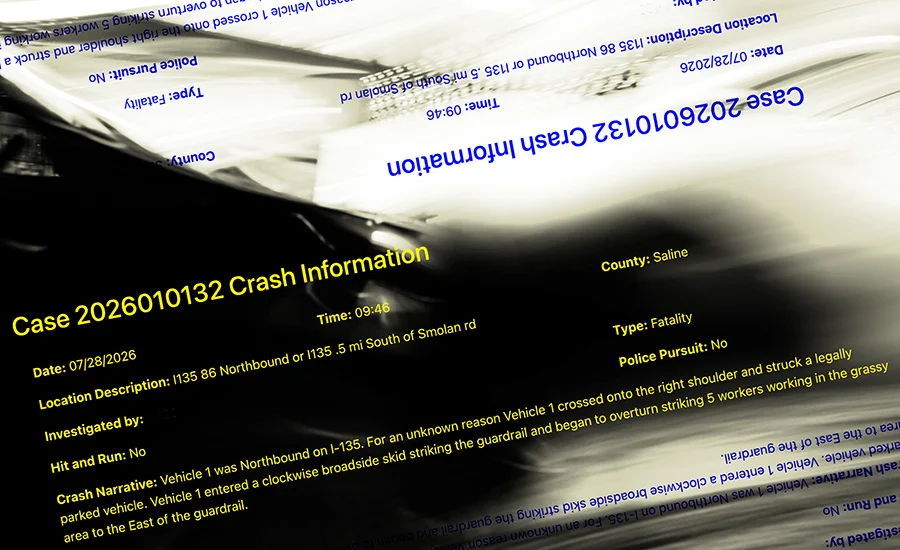
At approximately 9:46 a.m. on July 28, a 2000 Dodge Ram 3500 was traveling northbound on I-135. For reasons that remain under investigation by the Kansas Highway Patrol, the vehicle drifted from the main thoroughfare, exiting the roadway and onto the right shoulder.
According to preliminary reports from the Kansas Dept. of Transportation (KDOT), the truck struck a legally parked work vehicle before skidding into a guardrail. The impact caused the truck to overturn, launching it into the grassy area behind the guardrail—a space that, under typical circumstances, should have provided a buffer zone for the crew. Tragically, five workers were situated in that precise location at the moment of impact.
Toby Marco, a 55-year-old resident of Abilene, Kansas, and an employee of the Chicago-based engineering and construction firm Lochner, was pronounced dead at the scene. Of the four other injured workers, two were transported to Wichita-area hospitals in critical condition, while two others sustained non-life-threatening injuries. The driver of the Dodge Ram also sustained non-life-threatening injuries.
The identities of the other workers remain largely shielded from public disclosure, though it has been confirmed that at least one of the injured is an employee of the Wichita-based firm Atlas Electric. The employment status of the remaining personnel is still being clarified by authorities.
Context of the Work: "Routine" Maintenance
The site of the accident was part of a $2 million project focused on upgrading light fixtures and poles at the I-135 interchanges near Mentor Road. Catherine Magana, a spokesperson for KDOT, described the work as a standard, relatively small-scale infrastructure maintenance task.
"The contractor was drilling to install new footing on the right-of-way when they realized there appeared to be an existing footing already in place," Magana explained. "The five were investigating it, and they were behind the guard fence when they were struck."
The positioning of the workers behind a guardrail is a standard safety precaution designed to protect personnel from errant vehicles. The fact that the truck was able to clear the guardrail and penetrate this secondary safety zone highlights the unpredictable nature of work-zone collisions, where high-speed, heavy vehicles can defeat standard passive protective measures.
Chronology of the Response
The aftermath of the crash saw a rapid deployment of emergency services to the Saline County site. Following the initial collision, KHP troopers secured the scene to allow for medical transport and forensic analysis.
- 9:46 a.m.: The Dodge Ram 3500 exits the roadway and strikes the construction crew.
- Morning/Afternoon: Emergency responders arrive; medical helicopters and ground ambulances transport victims to Wichita-area trauma centers.
- Late July 28: KDOT confirms the fatality and the nature of the project.
- July 29 and Beyond: The Kansas Highway Patrol launches a comprehensive crash reconstruction investigation. Lochner and other affected firms begin internal reviews and employee support protocols.
Industry Response and Corporate Statements
The impact of the tragedy has reverberated through the professional construction community. Atlas Electric, while acknowledging the incident, has declined to provide further comment as the investigation remains active.
Lochner, a major player in the transportation infrastructure sector, issued a somber statement expressing its commitment to its staff. "Our thoughts are with our colleague’s family, friends, and coworkers during this difficult time. We are providing support to those affected by this tragic loss," the company stated. The firm confirmed that it is cooperating fully with the KHP investigation and conducting its own internal inquiry to understand how such a breach of the work zone occurred.

The tragedy underscores the delicate balance between the necessity of infrastructure repair and the physical vulnerability of the workers tasked with performing it.
Supporting Data: The Rising Tide of Work-Zone Danger
The Saline County crash is not an isolated event but rather part of a documented, concerning trend in the construction sector. The Associated General Contractors (AGC) of America has long sounded the alarm regarding the safety of workers on active roadways.
According to the AGC’s most recent annual Highway Work Zone Safety Survey, the risks are pervasive. The survey found that:
- 60% of highway contractors reported at least one crash involving a moving vehicle in an active work zone within the last year.
- Nearly one-third of contractors reported five or more such crashes during the same period.
These statistics represent more than just numbers; they reflect a high-stakes environment where human error, distraction, and vehicle failure frequently intersect with human labor. The industry is currently lobbying for more stringent safety measures to be included in federal and state transportation bills, advocating for increased enforcement of "move over" laws, better lighting, and more robust physical barriers.
The incident in Kansas draws inevitable comparisons to the 2023 catastrophe in Baltimore, where six construction workers were killed when an out-of-control vehicle careened into a work zone on the I-695 Beltway. Such events serve as catalysts for renewed debates regarding the adequacy of current safety standards.
Implications for Future Construction Practices
As the investigation into the Saline County crash continues, several critical questions remain for the construction and transportation sectors:
1. The Efficacy of Passive Barriers
Current safety protocols rely heavily on traffic cones, signage, and existing guardrails. However, as demonstrated by the Saline County incident, these measures are often insufficient when a heavy vehicle leaves the road at highway speeds. Engineering firms are increasingly looking into the use of heavy-duty, crash-rated temporary barriers (such as water-filled or concrete barriers) even for smaller, "routine" projects.
2. The Human Element of Driving
The KHP investigation will focus on the driver of the Dodge Ram—specifically, whether alcohol, medical issues, or mobile phone distraction played a role. While the engineering community focuses on physical safety, the broader society faces the challenge of curbing reckless driving in work zones.
3. Training and "Zone Awareness"
The fact that the workers were investigating an existing footing suggests that even in a static work zone, workers must be constantly vigilant. The industry is placing greater emphasis on "situational awareness" training, teaching workers to maintain a constant line-of-sight toward oncoming traffic, even when protected by barriers.
4. Regulatory Changes
The recurring nature of these accidents is likely to spur legislative action. There is growing support for "Work Zone Safety Acts" that would mandate higher penalties for speeding or distracted driving in designated construction zones and potentially increase funding for automated speed enforcement cameras.
Conclusion: A Community in Mourning
The loss of Toby Marco is a tragedy that extends beyond the immediate workplace. For the workers who survived and the families of those affected, the incident marks the beginning of a long process of recovery and grieving.
As the construction industry continues to modernize, the human cost remains the most significant metric of success. The Saline County accident serves as a haunting reminder that for every mile of interstate paved or every light pole replaced, there is a person—a colleague, a father, a friend—standing in the path of risk. Until the industry, government, and the driving public can find a way to reconcile the necessity of road work with the absolute requirement of worker safety, the shadow of the Saline County crash will loom large over every work zone in the nation.
The investigation by the Kansas Highway Patrol is expected to continue for several weeks. ENR will continue to provide updates as more information regarding the cause of the accident and the status of the injured workers becomes available.