






The Unfolding Crisis at the Roof of the World
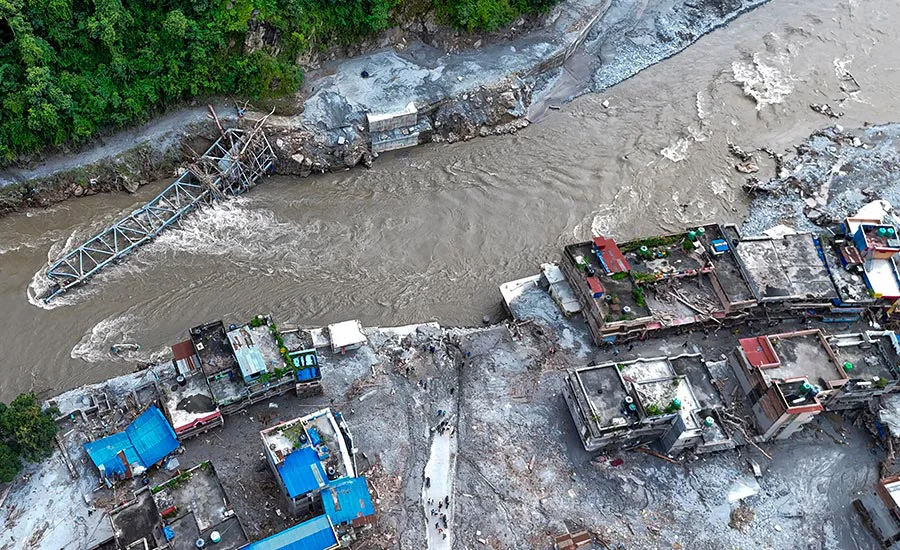
In a harrowing display of the volatility inherent to a warming planet, a catastrophic glacial collapse in the Himalayas has left a trail of death, displacement, and economic ruin across the border regions of Nepal and Tibet. On August 26, a massive 610-meter chunk of the Langtang-region glacier sheared off, triggering a devastating avalanche of ice, rock, and debris. This slurry roared down the Lende Khola and Trishuli Khola rivers, obliterating everything in its path, including vital infrastructure, hydroelectric projects, and human settlements.
As of August 31, the human cost of the disaster is staggering. Official figures from the Nepal Police report 903 confirmed deaths, with approximately 4,200 individuals still listed as missing. While the Chinese government has reported a more conservative death toll of 16 in Tibet, with 546 missing, international observers remain skeptical of these figures. The Red Cross of Nepal estimates that 90,000 people have been directly affected, and while rescue teams have successfully pulled more than 10,000 survivors from the mud and debris, the window for finding those trapped in underground caverns is closing rapidly.
Chronology of the Disaster
The timeline of the disaster underscores the terrifying speed with which such geological failures can overwhelm human defenses.
- August 26: A massive glacial collapse occurs in the Langtang region. Within minutes, a surge of debris travels over 100 meters downstream, inundating the Rasuwagadhi border post and multiple valleys.
- August 27: China’s Ministry of Water Resources issues a Level IV emergency alert. Water levels in a temporary barrier lake at the confluence of the Chhochen Khola and Purepu Tsangpo rivers reach 2 million cubic meters, threatening the Gyirong Port.
- August 28–29: Rescue efforts intensify. Satellite imagery reveals that the lower of two formed barrier lakes has drained, but a second, more precarious lake remains, continuing to pose a significant risk of a secondary flash flood should it breach.
- August 30–31: Expert rescue coordination begins, led by international consultants. The focus shifts to the grueling task of excavating survivors from the collapsed tunnels of partially constructed hydroelectric dams.
Supporting Data: Infrastructure and Economic Impact
The disaster has crippled the energy independence of the region. Hydroelectric power is the lifeblood of the local economy, and the floods have proven particularly lethal to these projects. According to Arnold Dix, an Australian tunneling expert and former president of the International Tunneling Association, 27 hydroelectric plants in Nepal have sustained damage, with 12 entirely destroyed.
The economic fallout is massive. In Tibet, the Gyirong Economic Zone, which has served as a center for trade and development since 2009, has seen the majority of its 39 infrastructure projects—including the critical Gyirong land port—rendered useless. The cost of damage in the Gyirong zone alone is estimated at $1.2 billion, while the total economic impact on Nepal is projected to exceed $2 billion.

Perhaps most distressing is the fate of workers at 12 under-construction hydroelectric dams. Reports suggest that up to 900 people may remain trapped in tunnels and underground structures. The rescue effort is described as a race against time in "nightmarish" conditions. Rescuers are forced to pump out dense, rock-laden glacial mud from narrow, unstable tunnels while attempting to restore oxygen lines for those who may have found pockets of air in the debris.
Official Responses and Rescue Logistics
The logistical challenge of managing the crisis is compounded by the severe degradation of communication infrastructure. Arnold Dix, coordinating the rescue from Melbourne, Australia, describes the situation as a series of "concurrent events" that are nearly impossible to manage with the current, fragmented data support.
"Anybody who was at the surface has been killed," Dix noted in an interview, highlighting the sheer force of the avalanche. "We are trying to identify locations where people might have survived [underground] and then trying to intervene to get them out."
The rescue operation is agonizingly slow. Because tunnels are packed with sediment, extraction often moves at a rate of only a few meters per hour, frequently requiring the construction of vertical shafts or the use of rope-based pulls in unstable environments.
The Scientific Consensus: Climate Change as a Catalyst
Geoscientists and glaciologists are unanimous in their assessment that this disaster was not a "black swan" event, but rather a predictable, if extreme, manifestation of climate change. Jakob Steiner, a fellow at the Asian Mountain Academic Alliance, explains that the Langtang-region glacier had been retreating rapidly since the 1990s.

"The glacier was vulnerable; it had been retreating over a rock nose, exposing the bedrock that failed due to freeze-thaw cycles," Steiner said.
Kristen Cook, a geomorphologist at the University of Grenoble Alpes, emphasizes that the event is linked to the long-term geological evolution of the mountain mass, triggered by glacial melt. This is corroborated by global data: according to Professor Jonathan Bamber of the University of Bristol, glacier melt rates in the Himalayas have increased by approximately 25% over the last decade. As permafrost thaws, the structural integrity of the mountains themselves is being compromised, making the slopes increasingly prone to catastrophic failure.
Implications: The Failure of Early Warning Systems
A recurring point of criticism among experts is the total lack of early warning systems. Nepal’s current disaster-mitigation architecture is designed to handle rainfall-driven floods, not the instantaneous and chaotic failure of a glacier. Because there were no sensors at the collapse point and no real-time data sharing from upstream regions in Tibet, the communities downstream had zero lead time.
The disaster has also sparked a debate over international development aid. Critics point to the recent withdrawal of U.S. Agency for International Development (USAID) funding, which had previously supported disaster risk reduction (DRR) projects in Nepal. Former USAID disaster relief leads have publicly linked the current vulnerability of the region to the cancellation of these programs, noting that thousands of lives were potentially left unprotected due to the cessation of climate-focused infrastructure monitoring.
Looking Forward: A Call for Rethinking Hydropower
As the immediate crisis subsides, the engineering community is beginning to sound the alarm on the viability of large-scale infrastructure in the high Himalayas. Quentin Shaw, a director at ARQ Consulting and vice president of the International Commission on Large Dams, described the destruction as "unprecedented."

Shaw and other experts argue that the industry must pivot its strategy. "I would suggest that hydropower schemes should perhaps be avoided on catchments with such enormous glacier volumes," Shaw said. The combination of precarious slope stability and the inherent danger of glacial outbursts suggests that the current model of industrial development in these high-altitude zones is fundamentally incompatible with the realities of a warming climate.
Steiner echoes this sentiment, warning that while events of this specific scale are rare, similar collapses are "inevitable" across India, Bhutan, China, and Nepal. For the communities living in the shadow of these peaks, the path forward is bleak. "Communities have little they can do apart from developing strategies to warn within their networks," Steiner said. "They must unite their voices to show the world that they are bearing the brunt of a global issue."
For now, the focus remains on the dark, mud-choked tunnels of the Himalayas, where thousands of families wait for news of their loved ones, and where the silence of the mountains serves as a somber reminder of the power of a changing climate.