








In the rapidly evolving landscape of modern network infrastructure, fiber optics serve as the backbone of global connectivity. Whether for high-speed internet, secure data transmission in sensitive government facilities, or robust audio/video distribution in commercial AV environments, the choice of cabling is foundational to system performance.
However, for many systems integrators and network engineers, a recurring dilemma persists: What is the fundamental difference between single mode and multimode fiber, and which should be specified for a given installation? While the general rule of thumb—that all pre-modem infrastructure must be single mode—remains a standard, the nuances of local area networks (LANs), security systems, and high-bandwidth A/V links require a deeper understanding of optical physics and cost-benefit analysis.
Main Facts: The Core of the Matter
At the heart of the fiber optic distinction lies the design of the optical core. Fiber optic cables function by transmitting light pulses through a glass core, protected by cladding and a protective buffer. The divergence between single mode and multimode is primarily a matter of physical dimensions and light propagation.
Single Mode Fiber (SMF) is engineered to propagate a single, focused mode of light. Because the core diameter is incredibly small—typically around 9µm—the light travels in a direct, straight path with minimal internal reflection. This precise delivery system virtually eliminates modal dispersion, allowing for significantly higher bandwidth and drastically longer transmission distances.

Multimode Fiber (MMF), by contrast, is designed to accommodate multiple simultaneous light modes. Modern multimode cables feature a 50µm core, while legacy systems (OM1) utilized a 62.5µm core. Because the core is larger, light bounces off the cladding as it travels, creating what is known as modal dispersion. While this makes the cable easier to manufacture and align with lower-cost, light-emitting diode (LED) electronics, it limits the distance and bandwidth potential compared to its single mode counterpart.
A Chronological Evolution of Optical Standards
The history of fiber optics is a testament to the pursuit of speed and distance. In the early days of fiber deployment, multimode was the industry standard. Because the larger 62.5µm core was easier to couple with the relatively crude light sources of the 1980s and 90s, it became the default choice for early data centers and campus backbones.
As bandwidth demands exploded with the rise of the internet, the industry shifted toward "Laser-Optimized" multimode fiber (OM3, OM4, and OM5). These standards were introduced to allow for higher transmission speeds over shorter distances by tightening the manufacturing tolerances of the glass.
Simultaneously, single mode fiber—originally reserved for long-haul telecommunications and submarine cables due to its high cost—began to drop in price. By the 2010s, the economies of scale in the manufacturing process for SMF had reached a point where the cable itself became cheaper than its multimode equivalent. Today, we are witnessing a transition where single mode is becoming the default choice for many enterprise-grade installations, effectively reversing the historical hierarchy of fiber deployment.

Supporting Data: Bandwidth, Distance, and Attenuation
To make an informed decision, an integrator must analyze three critical metrics: bandwidth, distance, and attenuation.
1. Bandwidth and Signal Integrity
Single mode fiber is the undisputed champion of bandwidth. Because it transmits only one mode of light, it avoids the "smearing" effect of modal dispersion. In practical terms, this means single mode is theoretically capable of unlimited bandwidth, limited only by the electronics (transceivers) connected to each end.
Multimode fiber is inherently limited by the grade of the cable. The industry ranks these grades from OM1 through OM5. As you progress from OM1 to OM5, the bandwidth-distance product improves, but it still pales in comparison to the consistent performance of OS2 (the common standard for single mode).
2. Transmission Distance
The physics of the light path dictates the reach.
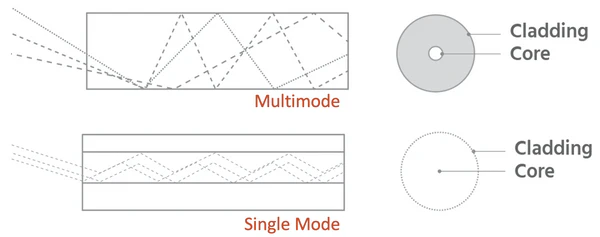
- Single Mode: Capable of transmitting data over 10km (6.2 miles) or more without the need for signal regeneration. This makes it the only viable option for campus-wide backbones or long-distance security camera runs.
- Multimode: Generally restricted to "short reach" applications, typically between 300m and 550m. Beyond these distances, signal degradation—caused by attenuation and dispersion—makes reliable data transfer difficult without active amplification.
3. The Cost Paradox
A common misconception is that single mode is more expensive. In reality, the cable itself is roughly 30% more cost-effective to manufacture than multimode fiber. The "catch" lies in the active electronics. Single mode requires high-precision lasers to inject light into the tiny 9µm core, whereas multimode can use more affordable VCSEL (Vertical-Cavity Surface-Emitting Laser) or LED sources. However, as the price of high-speed transceivers continues to fall, the total cost of ownership (TCO) for a single mode system is increasingly competitive, even for shorter runs.
Official Industry Perspectives
According to NSI Network Infrastructure experts, the shift toward single mode in commercial installations is a direct response to future-proofing. "When we consult with integrators," says a lead product specialist at NSI, "we emphasize that the labor cost to pull cable is the most expensive part of the job. If you install multimode today to save a small percentage on transceivers, you are effectively capping your future network capacity. Single mode is the foundation for 10G, 40G, and 100G upgrades."
Furthermore, industry standards bodies have emphasized the importance of compatibility. The use of incorrect connectors or the attempt to "bridge" different fiber types without appropriate media converters is a leading cause of link failure in the field.
Implications for Modern Installations
The implications for system designers are clear:

- Future-Proofing: If a project has any potential for expansion—whether it is a 4K/8K video distribution system or an enterprise-grade network—single mode is the prudent choice. It removes the "distance wall" that multimode creates.
- Infrastructure Complexity: While single mode is superior, it requires cleaner installation practices. Because the core is only 9µm, a single speck of dust can significantly impact signal quality. Proper cleaning kits and termination tools are mandatory.
- The "Don’t Mix" Rule: One of the most critical warnings for technicians is the danger of passive mismatching. Attempting to connect a 50µm multimode core to a 9µm single mode core will lead to massive optical loss, essentially killing the signal. If a system requires both, it must be bridged using active media converters or SFP-based switches that can manage the transition between the two optical standards.
- Connector Compatibility: Always ensure that your connectors (LC, SC, etc.) are matched to the specific fiber type. While a connector may physically fit, the internal alignment must be precise. Using a single mode connector on multimode fiber (or vice versa) can lead to back-reflections that damage sensitive laser transceivers.
Conclusion
The debate between single mode and multimode fiber is no longer just about choosing a cable; it is about choosing a roadmap for digital infrastructure. While multimode remains useful in legacy data centers or short-reach, high-density patch environments, the industry is unequivocally trending toward single mode for its superior bandwidth, longer reach, and decreasing cost.
For the modern integrator, the recommendation is to prioritize single mode for all new horizontal and vertical cabling. By doing so, you minimize the risk of obsolescence and ensure that the network can handle the increasing throughput demands of next-generation technologies. When in doubt, consult with infrastructure experts and ensure that your chosen transceivers, cabling, and termination tools are perfectly aligned with your project’s long-term performance requirements.
For those requiring further guidance on selecting the right fiber for a specific deployment, the NSI Customer Service Portal remains a vital resource for technical support and product selection assistance. Choosing the right path today ensures seamless connectivity for years to come.