








In the rapidly evolving landscape of telecommunications, security systems, and high-definition audio/video distribution, the backbone of connectivity remains the fiber optic cable. For system integrators and IT professionals, the choice between single mode and multimode fiber is not merely a technical preference; it is a fundamental design decision that dictates the lifespan, performance, and scalability of an entire network infrastructure.
As connectivity demands escalate—driven by the explosion of 8K video, AI-driven data centers, and high-density security surveillance—understanding the nuances of fiber architecture has become more critical than ever. This article dissects the core differences, technical specifications, and strategic implications of choosing between these two dominant fiber technologies.
Main Facts: The Physics of Light Transmission
At its simplest level, fiber optic cable functions by transmitting pulses of light through a glass core. The distinction between single mode and multimode fiber lies in how these light signals are guided through that core.
The Anatomy of the Cable
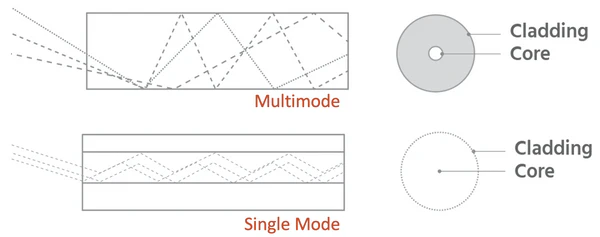
Single mode fiber features a remarkably narrow core—typically around 9µm in diameter. This minute diameter forces light to travel in a single, direct path, or "mode." Because the light does not bounce off the walls of the core, it experiences significantly lower attenuation (signal loss) and virtually zero modal dispersion.

In contrast, multimode fiber utilizes a significantly larger core, traditionally 50µm (with legacy OM1 cables reaching 62.5µm). This larger "pipe" allows multiple light modes to propagate simultaneously. While this makes the light easier to inject into the fiber using cheaper light sources like LEDs or VCSELs (Vertical-Cavity Surface-Emitting Lasers), it introduces "modal dispersion," where different light pulses arrive at the destination at slightly different times, limiting the distance and speed the signal can maintain.
Chronology: From Legacy Standards to Modern Fiber
To understand why we have two distinct types of fiber, one must look at the historical evolution of network electronics.
- 1970s–1980s (The Rise of Multimode): Early fiber installations favored multimode technology. Because fiber optic lasers were prohibitively expensive and difficult to align, the larger core of multimode fiber was a design necessity. It was "forgiving," allowing for easier, lower-cost coupling of light from simple LED sources.
- 1990s (The Expansion of Single Mode): As the telecommunications industry pushed for trans-oceanic and long-haul data transmission, single mode became the standard for carrier-grade infrastructure. The move toward laser-optimized single mode allowed for unprecedented bandwidth and distance.
- 2000s–Present (Convergence and Optimization): The barrier to entry for single mode has lowered significantly. While multimode remains prevalent in short-reach enterprise data centers, the industry has witnessed a massive migration toward single mode for structured cabling in buildings and campuses, largely due to the declining cost of high-speed transceivers and the "future-proofing" benefits it offers.
Supporting Data: Comparative Performance Metrics
When selecting a cable, engineers must balance bandwidth, distance, and budget. The following data points highlight why single mode is increasingly favored for modern installations.
Bandwidth and Distance Capabilities
Single mode fiber is technically capable of near-infinite bandwidth. Its primary limitation is not the cable itself, but the electronics at either end. It is the gold standard for long-haul transmission, easily handling distances of 10km (6.2 miles) or more without the need for signal regeneration.

Multimode fiber is graded by the Telecommunications Industry Association (TIA) based on its performance. These grades—OM1 through OM5—represent a hierarchy of bandwidth-distance products. While high-grade OM4 or OM5 fiber can support 40Gbps or 100Gbps speeds, it is strictly limited to shorter distances, typically ranging from 300m to 550m (approx. 1,000 to 1,800 feet). Beyond these lengths, signal integrity degrades rapidly, making multimode unsuitable for campus-wide or long-distance runs.
The Cost Equation: An Industry Paradox
A common misconception is that single mode cable is more expensive. In reality, the raw glass fiber is often cheaper to manufacture than multimode fiber. However, the total cost of ownership (TCO) is influenced by the electronics:
- Cable: Single mode is generally 30% more cost-effective.
- Electronics: Single mode transceivers (SFP modules) traditionally required more expensive, high-precision lasers.
- The Trend: As mass production has scaled, the price gap for single mode electronics has narrowed, often making the total system cost of a single mode installation competitive with—or even lower than—a multimode system.
Official Industry Perspectives
Industry experts and infrastructure manufacturers, such as NSI Industries, emphasize that the "one-size-fits-all" approach is no longer applicable. The consensus among network engineers is to prioritize Single Mode for horizontal and backbone cabling whenever possible.
"The decision-making process should be dictated by the longevity of the install," notes a product expert from NSI. "If you are pulling cable through a building, you don’t want to replace it in five years because the bandwidth needs exceeded the capabilities of your multimode fiber. Single mode provides a nearly infinite upgrade path; you simply change the transceivers as your speed requirements grow."
Regulatory bodies and standards organizations also highlight the importance of proper termination. Regardless of the cable type, the quality of the connector and the cleanliness of the ferrule are paramount. Contamination is the primary cause of network failure in fiber installations, regardless of whether the cable is single or multimode.
Strategic Implications: Choosing Your Infrastructure
When designing a new project, integrators should consider the following decision matrix:
When to Choose Multimode
- Legacy Integration: If the existing infrastructure is entirely multimode, it is often simpler to stick with the same standard to avoid complex media conversion.
- Short-Reach Data Centers: Within a single server rack or a small server room, multimode remains a reliable, cost-effective solution for patching.
When to Choose Single Mode
- Building Pre-wires: For any cable intended to be inside the walls or conduits for 10+ years, single mode is the only logical choice to ensure future-proofing.
- AV and Security: With the rise of 4K/8K video over IP and high-density security camera arrays, the bandwidth overhead of single mode ensures consistent, latency-free performance.
- Campus Environments: Any run exceeding 500 meters necessitates single mode to maintain signal integrity.
The "Golden Rule" of Compatibility
A critical warning for all installers: Never mix the two. You cannot simply patch a multimode cable into a single mode cable. The vast difference in core sizes (9µm vs. 50µm) creates a catastrophic mismatch. When light travels from a large core into a small one, most of the light is reflected, resulting in massive signal loss (insertion loss) that will effectively kill the link. If you must connect them, use a managed media converter equipped with appropriate SFP modules to bridge the two distinct optical standards.
Conclusion: Future-Proofing Your Network
The fiber optic debate is not about which cable is "better" in an absolute sense, but which is the right tool for the specific deployment. While multimode fiber has served the industry well for decades, the current trajectory of networking technology clearly favors the efficiency, scalability, and long-term value of single mode fiber.

By opting for single mode during initial installations, integrators provide their clients with a robust foundation that can evolve with the next generation of high-bandwidth electronics. As we look toward a future dominated by higher resolutions, faster data rates, and more complex security requirements, the choice of cabling will continue to be the most important decision an integrator makes.
For those navigating complex project requirements, remember that technical support and proper tooling are your greatest assets. Whether you are terminating high-count fiber trunks or installing a simple security link, ensure that your components—connectors, transceivers, and testers—are matched to the fiber type to guarantee a lifetime of reliable performance.
If you are currently planning an installation and have questions regarding specific hardware compatibility or testing procedures, consult your manufacturer’s technical documentation or reach out to specialized infrastructure support teams to ensure your project meets the highest standards of modern connectivity.