






The halls of the Mobile World Congress (MWC) have long served as a stage for the whimsical and the futuristic. In recent years, attendees have become accustomed to the sight of mechanical dogs navigating crowded corridors and robotic baristas precision-pouring lattes. However, as MWC Shanghai 2026 demonstrated, these displays have transitioned from mere trade-show novelties into the vanguard of a massive industrial shift.
The era of "Physical AI"—the embodiment of artificial intelligence in autonomous hardware—is no longer a distant prospect. From humanoid robots shattering athletic records to autonomous security fleets patrolling global sporting events, the intelligence once confined to smartphone screens and cloud servers is making a definitive leap into the physical world. This transition, however, demands a radical re-engineering of the global telecommunications infrastructure.
Main Facts: The 5G-Advanced Pivot
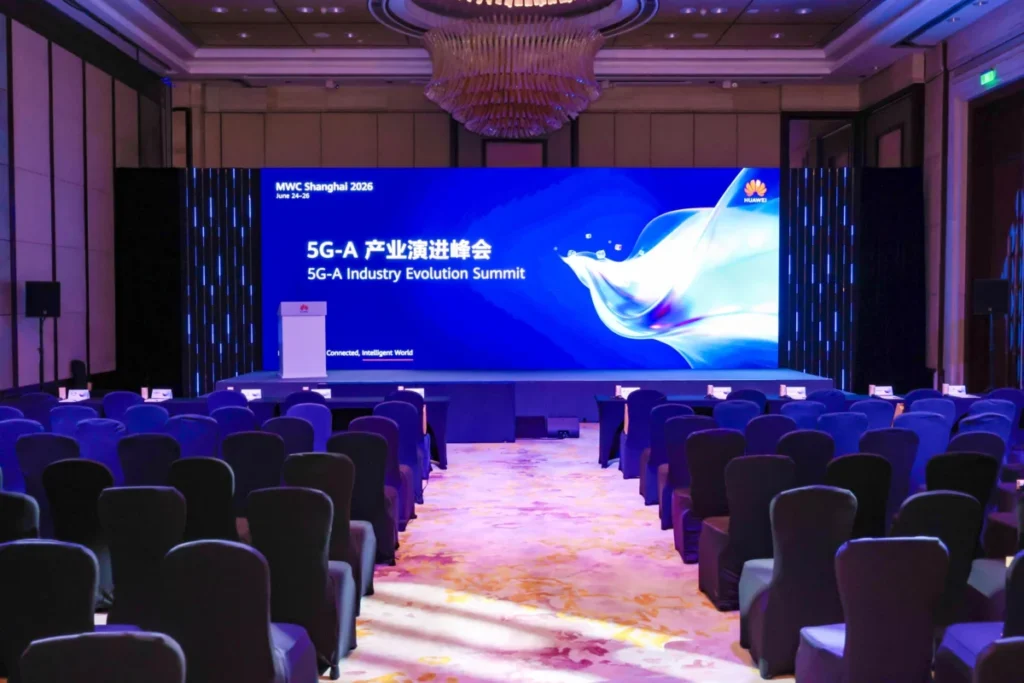
At the heart of this revolution is 5G-Advanced (5G-A), the next evolutionary step in mobile connectivity. The 5G-A Industry Evolution Summit held in Shanghai revealed a significant shift in the industry’s collective consciousness. While previous generations of mobile technology were judged primarily on download speeds and consumer capacity, the 5G-A era is being defined by its ability to support an ecosystem of "embodied AI."
The core challenge lies in the nature of AI interaction. Unlike a human user streaming a 4K video—a process that is overwhelmingly "downlink-heavy"—a robot or an autonomous vehicle is a data generator. These machines utilize a suite of sensors, LIDAR, and high-definition cameras to "see" and "interpret" their surroundings in real-time. This creates a massive demand for uplink capacity, low latency, and deterministic reliability.
Key takeaways from the summit include:
- The Uplink Baseline: A technical consensus has emerged that a 20Mbps uplink is the minimum requirement to sustain real-time AI modeling and situational awareness.
- Energy Efficiency through Offloading: Running AI "brains" locally on robots consumes 20 times more energy than processing data remotely via the cloud, making high-performance networks essential for battery life.
- The GigaUplink Solution: Industry leaders like Huawei have introduced technologies capable of a five-fold increase in uplink capacity to meet the demands of mass-scale robotics.
- The Monetization Shift: The industry is moving away from charging by the gigabyte (the "volume trap") and toward a "token-based" business model centered on computational value.
Chronology: From Consumer 5G to the AI-Native Network
To understand the urgency of the 5G-A transition, one must look at the trajectory of mobile evolution over the last decade.
2019–2022: The Consumer Era
The initial rollout of 5G was characterized by a focus on Enhanced Mobile Broadband (eMBB). Success was measured by how quickly a consumer could download a movie or how smoothly a mobile game performed. Networks were architected asymmetrically, prioritizing the downlink to satisfy a world dominated by content consumption.
2023–2025: The Rise of Industrial IoT and Early AI
As 5G matured, the focus shifted toward the Industrial Internet of Things (IIoT). However, AI remained largely "screen-bound." Generative AI models like LLMs gained prominence, but they were accessed primarily through static terminals (phones and laptops). During this period, the limitations of the "best-effort" network delivery model began to surface as early autonomous trials faced latency hurdles.
2026: The Physical AI Explosion
By MWC Shanghai 2026, the narrative had changed. The successful deployment of robots like Honor’s ‘Lightning’—which set a half-marathon record—and the use of robotic security dogs at the FIFA World Cup proved that autonomous machines were ready for the mainstream. This prompted the 5G-A Industry Evolution Summit to declare 5G-A as the "foundational layer" for a physical AI ecosystem, moving beyond speed and into the realm of intelligence orchestration.
Supporting Data: The Scale of the Robotic Surge
The sheer volume of data and devices expected in the coming decade is staggering. According to Huawei’s Intelligent World 2035 report, the world will be home to approximately 15 billion AI terminals by 2035. This includes everything from household humanoid helpers to autonomous industrial forklifts and city-wide security grids.
The Uplink Crisis
Traditional 5G networks were designed for a 10:1 downlink-to-uplink ratio. Physical AI flips this requirement. A single humanoid robot equipped with eight high-definition cameras requires constant, high-bandwidth transmission to a "cloud brain" to navigate complex human environments.
Industry experts at the summit noted that while a current 5G site might handle two cameras per robot for a handful of units, it would buckle under the weight of 100 robots operating simultaneously. Huawei’s GigaUplink solution, launched at the event, utilizes multi-antenna technology and sophisticated algorithms to provide the 500% increase in uplink capacity necessary to prevent a total network bottleneck.
The Energy Equation
Sustainability is a primary hurdle for the robotics industry. Chen Qi, President of the AI Product Line at TD Tech, provided a stark comparison: operating a "robotic brain" on-device uses roughly 20 times more energy than offloading that computation to the network. For a humanoid robot, this is the difference between a two-hour battery life and a full day of productivity. By shifting the computational "pressure" to the network and the cloud, 5G-A enables the commercial viability of lightweight, long-lasting robotic units.
Latency and Safety
In the physical world, latency is not just a matter of convenience; it is a matter of safety. For a robot to interact with humans safely, it requires a "human-like" response latency of approximately 650ms or less. 5G-A provides "deterministic performance," ensuring that data packets are delivered with guaranteed timing, a departure from the "best-effort" delivery of previous generations.
Official Responses: Industry Leaders Weigh In
The consensus at MWC Shanghai was bolstered by high-level endorsements from telecommunications and technology giants.
Yang Lifan, Deputy General Manager of China Unicom Beijing, emphasized the scalability challenge: "Scaling autonomous intelligence puts a lot of pressure on our networks. We need to highly optimize our 5G-A networks for these conditions, and that means a much greater focus on uplink."
Eric Yang, President of Huawei Carrier Business, identified the three pillars of the new era: "Big bandwidth, uplink expansion, and user experience guarantee. Those will be the key network features that enable the mobile AI era."
The debate over spectrum also took center stage. Tim Hatt, Head of Research and Consulting at GSMA Intelligence, addressed the ongoing competition for the Upper 6GHz (U6G) band between the mobile and Wi-Fi industries. "Mobile is much more likely to be capacity constrained than Wi-Fi," Hatt noted, advocating for mobile access to the band to ensure ubiquitous AI coverage.
David Li, President of Huawei’s TDD Product Line, echoed this sentiment, calling for the alignment of U6G with the existing C-band. "U6G is the second-best spectrum for widespread 5G-A deployment… with improvements to our technology, we will soon be able to make the U6G coverage as good as C-band."
Implications: Escaping the "Volume Trap" through the Token Economy
Perhaps the most profound implication discussed at the summit was the death of the traditional telecom business model. For decades, telecommunications companies (telcos) have been caught in a "volume trap"—a cycle where data usage skyrockets, but Average Revenue Per User (ARPU) remains stagnant because they charge for raw bytes of data.
The Byte-Plus-Token Strategy
In the AI era, a gigabyte of data containing millions of AI "tokens" (the basic units of text or image processing) is infinitely more valuable than a gigabyte of random background data. However, transmitting these tokens requires immense computational power and electricity.
The proposed solution is Token Monetization. Under this model, operators would evolve into "Network-as-a-Service" (NaaS) providers. Instead of billing for data volume, they would bill for:
- Computational Capacity: The "tokens" processed via the cloud-edge.
- Deterministic Guarantees: Tiered pricing based on guaranteed low latency for critical applications like remote surgery or autonomous transport.
- Orchestration: Acting as the bridge between the raw spectrum and the AI’s "compute" needs.
"A byte-plus-token strategy will redefine commercial value for operators," said Huawei’s David Li. "In the future, the difference between data traffic and tokens will continue to grow. We must be ready to embrace that."
Conclusion: The Indispensable Backbone
The transition to 5G-Advanced represents more than a simple speed upgrade; it is the construction of a nervous system for the physical AI revolution. By solving the uplink crisis, securing the 6GHz spectrum, and shifting toward a value-based token economy, the mobile industry is positioning itself as the indispensable backbone of a new world.
As robots move from the trade-show floor to the streets, the success of the physical AI era will not be measured by the dexterity of the machines themselves, but by the strength and intelligence of the networks that power them. For telcos, this is a rare opportunity to step out of the "dumb pipe" shadow and become the orchestrators of the global intelligent economy.