





Main Facts: A Marvel of Subterranean Infrastructure
In the heart of the Bronx, beneath the rolling greens of Van Cortlandt Park, lies one of the most sophisticated engineering achievements in modern municipal history. The Croton Water Treatment Plant (CWTP), a subterranean behemoth located 300 feet below the surface, processes approximately 290 million gallons of potable water per day. This facility serves as a critical artery for New York City’s water supply, yet its most remarkable attribute is not what it produces, but how it interacts with the landscape above it.
The project, which received a prestigious Award of Merit for its integration of civil engineering and environmental stewardship, represents a paradigm shift in how dense urban centers manage water. By repurposing the byproducts of its own massive excavation, the project team—led by the New York City Department of Design & Construction (DDC) and designed by Grimshaw—transformed a potential environmental liability into a self-sustaining ecological engine.
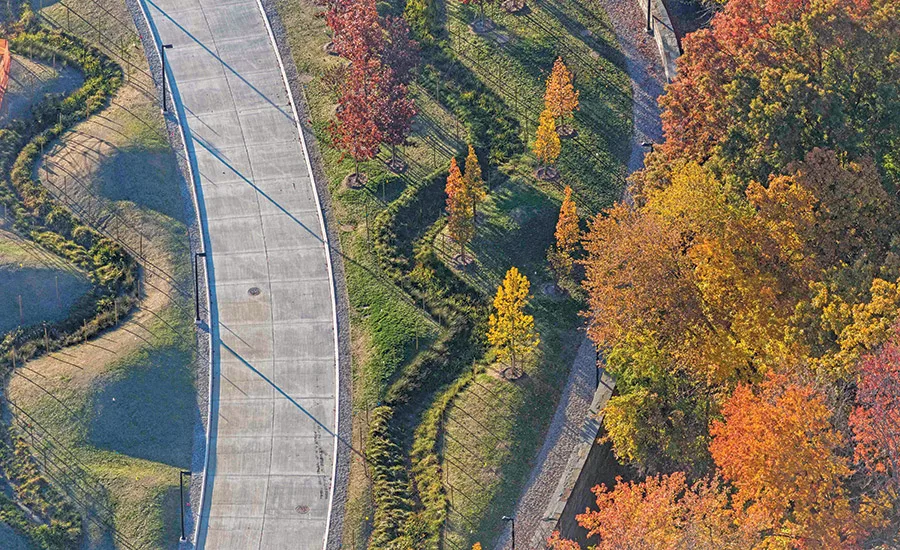
The project’s primary engineering challenge was the continuous dewatering required to maintain the safety and stability of the 300-foot-deep excavation. Rather than treating this groundwater as waste, the team, supported by the civil engineering expertise of Sherwood Design Engineers, integrated the water into a 10-acre golf course that functions as the city’s largest contiguous high-performance green roof.
Chronology: From Excavation to Ecological Integration
The development of the Croton Water Treatment Plant was a multi-year odyssey that necessitated unprecedented coordination between government agencies, structural engineers, and ecological consultants.
The Planning Phase (Early 2000s): The city identified the need for a massive underground facility to filter the Croton reservoir water supply. The site selection within Van Cortlandt Park necessitated an architectural strategy that would preserve the park’s recreational utility while burying the industrial capacity required to support a metropolis of eight million people.
Excavation and Dewatering (The Mid-Construction Era): As C&L Contracting began the colossal task of excavating deep into the bedrock, the sheer volume of groundwater seepage became a focal point. At 55 gallons per minute, the dewatering process posed a logistical hurdle. It was at this juncture that the project shifted from a traditional construction site to an innovative ecological laboratory.
System Implementation (The Landscape Phase): Working in tandem with Ken Smith Workshop and Great Ecology, the team began constructing the perimeter wetland treatment cells. These cells were designed not merely as aesthetic features, but as functional biological filters. By 2010 and through the following years of completion, the site moved from a massive construction scar to a functional, "living" infrastructure, integrating bioswales and wetland filtration into the park’s topography.
Final Commissioning: With the mechanical and electrical systems—expertly managed by Buro Happold—fully integrated, the facility began its dual life: a high-tech water treatment center deep underground, and a lush, water-conscious recreational space above.
Supporting Data: Engineering Metrics of Success
The success of the Croton Water Treatment Plant is quantified by its environmental performance metrics, which serve as a blueprint for future "green" infrastructure projects globally.
- Hydrological Efficiency: The project achieves a 100% reduction in onsite irrigation demand for the golf course. By capturing stormwater runoff from the driving range and parking lots, combined with the treated groundwater seepage from 12 stories below, the site has become a closed-loop system.
- Sewer Impact: The design successfully eliminated all site discharge into New York City’s notoriously taxed combined sewer system. This prevents millions of gallons of water from entering the city’s aging treatment pipes, reducing the risk of overflow during heavy rainfall events.
- Water Conservation: The facility offsets 40% of the golf course’s total potable water use. This is a staggering achievement for an urban landscape that would otherwise rely entirely on the city’s municipal water supply for maintenance.
- Ecological Sustenance: Beyond the golf course, the perimeter network of constructed wetland cells and bioswales sustains the park’s surrounding wetland ecology, effectively turning an industrial site into a biodiversity corridor.
Official Responses and Stakeholder Perspectives
The collaboration behind the CWTP has been lauded by industry experts as a masterclass in multidisciplinary integration.
"The challenge was never just about building a plant; it was about building a place," says a spokesperson for the New York City Department of Design & Construction. "We recognized that we were occupying a historic park. We had a responsibility to ensure that the infrastructure did not degrade the park experience, but rather enhanced it through sustainable design."
Sherwood Design Engineers, in their submission for the project’s merit award, emphasized the technical complexity of the hydrological systems. "Managing complex hydrological dynamics at that depth requires a level of precision that is rarely seen in public works. We weren’t just moving water; we were managing an ecological cycle that had been disrupted by the excavation process."
Grimshaw, the lead design firm, noted the significance of the green roof integration. "Creating the city’s largest contiguous high-performance green roof on top of a 300-foot-deep industrial plant required constant communication between the architects, the structural engineers at Buro Happold, and the landscape architects. The result is a seamless interface between the built and natural environments."
Implications: The Future of Urban Resilience
The Croton Water Treatment Plant serves as a powerful case study for the future of urban resilience in an era defined by climate change and population growth.
A New Model for Public Works
For decades, municipal utility projects were hidden away behind chain-link fences, treated as "black boxes" that were physically and mentally separated from the public. The CWTP suggests a different future: one where critical infrastructure is embedded within public spaces. By layering recreation (the golf course) over industrial utility (the treatment plant), the city has maximized the value of every square foot of land in a city where space is at a premium.
Managing Stormwater in a Dense City
The success of the wetland treatment cells and bioswales demonstrates that nature-based solutions are viable, even in high-density environments. As cities across the globe face more frequent and intense storm events, the ability to manage water onsite—rather than funneling it into overstretched sewer systems—is becoming a matter of public safety. The CWTP proves that with intentional engineering, urban surfaces can act as sponges, mitigating the risk of local flooding and replenishing local ecosystems.
The "Hidden" Value of Engineering
The implications for future architects and engineers are clear: environmental performance should be a foundational design constraint rather than an afterthought. The CWTP highlights that sustainability is not limited to solar panels and low-flow toilets; it involves the fundamental rethinking of how we handle the most basic of natural resources—water—within the urban fabric.
As New York City continues to evolve, the Croton Water Treatment Plant stands as a silent sentinel. To the casual visitor walking the fairways of the Van Cortlandt Park golf course, it is simply a beautiful landscape. But beneath the surface, it is a testament to the ingenuity of engineers and designers who saw the potential to turn a massive industrial undertaking into a legacy of ecological restoration. It is a reminder that the most successful projects are those that work in harmony with the environment, even—and perhaps especially—when they are buried deep beneath it.
The project continues to serve as an international benchmark, influencing how urban planners approach the intersection of civil infrastructure, recreational space, and ecological health. In the final analysis, the Croton project is not just a triumph of engineering; it is a triumph of imagination, proving that even the most massive industrial requirements can be reconciled with the delicate balance of the natural world.