





In the electrical contracting industry, the measure of a professional is rarely found in the hidden complexities of the circuit design alone, but in the physical manifestation of the work left behind. Every cable run, every conduit bend, and every termination point serves as a permanent testament to an installer’s attention to detail. As modern infrastructure grows increasingly complex—incorporating higher data densities, more intricate automation, and rigorous safety standards—the importance of meticulous cable management has transitioned from a "nice-to-have" aesthetic preference to a critical operational requirement.
The Foundation of Professionalism: Why Organization Matters
At its core, cable management is the practice of securing, routing, and identifying wires in a way that prioritizes safety, accessibility, and longevity. While the visual appeal of a "neat" panel or cable tray is often the first thing a client notices, the underlying benefits are far more functional.
Industry leaders, including the engineering teams at NSI Industries, emphasize that organized installations are the primary defense against the three great enemies of electrical infrastructure: downtime, hazard, and premature failure.
Operational Efficiency and Troubleshooting
When a system encounters a fault, the speed at which a technician can diagnose and resolve the issue is directly proportional to the clarity of the installation. In a chaotic, "spaghetti-style" cable run, identifying a single compromised wire becomes a time-consuming—and potentially costly—ordeal. Conversely, a managed system allows for immediate visual identification. By utilizing consistent routing and standardized labeling, technicians can move from diagnosis to repair with surgical precision, drastically reducing labor costs and system downtime.
The Safety Imperative
Beyond efficiency, the safety implications of disorganized cabling are profound. Loose cables frequently create trip hazards in commercial and industrial settings, posing liability risks to the contractor. More insidiously, poor cable management can lead to physical damage. Cables that are coiled, knotted, or bent beyond their rated bend radius are susceptible to internal wire fatigue. Furthermore, bundled cables that are not managed with heat dissipation in mind can create "hot spots." These localized areas of extreme heat can cause insulation degradation, electrical failure, and in worst-case scenarios, ignite surrounding materials.
The Evolution of Installation Standards
The history of electrical installation has seen a shift from rudimentary securing methods to advanced, modular management systems. In the early days of the trade, wire management was often an afterthought, relegated to simple staples and gravity-fed routing. However, as the demands of the digital age—specifically the proliferation of low-voltage data cables alongside high-voltage power lines—have grown, the need for advanced containment has surged.
Modern standards now demand that installers consider electromagnetic interference (EMI) and signal integrity, which are heavily influenced by how cables are bundled and separated. This evolution has forced a paradigm shift: cable management is no longer a final, superficial step; it is an integrated component of the installation process.
Strategic Planning: From Vision to Reality
Achieving a "gold standard" installation requires a departure from reactive, "on-the-fly" methods. Professional contractors follow a strategic lifecycle for every project, regardless of scale.
1. Developing the Design Vision
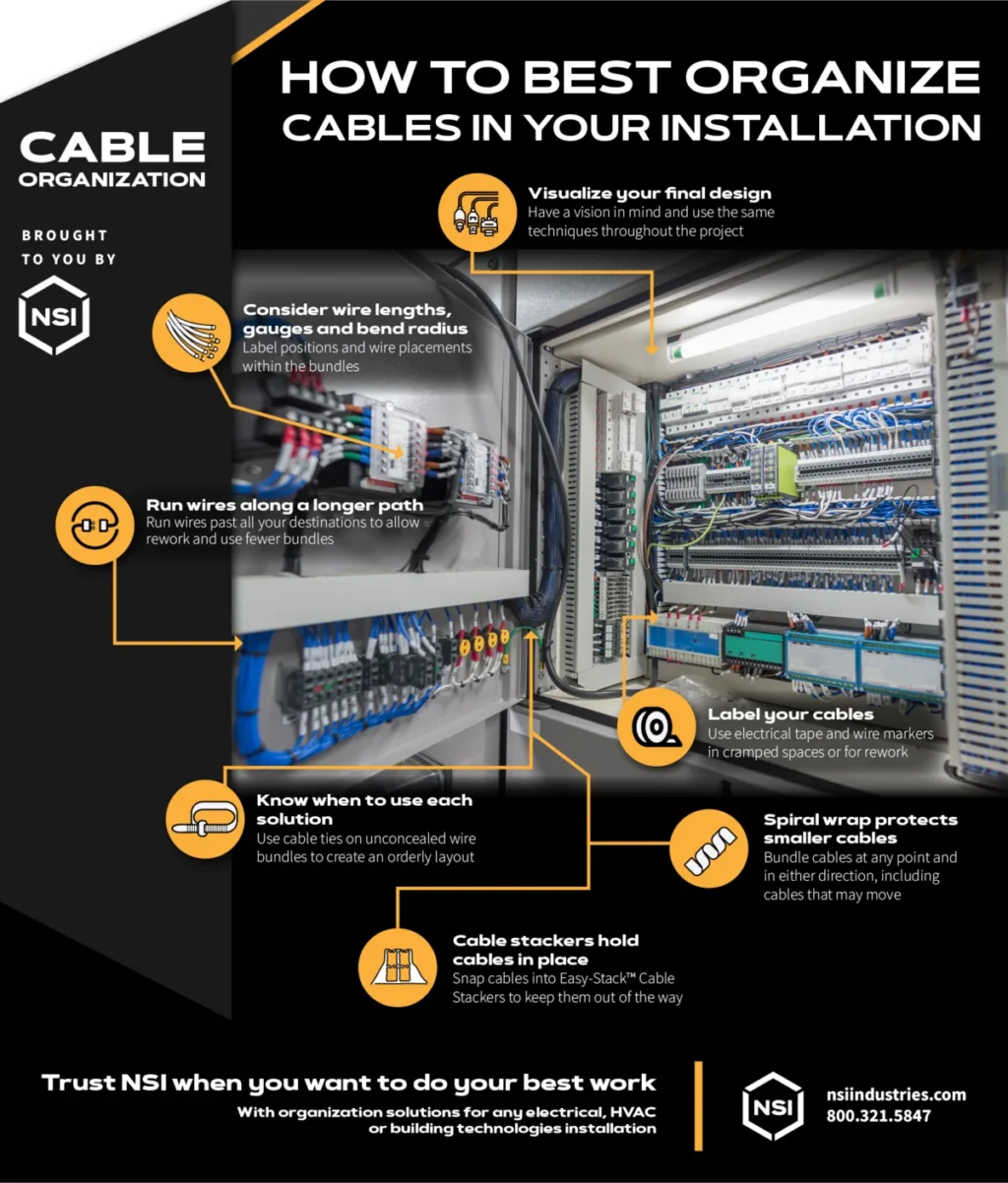
Every successful installation begins with a clear vision of the final outcome. Consistency is the hallmark of a master electrician. By establishing a standard approach—deciding on specific cable ties, color-coding schemes, and routing paths—at the start of a project, the installer ensures that the entire system functions as a cohesive unit. This uniformity not only aids in current installation but serves as a roadmap for future maintenance.
2. The Geometry of the Path
It is a common temptation for novice installers to take the shortest distance between two points. However, experienced professionals know that the "shortest path" is rarely the "best path." Planning longer, more deliberate routes allows for service loops. These extra lengths of wire provide the necessary slack for future re-terminations, allowing a technician to trim back a damaged wire end without having to replace an entire cable run. Furthermore, by grouping cables into logical bundles, installers can reduce the overall footprint of the wiring, creating a cleaner, more manageable workspace.
Technical Solutions for Modern Challenges
Knowing how to organize is only half the battle; selecting the right hardware for the specific environment is the second. NSI Industries provides a comprehensive ecosystem of solutions designed to handle the diverse demands of the field.
Cable Ties and Mounts: The Building Blocks
For most installations, cable ties serve as the primary containment method. When used in conjunction with mounting bases, they provide a secure, vibration-resistant hold. The key to professional execution lies in the spacing and tensioning; over-tightening can crush insulation, while under-tightening leads to sagging and "hot spots."
Spiral Wraps and Protection
In environments where cables are subject to movement or abrasion, spiral wrap is an indispensable tool. Its unique, helical design allows cables to exit or enter a bundle at any point, providing maximum flexibility. This makes it ideal for robotic arms, equipment that vibrates, or desk-based setups where flexibility is paramount.
Labeling: The Silent Technician
Perhaps the most overlooked, yet vital, component of management is marking. Electrical tape, heat-shrink labels, and mechanical markers are the language through which an installer communicates with the next technician. In complex industrial panels, a well-labeled wire is the difference between a five-minute repair and an hour of manual tracing.
Cable Stackers: The Efficiency Multiplier
For modern construction, products like the Easy-Stack™ Cable Stackers have revolutionized the speed at which installers can secure cables to studs. By eliminating the need for complex mounting hardware, these snap-in solutions save significant man-hours, allowing for a higher density of cables to be installed in a smaller space while maintaining perfect separation.
Implications for the Future of the Trade
The long-term implications of prioritizing cable management are clear: businesses that invest in high-quality organizational hardware and disciplined installation practices see a higher return on investment.
The Financial Argument
While premium cable management products carry an upfront cost, they drastically reduce the "Total Cost of Ownership" (TCO) for the facility owner. When repairs are faster, the cost of labor is lower. When cables are protected from damage, the frequency of total system replacements is reduced. In the competitive landscape of contracting, the ability to deliver a "cleaner" job is a powerful marketing tool. Customers recognize quality; a neat, well-organized electrical room inspires confidence and trust, often leading to repeat business and referrals.
Industry Feedback
Official responses from project managers and facility engineers consistently highlight that "neatness" is interpreted as "competence." During electrical inspections, an organized panel allows inspectors to verify compliance much faster, reducing the likelihood of rework orders. The message from the industry is unified: organization is not just about looks; it is a critical professional standard.
Conclusion: Setting the Standard
Whether you are working on a massive industrial plant or a residential renovation, the principles of cable management remain constant: plan with intent, execute with precision, and utilize the right tools for the environment.
As NSI Industries continues to innovate its product lines—from advanced clamps to high-durability conduit solutions—they remain committed to the belief that the installer is only as good as the work they leave behind. By integrating these practices into your daily workflow, you aren’t just installing wires; you are building a reputation for excellence that will stand the test of time.
In a world where technology is constantly evolving, the one thing that never goes out of style is a job done right, organized from start to finish. When you demand the best for your project, ensure that your toolkit is backed by the reliability and breadth of NSI’s organizational solutions. Remember, your installation is your signature—make sure it’s one you are proud to leave behind.