







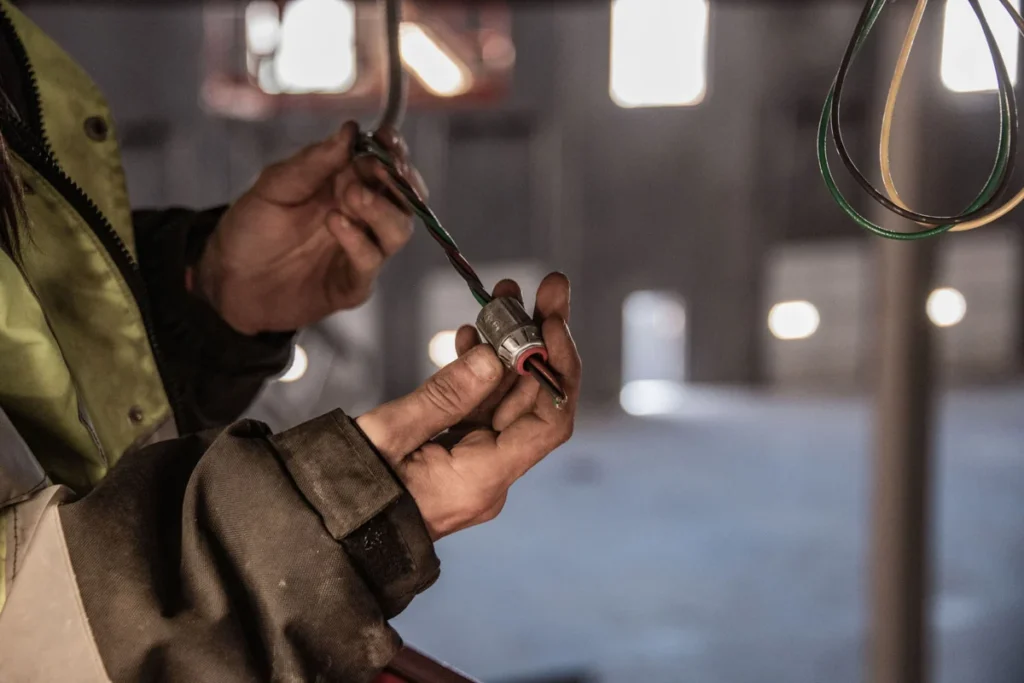
In the high-stakes world of electrical contracting, time is quite literally money. For nearly a century, the installation of cable-to-knockout connections has been defined by the traditional locknut connector—a staple of the trade that has remained largely unchanged since the early 20th century. However, as labor shortages persist and project deadlines tighten, the industry is undergoing a paradigm shift. Bridgeport Fittings, a brand synonymous with quality and engineering, is at the forefront of this transition, proving that "snap-in" technology has finally shed its reputation for being a shortcut and has evolved into a high-performance standard.
The Traditionalist’s Dilemma: The Reign of the Locknut
For generations, the locknut connector has been the undisputed "king" of the electrical box. Its design is deceptively simple: a threaded body and a matching metal nut that, when tightened, secures the conduit or cable to the electrical enclosure.
From a structural perspective, the locknut connector offers a sense of permanence that many veteran installers find reassuring. When torqued correctly, the metal-on-metal connection provides an ironclad bond, ensuring ground continuity and mechanical integrity. Because of this, it has remained the gold standard for high-vibration environments or heavy-duty industrial settings where the conduit must remain immovable.
However, the traditional locknut is not without its systemic flaws. The installation process is notoriously labor-intensive. In a commercial build-out involving hundreds of circuits, an installer must manually thread the locknut onto the connector body, tighten it with pliers or a specialized tool, and ensure that the teeth of the locknut bite into the box to provide a proper electrical bond. If the nut is loose, it fails to meet NEC (National Electrical Code) standards; if it is overtightened, it can strip threads or damage the enclosure. These repetitive motions are not only time-consuming but are also significant contributors to wrist and hand fatigue among journeymen.
Challenging the Stigma: The Rise of E-Z Lock Technology
For years, the term "snap-in connector" carried a negative connotation. Early iterations in the market were often perceived as "cheap," "flimsy," or prone to slipping under tension. Many contractors felt that by choosing a snap-in product, they were trading reliability for convenience.
Bridgeport Fittings, leveraging 95 years of engineering experience, decided to address this stigma head-on. Their engineering team analyzed the failure points of traditional snap-ins—weak tension springs, poor grounding paths, and difficulty in removal—and developed the E-Z Lock® system.
"At Bridgeport, we build every fitting to exceed expectations," the company states. By utilizing advanced metallurgy and a proprietary clamping mechanism, the E-Z Lock series was engineered to provide the same—if not better—bonding security as a threaded locknut, while eliminating the physical labor of the "screw-on" process.
A Chronology of Connector Innovation
The evolution of these products reflects the broader history of the American electrical trade:
- 1920s–1950s: The Formative Years. The electrical industry standardized the threaded conduit and locknut system. This era established the primary methods for securing cables into metal boxes, relying on manual torque and physical fastener integrity.
- 1960s–1990s: The Search for Efficiency. As labor costs began to rise, the first wave of snap-in connectors hit the market. While they promised speed, the materials were often inferior, and they struggled to gain mass adoption in mission-critical infrastructure.
- 2000s–2015: Precision Engineering. The industry saw a push toward higher-grade materials, such as hardened steel and improved zinc plating, allowing for better grounding performance.
- 2016–Present: The Era of Versatility. With the rise of MC-PCS (Metal-Clad Power, Control, and Signal) cables and complex smart-building requirements, manufacturers like Bridgeport expanded their catalogs. Today’s E-Z Lock connectors are designed to be "future-proof," accommodating a wide range of cable diameters and sheath types.
Supporting Data: The Case for Snap-In Efficiency
To understand why contractors are pivoting to E-Z Lock, one must look at the time-study data. In an average commercial installation, a single-circuit termination using a traditional locknut connector takes approximately 30 to 45 seconds when accounting for the physical movement of the hands and the use of tools.
Conversely, an E-Z Lock snap-in connector can be installed in under 5 seconds. In a project requiring 500 terminations, this translates to:
- Traditional: ~6.25 hours of labor.
- E-Z Lock: ~0.7 hours of labor.
This efficiency gain of nearly 90% is a critical factor for project managers operating on tight margins. Beyond time, there is the "human factor." By removing the need to repeatedly reach into cramped electrical boxes to spin a locknut, installers reduce their exposure to sharp metal edges and minimize the risk of repetitive strain injuries.
Official Responses: Why Quality Matters
Industry experts and veteran installers have noted a marked difference in the Bridgeport approach compared to mass-market alternatives. The key is in the "system bond." A high-performance snap-in connector must maintain a consistent, low-resistance path to ground, even if the knockout hole has been slightly deformed during the punch process.
Bridgeport’s design utilizes a robust, tensioned-spring mechanism that maintains constant pressure against the interior and exterior of the box. This ensures that the fitting remains locked in place despite building vibrations or thermal expansion and contraction.
Furthermore, the E-Z Lock system addresses the "removal problem." Older snap-in models were often "one-way" devices; if you made a mistake, you had to cut the cable or destroy the connector to remove it. Bridgeport’s design allows for clean, easy removal, saving both the material and the labor of re-wiring.
The Implications of Modernizing the Job Site
The shift toward high-performance snap-in connectors like E-Z Lock has profound implications for the construction industry:
- Safety and Compliance: Because E-Z Lock connectors are designed to be "foolproof," they reduce the likelihood of human error during the installation process. An improperly tightened locknut is a hidden fire hazard; a properly snapped-in E-Z Lock is a verified connection.
- Versatility in Design: With the inclusion of duplex connectors for MC-PCS cables, Bridgeport is ensuring that the snap-in category can handle the complex wiring requirements of modern smart buildings, which often include integrated data and control lines alongside standard power.
- Scalability: As the industry faces a shortage of skilled labor, the ability to train new apprentices to perform complex tasks quickly and correctly is vital. Systems like E-Z Lock shorten the learning curve, allowing less-experienced installers to contribute to high-value projects with confidence.
Expanding the Portfolio: A Solution for Every Knockout
Bridgeport has continued to expand its E-Z Lock line to cover a wider spectrum of conduit and cable types. From single-cable configurations to sophisticated 90-degree elbows and combination snap-in/duplex units, the ecosystem is designed to minimize the number of SKUs a contractor needs to stock on a truck.
For contractors running cables between 0.38" and 0.85" into standard 1/2" or 3/4" knockouts, the E-Z Lock series has effectively become a "one-stop-shop." This consolidation reduces inventory costs for electrical distributors and simplifies the supply chain for contractors.
Conclusion: The New Standard
The evolution from traditional locknut connectors to high-performance snap-in technology is more than a change in hardware—it is a change in philosophy. It represents a move toward smarter, faster, and more reliable construction practices.
Bridgeport Fittings, by respecting the heritage of the trade while embracing the necessity of innovation, has managed to turn a once-maligned technology into a cornerstone of the modern job site. For the electrical contractor, the message is clear: when speed, ease-of-installation, and uncompromising bonding integrity are the metrics of success, the E-Z Lock system isn’t just an alternative to the traditional locknut—it is the evolution of it.
As we look toward the future of building infrastructure, the demand for precision, efficiency, and reliability will only grow. With 95 years of history behind them, Bridgeport continues to prove that while they may have built their reputation on the "king" of connectors, they are the ones defining the future of the connection. For those ready to upgrade their workflow, the choice is clear. E-Z Lock is ready to go.