




As the global landscape of commercial and industrial architecture shifts toward hyper-connectivity, the "Smart Building" has transitioned from a futuristic concept to a modern necessity. Central to this transformation is the integration of Internet of Things (IoT) devices that automate operations previously reliant on manual oversight. From climate control and dynamic lighting to high-resolution security surveillance, these systems require a robust, reliable, and scalable infrastructure. Enter Type 4 Power over Ethernet (PoE)—the high-performance standard that is quietly rewriting the rules of building management.
Main Facts: Defining the Type 4 PoE Standard
At its core, Type 4 PoE is the pinnacle of the IEEE 802.3bt standard. While earlier iterations of Power over Ethernet were largely confined to low-power devices like basic IP phones or entry-level cameras, Type 4 PoE shatters those limitations. By utilizing all four twisted pairs of copper cabling within a standard Ethernet connection, Type 4 PoE delivers up to 71.3W of power at the device level, with capabilities reaching 90W to 100W in advanced, proprietary implementations.
This dual-utility approach—delivering both high-speed data and substantial electrical power over a single cable—eliminates the need for dual-infrastructure deployments. In traditional builds, an IP camera or a sophisticated sensor required both an Ethernet port for data and a dedicated AC outlet for power. Type 4 PoE renders the latter obsolete, simplifying the physical landscape of modern structures while significantly lowering installation overhead.
A Chronological Evolution of Power Delivery
To understand the gravity of Type 4 PoE, one must look at the trajectory of Ethernet power standards.
- The Early Days (IEEE 802.3af): Introduced in 2003, the original PoE standard provided a modest 15.4W. It was revolutionary for its time, allowing for the deployment of basic VoIP handsets and early-generation wireless access points (WAPs).
- The Expansion Phase (IEEE 802.3at): Known as PoE+, this standard increased the power budget to 30W. This was the catalyst for the first wave of smart building tech, supporting pan-tilt-zoom (PTZ) cameras and mid-range WAPs.
- The High-Power Era (IEEE 802.3bt): The ratification of the 802.3bt standard, which encompasses Type 3 and Type 4, marked a paradigm shift. With Type 4, the industry moved from "low-power peripherals" to "heavy-duty building systems." We are no longer just powering a sensor; we are powering entire building ecosystems, including digital signage, sophisticated LED lighting arrays, and complex HVAC actuators.
Supporting Data: Efficiency and Infrastructure Metrics
The technical superiority of Type 4 PoE is best measured in its efficiency and impact on capital expenditure (CapEx).

The Power Budget Breakdown
Type 4 PoE operates on a sophisticated "auto-classification" handshake. Before delivering maximum wattage, the Power Sourcing Equipment (PSE) communicates with the Powered Device (PD) to determine its exact power requirements. This prevents energy waste and protects the hardware.
Operational Cost Reductions
Data from building management studies suggests that moving to a single-cable infrastructure for smart lighting and IoT sensors can reduce labor costs associated with electrical installation by 30% to 40%. Because Ethernet cabling is low-voltage, it does not require the same rigorous—and expensive—conduit and fire-rating protocols as traditional AC high-voltage lines.
Heat and Load Density
As we consolidate more power into the ceiling plenum, heat management becomes a critical metric. Type 4 PoE infrastructure is designed to be monitored. When multiple cables are bundled, modern switches provide the telemetry necessary to ensure that thermal thresholds are never exceeded, preserving the longevity of both the cabling and the connected endpoints.
Official Industry Perspectives and Implications
Industry experts view Type 4 PoE as the "glue" that holds the smart building together. Without a high-power, high-data-rate backbone, the promise of the "Intelligent Office" remains stalled by physical connectivity bottlenecks.
"The move to Type 4 PoE is not just an upgrade in wattage; it is a fundamental shift in how we conceive building design," notes one lead systems integrator. "We are moving away from silos. By using the network as the power plant, we achieve a level of granular control—’the single pane of glass’—that was simply impossible when power and data lived in two separate worlds."

The Strategic Shift
The implications of this technology are far-reaching:
- Agility in Design: Tenants can reconfigure office spaces without needing to call an electrician. Sensors and lighting can be moved as easily as a desk.
- Predictive Maintenance: Because every device is networked, the system can report its own health. A smart switch can detect a drop in power draw from a camera, signaling a potential hardware failure before it occurs.
- Sustainability: By enabling centralized power management, facilities managers can shut down non-essential lighting and sensors during off-hours with millisecond precision, directly contributing to LEED certification and green building initiatives.
Managing the Smart Building Ecosystem
The transition to Type 4 PoE necessitates a change in how IT and Facilities teams interact. Managing a modern smart building is now a converged discipline.
Remote Power Cycling and Diagnostics
One of the most impactful features is the ability to perform a "hard reboot" of a frozen or malfunctioning device remotely. In a high-ceiling warehouse or a hard-to-access office plenum, the ability to cycle power to a specific port from a central management console saves hundreds of hours in manual labor per year.
The Role of Managed Switches
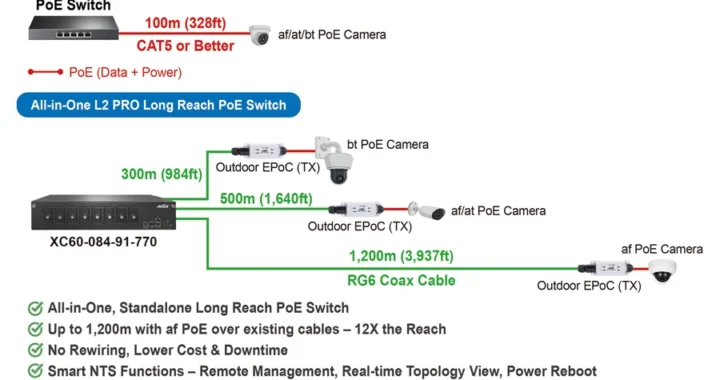
Modern hardware, such as the C62-084-91-770 L2 Managed 802.3bt PoE Switch, serves as the heart of this architecture. These devices provide the high-wattage throughput required for 802.3bt compliance, while offering advanced management features like VLAN segmentation, QoS (Quality of Service) for data traffic, and real-time power monitoring.
Security in a Connected Environment
As buildings become more connected, they become larger targets for cyber threats. Type 4 PoE infrastructures allow for advanced security protocols, such as port-based authentication and encrypted firmware updates. Because the network is the power source, if a device is deemed compromised, administrators can instantly cut both data and power at the switch level, effectively isolating the threat.

Future-Proofing for the Next Decade
Looking ahead, Type 4 PoE is positioned to be the foundation for the next generation of building technology. As 5G small-cell deployments become common within large buildings to ensure signal penetration, they will rely on the high-power, high-speed capabilities of Type 4 PoE. Similarly, as AI-driven building analytics demand more sensor data, the infrastructure must be ready to support an exponentially higher density of endpoints.
The modular nature of Type 4 systems means that an organization can start with a partial deployment—perhaps just in the lobby or on a single floor—and scale outward. Because standard Type 4 switches are backward compatible with earlier PoE standards, the transition is inherently cost-effective, allowing for a phased migration strategy.
Conclusion: Making the Move to Intelligent Infrastructure
The integration of Type 4 PoE is no longer an optional upgrade for developers and property managers—it is a competitive necessity. By consolidating data and power, reducing the complexity of installation, and enabling centralized, intelligent management, Type 4 PoE empowers organizations to build environments that are as efficient as they are responsive.
As we look toward a future defined by AI, predictive maintenance, and radical energy efficiency, the infrastructure that powers our buildings must be up to the task. Versa Technology remains at the forefront of this evolution, providing the high-performance hardware necessary to transition from traditional, siloed building management to a future-ready, unified network.
For those ready to capitalize on the benefits of a smarter, more resilient facility, the time to evaluate your network infrastructure is now. A well-designed, Type 4 PoE-enabled network is not merely an expense; it is a long-term asset that provides the flexibility, reliability, and intelligence required for the buildings of tomorrow. To learn more about designing a scalable network for your smart building project, reach out to the experts at Versa Technology today.