






In a landmark decision that promises to reshape the infrastructure landscape of the American South, Tennessee transportation officials have officially selected the consortium "DriveTN" to spearhead the $9.2-billion expansion of Interstate 24. The project, which targets the critical 26-mile artery connecting downtown Nashville to I-840 near Murfreesboro, stands as the most ambitious public-private partnership (P3) in the history of U.S. interstate "Choice Lane" development.
The Transportation Modernization Board finalized the selection on August 19, marking a pivotal turn in the state’s strategy to combat the chronic congestion plaguing one of the nation’s fastest-growing corridors. The DriveTN consortium—a heavyweight alliance featuring Cintra, Transurban, Tikehau Star/Infra/Capital, Ferrovial, Webber, and AECOM—has been tasked with the design, financing, construction, operation, and maintenance of the project under a 50-year revenue-risk concession agreement.
A Vision for Managed Growth
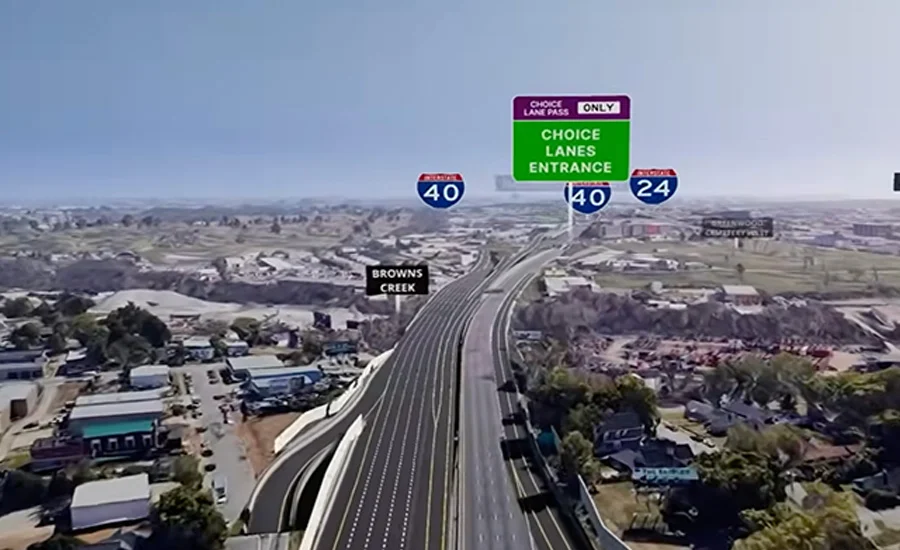
The core of the proposal involves the addition of two price-managed "Choice Lanes" in each direction, running parallel to the existing general-purpose lanes. These lanes will utilize open-road electronic tolling, with pricing that fluctuates in real-time based on traffic demand to ensure an average operating speed of at least 45 mph during peak congestion hours.
"We knew incremental change would not be enough to meet the demands of one of the fastest-growing states in America," said Governor Bill Lee during the announcement. The governor’s administration has framed the project as a necessary evolution for a region that has struggled to keep pace with the massive influx of residents and commercial activity over the last decade.
By entering into a revenue-risk concession, the state effectively shifts the burden of traffic fluctuations and toll revenue collection to the private sector. If traffic counts underperform or if maintenance costs exceed initial projections, the financial liability rests primarily with the DriveTN consortium rather than Tennessee taxpayers.
Chronology: From Concept to Selection
The path to this historic agreement has been defined by rigorous environmental assessment and strategic planning:
- Pre-2024: TDOT identifies the I-24 corridor as a critical failure point in Tennessee’s infrastructure, leading to initial feasibility studies for managed lanes.
- June 16, 2026: The Federal Highway Administration (FHWA) issues a "Finding of No Significant Impact" (FONSI) regarding the environmental assessment of the proposed I-24 expansion, clearing the regulatory path forward.
- August 19, 2026: The Tennessee Transportation Modernization Board formally selects DriveTN as the project partner, ending a competitive bidding process.
- Post-August 2026: The state enters a period of intensive negotiation to finalize contract terms, working in coordination with the U.S. Department of Transportation’s Build America Bureau to ensure federal compliance.
Structural Engineering and Design Innovation
The project is as much a feat of civil engineering as it is a financial undertaking. The baseline design, while subject to modifications under the DriveTN proposal, is monumental in scope. It includes the replacement or widening of dozens of bridges, the construction of massive retaining walls to navigate the hilly topography, and the implementation of sophisticated noise mitigation measures.
The "DriveTN" Design Pivot
One of the most significant revelations following the selection is that DriveTN intends to diverge from the state’s baseline design. By placing the new Choice Lanes outside of the existing general-purpose lanes, the consortium aims to minimize the project’s footprint.
According to preliminary briefings, this design change offers two major strategic advantages:
- Right-of-Way Efficiency: The revised layout significantly reduces the need for property acquisition, which was initially estimated at 43 acres.
- Community Preservation: The new design specifically avoids encroaching on sensitive local infrastructure, such as the Noble Place Townhomes and the Pan-Asia Supermarket, while eliminating the need for a complex reconstruction of the Hickory Hollow Parkway Bridge.
However, these improvements come with a significant price tag. The $9.2-billion proposal is more than double the $4.5-billion estimate previously cited by TDOT for its baseline design. Officials maintain that this is not a result of "scope creep" or inflationary cost hikes for the same work, but rather the inclusion of enhanced features, superior materials, and broader long-term maintenance commitments embedded in the private-sector proposal.

Technical Specifications and Infrastructure Scope
The project scope is staggering. The plans call for:
- Bridge Infrastructure: 37 bridge replacements, three bridge widenings, and 55 brand-new structures.
- Retaining Walls: Approximately 77 walls spanning 18.9 miles to support the elevated sections.
- Noise Mitigation: The installation of roughly 30 noise barriers to protect adjacent residential communities.
- Elevated Managed Lanes: In areas where space is constrained—particularly between downtown Nashville and Briley Parkway—the design utilizes elevated structures to bypass interchanges and sensitive environmental floodplains.
Specific attention is being paid to "substandard" infrastructure. For example, the project includes the replacement of the I-24 bridge over Mill Creek, coupled with significant approach work designed to mitigate recurring flood risks. Similarly, the Bell Road bridge will be replaced, and the highway elevation will be raised to meet modern vertical clearance requirements.
Official Responses and Stakeholder Accountability
TDOT Commissioner Will Reid emphasized that the selection of a partner is only the first step in a long process of due diligence. "Our responsibility now is to verify the commitments, complete the required reviews, finalize the agreement and deliver as promised," Reid said.
The state is currently engaged in a delicate dance with federal partners. Because the project involves interstate highways, the Federal Highway Administration and the U.S. DOT’s Build America Bureau must sign off on the final contract. The confidentiality of certain aspects of the proposal—particularly the financial modeling—remains a sticking point as negotiations continue, though officials are committed to transparency as the project approaches its groundbreaking.
Implications for the Future
The implications of the I-24 project extend far beyond the asphalt. If successful, this P3 model could set the standard for how Tennessee and other states address urban congestion.
Economic and Financial Impact
The consortium has cited a "concession value" of approximately $24.8 billion—a figure that represents the total economic value of the corridor over the 50-year life of the contract. It is critical to note that this is not liquid cash for the state; rather, it reflects the consortium’s assessment of potential revenue streams against the massive upfront construction and long-term maintenance costs.
Transit and Future-Proofing
A notable feature of the DriveTN proposal is the inclusion of provisions for future transit integration. By incorporating park-and-ride facilities and designing the corridor to allow for potential bus rapid transit (BRT) or other public transit modes within the managed lanes, the state is attempting to build a multi-modal future into what has historically been a car-centric highway project.
The Uncertainty of the Timeline
Despite the excitement surrounding the selection, the project remains in a state of transition. TDOT has not yet provided a definitive construction schedule. While previous federal traffic analyses assumed a 2032 completion date, the introduction of the DriveTN design necessitates a total recalculation of sequencing and duration.
As the project moves from the planning phase to the negotiation phase, the residents of Nashville and Murfreesboro remain in a state of cautious optimism. For commuters who spend hours every week idling on I-24, the promise of a 45-mph minimum speed is an enticing prospect. For taxpayers and fiscal watchdogs, the focus will remain squarely on the $9.2-billion price tag and the rigorous oversight required to ensure that this public-private partnership delivers on its ambitious promises without placing undue burden on the public purse.
With the environmental assessments cleared and a partner selected, the "Choice Lanes" project is officially the largest infrastructure initiative in modern Tennessee history—a project that will define the region’s mobility for the next half-century.