





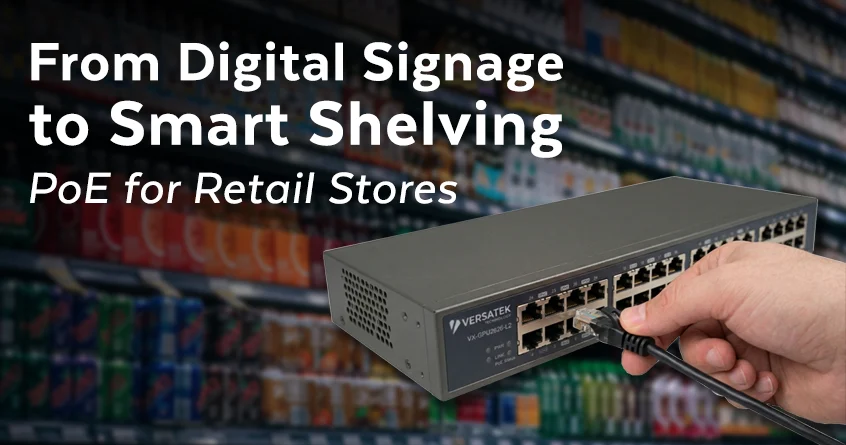
In an era where the digital and physical worlds are inextricably linked, the retail industry stands at a critical crossroads. While e-commerce has fundamentally altered consumer behavior, the physical storefront remains the heartbeat of the customer journey. Today’s shoppers do not merely visit stores to transact; they visit for the sensory experience of products, the immediacy of fulfillment, and the social interaction of community-driven retail. However, this evolution has birthed a new set of demands. Modern consumers expect a "connected" environment that rivals the efficiency of the internet—complete with seamless Wi-Fi, instant product information, and frictionless checkout processes.
To meet these expectations, retailers are increasingly turning to a silent powerhouse: Power over Ethernet (PoE) technology. By consolidating power and data delivery into a single cable, PoE is rapidly becoming the foundational infrastructure required to transform static shops into dynamic, intelligent retail environments.
The Evolution of Retail Infrastructure: From Cables to Connectivity
The transition toward the "Storefront of the Future" is not merely about adding gadgets; it is about building a resilient, scalable nervous system for the business. Historically, retail expansion was hindered by the logistical nightmare of electrical wiring. Adding a new security camera, a digital kiosk, or an inventory sensor often meant invasive construction, costly permits, and significant downtime.
The PoE Paradigm Shift
Power over Ethernet (PoE) technology fundamentally changes this calculus. By enabling both power and data to be transmitted over a single Ethernet cable, retailers can eliminate the need for localized electrical outlets at every device endpoint. This simplifies deployment, slashes installation costs, and provides an unprecedented level of architectural flexibility.
When a retailer decides to reconfigure their floor plan for a seasonal promotion or a new product layout, PoE allows for the "plug-and-play" relocation of hardware. Cameras, wireless access points (WAPs), and IoT sensors can be moved in minutes rather than days. Furthermore, with the latest PoE standards—such as IEEE 802.3bt, which supports up to 90 watts of power—retailers can now power high-demand devices like sophisticated Point-of-Sale (POS) systems and interactive digital kiosks that were previously tethered to traditional AC power.
Chronology of Retail Transformation: The Rise of the Smart Store
The integration of advanced technology into retail did not happen overnight. It has been a decade-long progression characterized by distinct phases of implementation:
- Phase 1 (2010–2015): The Digital Bridge. Retailers began by installing basic guest Wi-Fi and rudimentary POS systems. These were often disjointed, with power and data managed by separate, aging systems.
- Phase 2 (2016–2020): The IoT Explosion. The emergence of smart cameras, RFID inventory tracking, and localized environmental sensors required a more robust backbone. The industry moved toward centralized data management, setting the stage for wide-scale PoE adoption.
- Phase 3 (2021–Present): The Intelligent Edge. Today, the focus is on real-time analytics. Edge computing, supported by high-wattage PoE switches, allows stores to process data locally. Cameras now do more than record; they perform real-time heat mapping, license plate recognition, and queue management, all while operating on a unified, PoE-powered network.
Supporting Data: The Economics of Efficiency
For the modern retailer, the bottom line is often razor-thin. In the warehouse and grocery sectors, profit margins frequently hover between 1.5% and 3%. In such a high-pressure environment, operational inefficiency is not just a nuisance—it is a threat to survival.

The Cost of Inaction
- Shrinkage and Loss Prevention: According to recent industry reporting, retail crime has reached critical levels. A study noted that 38% of shoppers have witnessed a crime in a grocery environment, with 70% of those individuals choosing to avoid such stores in the future. Effective, high-definition PoE surveillance is no longer a luxury; it is a primary driver of customer retention.
- Space Management: A typical retail warehouse spans over 146,000 square feet. Managing the environment of such a vast space is a logistical challenge. PoE-powered sensors that regulate temperature and humidity in real-time protect sensitive inventory, preventing spoilage and reducing waste—critical factors in maintaining those thin 3% profit margins.
- Operational Uptime: With PoE switches connected to Uninterruptible Power Supplies (UPS), stores can maintain security and communication systems even during local power grid failures, ensuring business continuity in an unpredictable world.
The Vertical Impact: Tailored Solutions for Retail Segments
Different retail formats require different applications of PoE technology to optimize their specific operational goals.
Convenience Stores: The 24/7 Security Challenge
Convenience stores, often operating in high-risk, 24-hour environments, face unique security hurdles. Data from the FBI indicates that 15% of all robberies occur in 24-hour convenience stores and gas stations. Here, PoE acts as a force multiplier. Pan-tilt-and-zoom (PTZ) cameras can be installed at the perimeter and fuel pumps, providing comprehensive, real-time coverage that deters criminal activity. When integrated with smart software, these systems can trigger automated alerts or notify local authorities the moment a threat is detected, significantly reducing response times.
Retail Warehouses: Scaling the Infinite Aisle
In large-format warehouses, the challenge is visibility. Managing inventory in a space the size of three football fields requires a massive density of endpoints. PoE-enabled RFID and barcode systems allow for constant, real-time inventory tracking. Furthermore, by utilizing PoE to power Wi-Fi access points across these vast distances, retailers empower staff with mobile tablets, allowing them to provide instant answers to shoppers—turning a sprawling warehouse into a manageable, service-oriented space.
Supermarkets: The Frictionless Experience
Grocery stores are increasingly focused on the "frictionless" checkout. By deploying PoE-enabled POS terminals and self-checkout kiosks, supermarkets streamline the transaction process. Beyond the register, personal shoppers—who now fulfill thousands of digital orders daily—rely on robust, PoE-supported WAPs to navigate the aisles and ensure order accuracy, which is vital for customer satisfaction in the competitive grocery landscape.
Official Perspectives: The Future-Proofing Imperative
Industry experts argue that retailers who fail to invest in a modular, high-capacity network infrastructure will be left behind. The "Storefront of the Future" is not a static destination; it is an iterative process.
"Retailers shouldn’t try to guess exactly what the next five years will hold," notes a spokesperson from Versa Technology. "Instead, they must build the infrastructure that allows them to pivot. Whether it’s AI-driven inventory management or biometric security, the backbone of these future innovations is a reliable, high-wattage PoE network."
The professional consensus is clear: Infrastructure is no longer a "back-office" expense; it is a strategic asset. By leveraging industrial-grade managed switches—such as those capable of handling extreme temperatures and power surges—retailers can build a network that is as rugged as it is intelligent.

Implications for the Future of Retail
The implications of this shift are profound. As retailers move toward a future where every shelf, camera, and terminal is connected, the role of the store manager is evolving into that of a "system operator." The store is no longer just a place to hold inventory; it is a data-collection engine that provides insights into human behavior, product popularity, and supply chain health.
Protecting Property and People
The most significant implication of a robust PoE-based infrastructure is the enhancement of safety. By securing the physical perimeter with smart sensors and protecting the interior with automated surveillance, retailers are creating environments where customers feel safe and staff feel supported. This, in turn, translates into increased foot traffic and stronger community ties.
Preparing for the Unseen
Finally, the scalability of PoE ensures that when new, unforeseen technologies emerge, the physical store will be ready to adopt them. Whether it is augmented reality shopping mirrors, autonomous shelf-stocking robots, or advanced customer sentiment sensors, a high-wattage, data-rich Ethernet backbone will provide the "plug-and-play" capability needed to integrate these advancements without a complete overhaul of the store’s physical structure.
Conclusion: Investing in the Backbone
As we look toward the next decade of retail, the winners will be those who recognize that technology is the bridge between the physical and digital. Power over Ethernet offers the perfect balance of simplicity, scalability, and power, making it the essential foundation for any retailer aiming to thrive in a modern, connected world.
From the safety of the local convenience store to the efficiency of the massive retail warehouse, PoE is empowering retailers to protect their assets, streamline their operations, and, most importantly, deliver the seamless, high-touch experiences that keep customers returning. For those ready to future-proof their operations, the journey begins with the infrastructure beneath their feet. By partnering with industry leaders to deploy managed, industrial-grade PoE switches, retailers can stop worrying about the limitations of their hardware and start focusing on the limitless potential of their storefronts.