





Volatility has long been the defining characteristic of the global oil and gas industry. The delicate, often precarious balance between global supply and fluctuating demand is less a precise science and more a complex, high-stakes art. For producers, forecasting output is frequently an exercise in looking backward at what has been produced rather than predicting what will be. In this environment, a single operational disruption or a sudden geopolitical tremor can reconfigure the entire industry landscape in a matter of hours.
While external forces—market shifts, regulatory changes, and regional conflicts—are often beyond the control of any single operator, the industry is increasingly doubling down on the factors it can govern. By hardening infrastructure, optimizing asset performance, and leveraging the Industrial Internet of Things (IIoT), oil and gas leaders are shifting from a reactive posture to one of predictive resilience. Central to this transition is the evolution of monitoring systems, which now rely on high-speed, continuous, and ruggedized connectivity to maintain transparency across the entire value chain.
The Digital Transformation of the Oil Field
Modern oil and gas monitoring systems are the backbone of modern operational safety and efficiency. From the remote, wind-swept wellheads of the Permian Basin to the complex, hazardous environments of deep-water offshore platforms and sprawling refineries, continuous connectivity is no longer a luxury—it is an operational necessity.
Operators are increasingly deploying vast arrays of sensors to record real-time operating conditions, optimize extraction rates, and predict mechanical failures long before they result in costly downtime. However, the efficacy of these sensors is entirely dependent on the quality of the network infrastructure supporting them. By integrating advanced artificial intelligence (AI) and the Industrial Internet of Things (IIoT), firms can achieve a level of end-to-end transparency that was previously thought impossible.
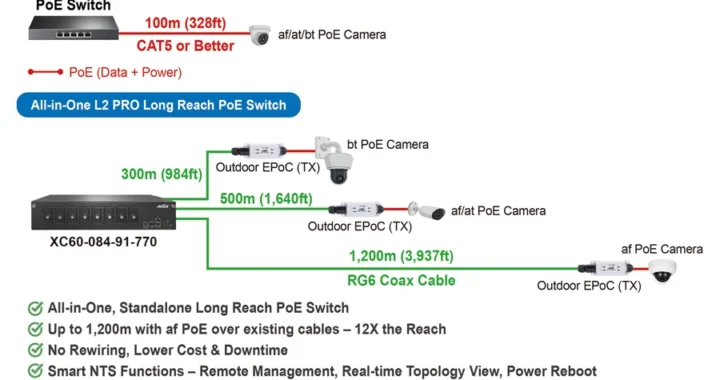
A cornerstone of this infrastructure overhaul is Power over Ethernet (PoE) technology. By consolidating power and data transmission into a single Ethernet cable, PoE deployments simplify complex network topologies, drastically reduce operational expenditures, enhance system reliability, and provide the resilience required for 24/7/365 monitoring.
Chronology of Connectivity: From Copper to Fiber and Beyond
The evolution of monitoring in the energy sector has followed a distinct path. In the early 2000s, monitoring was largely localized and manual. Data was recorded on-site and physically retrieved by technicians, leading to significant "information lag."

- The Early 2010s: The adoption of SCADA (Supervisory Control and Data Acquisition) systems improved remote monitoring, but these were often limited by low bandwidth and the need for separate, bulky power supplies for every camera or sensor.
- The Mid-2010s: The rise of IIoT began to demand higher data throughput. This period saw the integration of IP-based cameras and sophisticated vibration sensors, necessitating more robust networking equipment.
- The Present Day: We are in the era of Edge Computing and AI-driven predictive maintenance. Today’s requirements involve Type 4 PoE devices—such as 90W multi-sensor cameras and sophisticated access control systems—that require high-speed data and consistent power, regardless of the environment.
Supporting Data: Why Reliability is Non-Negotiable
Oil and gas infrastructures are categorized by their extreme operational demands. A failure in a monitoring system can lead to safety hazards, environmental incidents, and massive revenue loss. To mitigate this, architectures must incorporate built-in redundancy to ensure maximum uptime.
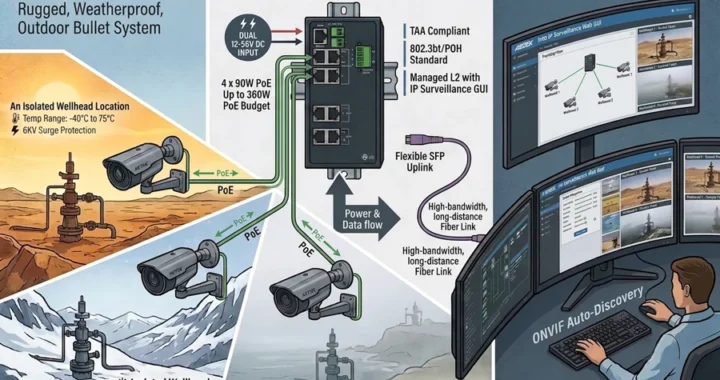
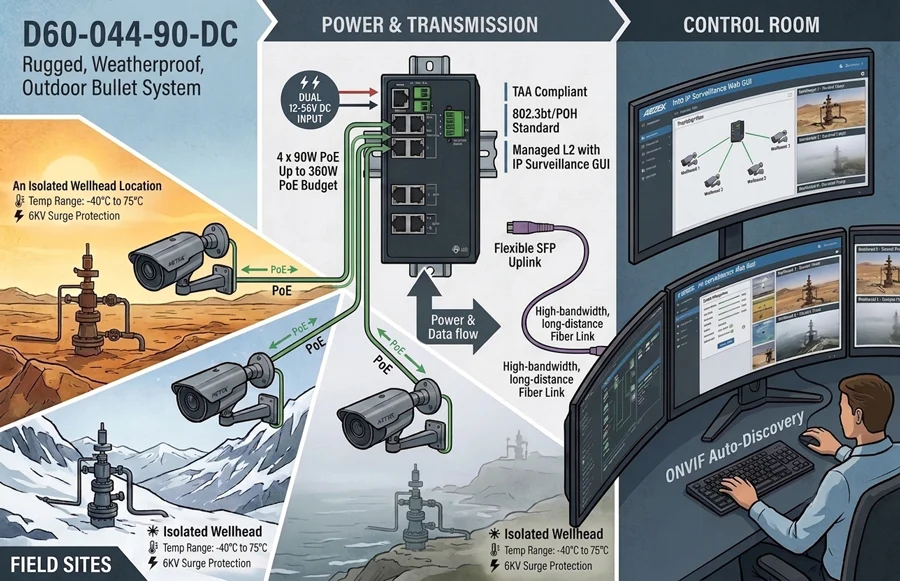
Versa Technology has emerged as a key player in addressing these requirements. Their industrial PoE switches, such as the D60 series, are engineered for the "edge" of the energy network. These units feature:
- Ruggedized Enclosures: Penetration ratings that shield internal components from dust, moisture, and corrosive atmospheric elements.
- Thermal Resilience: Operation ranges from -40°C to +75°C, ensuring functionality in everything from Arctic tundra to scorching desert environments.
- High-Power Delivery: The ability to provide up to 90W of power (802.3bt standard), sufficient to power advanced surveillance, radar, and edge-computing nodes.
- High-Speed Throughput: Gigabits per second data transfer capabilities, essential for real-time video analytics and instant machine-to-machine (M2M) communications.
Official Industry Perspectives and Operational Implications
Industry experts argue that the shift toward PoE-powered monitoring is not merely about hardware—it is about safety culture. "Real-time monitoring is the only way to transform from a reactive stance to a proactive one," says a lead systems engineer at a major midstream operator. "When we eliminate the need for high-voltage power lines at remote wellheads, we aren’t just saving money; we are removing a significant fire risk in explosive environments."
Monitoring Wellheads and Pipelines
The deployment of PoE switches like the D60-044-90-DC allows operators to extend their digital reach to the most remote corners of a pipeline. By using a single Ethernet cable, operators can deploy wireless access points (WAPs) along pipelines. This enables field technicians to connect their mobile devices or tablets directly to the local network for rapid troubleshooting, reducing the time required to diagnose a leak or a valve malfunction from days to minutes.
Enhancing Offshore Platform Safety
Offshore oil rigs are essentially floating, industrial cities. In such confined, hazardous environments, worker safety is the ultimate priority. PoE-enabled monitoring allows for:
- Intelligent Surveillance: Deploying high-definition, thermal imaging cameras that can detect gas leaks or overheating machinery in low-light, high-vibration areas.
- Access Control: Managing entry to sensitive zones of the rig, ensuring that only authorized personnel enter high-risk areas.
- Environmental Monitoring: Tracking wind speeds, wave heights, and structural integrity of the platform itself through a consolidated, low-latency network.
The Future of Predictive Maintenance with IIoT
Predictive maintenance is the engine of efficiency in modern asset management. By analyzing vibration, temperature, and pressure data, AI algorithms can identify subtle patterns indicative of impending failure.

Versa’s D60-084-90 series supports this by offering multiple port connections, allowing for the deployment of hundreds of sensors across a single facility. These sensors monitor:
- Compressor Health: Detecting bearing wear before a catastrophic failure occurs.
- Leak Detection: Using acoustic sensors to identify pipeline integrity issues.
- Corrosion Monitoring: Measuring the rate of pipe degradation in real-time.
By dispatching maintenance teams based on data-driven triggers rather than rigid, calendar-based schedules, companies significantly reduce the "mean time to repair" (MTTR) and extend the lifespan of critical capital equipment.
Implications for the Future of Energy
The implications of robust, PoE-enabled monitoring are profound. As the energy industry navigates the transition toward a more digitized and efficient future, the ability to "see" and "analyze" assets in real-time will determine the winners and losers in the market.
- Reduced Operational Costs: By simplifying cabling requirements and reducing the need for localized, high-voltage power grids, companies see an immediate drop in installation and maintenance expenses.
- Increased Safety: Automated, real-time data collection means fewer technicians are required to perform high-risk manual inspections in dangerous zones.
- Environmental Stewardship: Earlier detection of leaks and equipment failures directly correlates to a reduction in fugitive emissions and environmental contamination.
- Operational Agility: With better data, companies can pivot their production strategies faster, responding to global market volatility with precision.
Versa Technology’s commitment to providing industrial-grade, reliable networking solutions underscores a broader trend: the modernization of the oil and gas field. As companies continue to invest in the "connected well" and the "smart refinery," the reliance on robust, hardened, and efficient connectivity will only grow.
Whether a firm is currently evaluating its initial IIoT rollout or seeking to upgrade a legacy network to support advanced AI-driven analytics, the path forward is clear. By prioritizing infrastructure that can handle the extreme realities of the oil and gas sector—while simplifying the underlying network architecture—operators can ensure they remain not only functional but competitive in an increasingly complex global landscape. For those looking to discuss project specifications or explore the latest in industrial PoE solutions, reaching out to specialized providers like Versa Technology remains the primary step toward building a more resilient, transparent, and profitable future.