








In the rapidly evolving landscape of modern telecommunications, the backbone of connectivity—fiber optic cabling—remains a source of frequent confusion for system integrators, network architects, and IT professionals. As high-bandwidth demands from 8K video streaming, massive data center traffic, and real-time security surveillance skyrocket, selecting the correct transmission medium is no longer a secondary consideration; it is the fundamental decision that dictates the lifespan and scalability of an entire network installation.
At the heart of this selection process lies the persistent question: Should you deploy single mode (SM) or multimode (MM) fiber? While the choice may seem simple in the context of ISP-provided modem connections, the nuances of enterprise networking, AV distribution, and campus-wide security links require a deeper understanding of optical physics, budgetary constraints, and future-proofing strategies.
The Core Distinctions: A Technical Overview
To understand the difference between these two fiber types, one must first look at the physical architecture of the glass strands themselves. The fundamental distinction lies in the core size and the way light propagates through the fiber.
Single Mode Fiber: The Precision Conduit
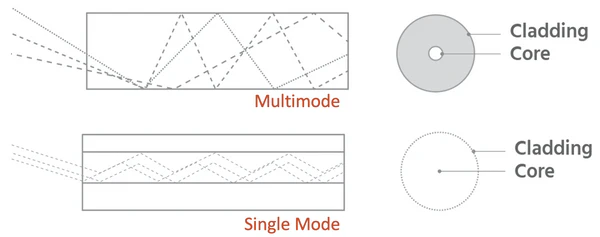
Single mode fiber is designed to propagate a single, narrow beam of light. Its optical core is incredibly small—typically measuring just 9µm in diameter. Because the core is so narrow, the light travels directly down the center without bouncing off the cladding walls. This eliminates "modal dispersion," a phenomenon where different light paths arrive at the destination at different times, which would otherwise smear the signal. By allowing only one mode of light, single mode fiber achieves near-infinite bandwidth potential and exceptionally low attenuation, making it the industry standard for long-haul and high-performance data transmission.

Multimode Fiber: The Multi-Path Alternative
In contrast, multimode fiber features a significantly larger core—standardized at 50µm in modern deployments, with older legacy systems using 62.5µm. This larger "pipe" allows multiple light modes (or rays) to propagate simultaneously. While this makes it easier to inject light into the fiber using cheaper, less precise LED or VCSEL (Vertical-Cavity Surface-Emitting Laser) light sources, it introduces the aforementioned modal dispersion. As light rays bounce off the internal walls of the cladding, they take slightly different paths and arrive at varying intervals, which ultimately limits the maximum distance and bandwidth capacity of the cable.
Chronology of Development: From Legacy to Modern Standards
The evolution of fiber optics is a history of chasing higher data rates over longer distances. Understanding the timeline of these technologies provides context for current installation choices.
- The Early Days (1970s–1980s): Initial fiber deployments were primarily multimode. The manufacturing tolerances required to align light sources with a 9µm core were prohibitively expensive for early commercial hardware.
- The Rise of Single Mode (1990s): As the internet matured, the need for long-distance connectivity drove the adoption of single mode. It became the dominant choice for telecommunications companies connecting cities and countries.
- The Multimode Evolution (2000s–Present): Multimode fiber underwent several iterations, classified by grades (OM1 through OM5). OM1 and OM2 were the standards for early local area networks (LANs). With the shift to 10Gbps, 40Gbps, and 100Gbps speeds, the industry moved toward laser-optimized OM3 and OM4, and more recently, OM5, which supports Shortwave Wavelength Division Multiplexing (SWDM).
Supporting Data: Comparative Performance Metrics
When selecting a medium, data-driven decisions are paramount. The following breakdown illustrates why single mode has become the preferred choice for modern infrastructure:
Bandwidth and Signal Stability
Single mode fiber supports significantly brighter, more powerful light sources. Because the signal remains coherent over much longer distances, it effectively offers theoretically unlimited bandwidth. In practice, the limiting factor for single mode is the capability of the transceiver electronics at either end, not the glass itself. Multimode, restricted by its modal dispersion, requires increasingly complex "laser-optimized" grades to maintain integrity as speeds increase.

Transmission Distance
The gap in distance capabilities is profound.
- Single Mode: Standard optics can easily transmit data up to 10km (6.2 miles) or more. For specialized long-haul applications, this distance can stretch into the hundreds of kilometers without needing signal amplification.
- Multimode: Distance is highly dependent on the grade of cable and the data rate. For high-speed 10Gbps or 40Gbps applications, multimode is often capped at 300m to 550m (approximately 1,000 to 1,800 feet). Beyond this, the signal degradation makes reliable data transfer impossible.
The Cost Paradox
Conventional wisdom suggests that the superior performance of single mode should come with a higher price tag. However, the manufacturing efficiency of single mode cable has reached a point where it is often 30% cheaper than equivalent multimode cabling. The cost-saving shifts to the electronics: single mode transceivers (SFP/SFP+ modules) typically cost more because they require more precise laser sources to inject light into the narrow 9µm core. Despite this, the total cost of ownership (TCO) for many large-scale installations favors single mode, especially when factoring in the lower cost of the cable runs.
Official Perspectives: The Industry Shift
Leading infrastructure experts at organizations like NSI Industries and industry bodies such as the Telecommunications Industry Association (TIA) have noted a distinct trend among professional integrators.
"In the past, we saw a heavy split between campus backbones (single mode) and building-level LANs (multimode)," says a senior technical expert. "Today, that line is blurring. Because of the cost parity of the cabling and the increasing demand for high-bandwidth applications like 8K video and AI-driven data centers, we see more integrators standardizing on single mode for almost everything. It effectively future-proofs the installation against any future bandwidth requirement."
The consensus is clear: while multimode still holds a niche for specific, short-distance, low-cost equipment connections, single mode is the universal recommendation for any project where longevity is a priority.
Strategic Implications for Future Installations
When planning a network, the choice of fiber carries significant long-term implications.
Avoiding "Signal Killing" Mismatches
One of the most critical warnings provided by engineers is the danger of attempting to bridge the two types. One cannot simply patch a multimode cable into a single mode port. Because the core sizes are mismatched (50µm vs 9µm), the vast majority of the light signal will be lost at the interface, causing "optical return loss" that can degrade or completely kill the connection. If a legacy network must be connected to a new single mode backbone, specialized media converters and active SFP modules are required to bridge the gap.
The Importance of Infrastructure Tooling
Integrators must ensure that their toolkit is ready for the transition. Fortunately, modern fiber termination kits, testing equipment (such as OTDRs and light meters), and cleaning supplies are generally compatible with both types of fiber. However, connectors—LC, SC, ST, etc.—must be matched to the specific fiber type to ensure proper alignment and performance. Using a connector designed for a larger core on a smaller fiber will lead to catastrophic signal loss.

Future-Proofing for the AI Era
With the explosion of high-density data requirements, the "install once" philosophy is gaining traction. By installing single mode fiber today, a facility ensures that as networking hardware evolves from 10G to 100G or 400G, the physical layer will not need to be replaced. The only required upgrade will be the transceiver modules at the ends of the fiber, providing a scalable path that protects the initial capital investment.
Conclusion
The debate between single mode and multimode fiber is no longer just a technical exercise; it is a strategic business decision. While multimode fiber served the industry well during the era of localized, low-speed networking, the demands of the modern digital landscape favor the performance, distance, and economic efficiency of single mode fiber.
For integrators, the path forward involves evaluating the specific constraints of each site, yet recognizing that single mode provides a robust, future-ready foundation for virtually any application. Whether for a smart building, a high-security surveillance network, or a high-speed data center, the investment in single mode fiber is an investment in the longevity and reliability of the network. When in doubt, consult with technical experts to ensure that your hardware, transceivers, and cable grades are perfectly matched to meet the demands of tomorrow.