





SANTA CLARA, CA – [Date of Publication] – In a move poised to redefine enterprise AI adoption, Palo Alto Networks today announced the general availability of Prisma AIRS AI Gateway. This groundbreaking solution is positioned as the central AI control plane for businesses, designed to bridge the inherent tension between the rapid velocity of AI innovation and the critical need for robust enterprise-grade security and control. The launch significantly accelerates the integration of AI capabilities, enabling organizations to harness the transformative power of artificial intelligence at machine speed without compromising their security posture or operational governance.
The advent of AI is fundamentally reshaping how modern enterprises operate, transitioning them from software-defined organizations to AI-orchestrated entities. This paradigm shift, while promising unprecedented efficiency and innovation, has simultaneously introduced a critical dichotomy: the imperative for rapid deployment versus the necessity for stringent oversight. Palo Alto Networks asserts that a unified architecture is not merely beneficial but essential to navigate this complex landscape.
The Prisma AIRS AI Gateway, a direct result of Palo Alto Networks’ strategic acquisition of Portkey, is being brought to market with remarkable speed. Just six weeks after the acquisition’s closure, the innovations and expertise from Portkey have been seamlessly integrated into the Prisma AIRS platform. This swift integration underscores the company’s commitment to providing immediate, impactful solutions for the evolving AI frontier.
The Accelerating AI Footprint: A Growing Governance Gap
Evidence from Palo Alto Networks’ next-generation firewall telemetry paints a stark picture of the accelerating AI adoption and the widening gap in its governance. Late last year, Machine Control Plane (MCP) activity, a key indicator of AI integration into enterprise workflows, stood at a mere 11%. By mid-2026, this figure has surged to an astonishing 41.4%. This exponential growth is mirrored in the sheer volume of AI transactions. Over a six-month period, monthly AI transaction volume has increased twelve-fold. Disturbingly, some individual AI sessions have been observed transferring hundreds of megabytes of sensitive enterprise data outbound, highlighting a significant and rapidly expanding risk surface.
The most aggressive adoption of AI is currently being witnessed in critical areas such as coding assistants, enterprise agents, and copilots. These tools are empowering development teams, streamlining complex tasks, and fostering a new era of productivity. However, as these AI tools actively engage with enterprise data, generating and transmitting information, they inherently create security and governance challenges of an unprecedented scale and velocity. The AI footprint that organizations can effectively govern today is, by definition, the smallest it will ever be, emphasizing the urgent need for proactive and scalable solutions.
The Unraveling of Traditional Controls in the Age of AI Agents
The rapid proliferation of AI tools across every team and function within an organization inevitably exposes vulnerabilities in existing security and governance frameworks. When AI adoption outpaces the infrastructure designed to secure it, several critical areas begin to falter:
- Data Exfiltration Risks: As AI agents and copilots process and transmit enterprise data, the risk of sensitive information, proprietary code, intellectual property, and customer data leaving the organization’s controlled environment increases dramatically. Traditional security perimeters are often ill-equipped to monitor and control the dynamic, API-driven nature of AI interactions.
- Shadow AI and Unsanctioned Usage: Without a centralized control plane, teams may adopt AI tools and services independently, leading to "shadow AI." This decentralized adoption bypasses IT oversight, creating blind spots in security monitoring, cost management, and compliance enforcement. The use of unsanctioned models or tools can introduce significant vulnerabilities and compliance risks.
- Credential and Access Management: AI agents often require access to sensitive systems and data. Managing these access credentials securely, especially when dealing with numerous AI agents and dynamic access needs, becomes a monumental challenge. The risk of compromised credentials or over-privileged AI agents can have catastrophic consequences.
- Prompt Injection and Malicious Inputs: AI models are susceptible to prompt injection attacks, where malicious actors craft inputs to manipulate the AI’s behavior, potentially leading to the disclosure of sensitive information, unauthorized actions, or the generation of harmful content. Securing against these novel attack vectors requires specialized capabilities.
- Compliance and Regulatory Hurdles: The increasing use of AI raises complex questions around data privacy, regulatory compliance (e.g., GDPR, CCPA), and auditability. Organizations struggle to demonstrate compliance when the usage and data flows associated with AI are not adequately monitored and controlled.
- Cost Management and FinOps Challenges: The consumption of AI services, particularly large language models (LLMs), can lead to significant and often unpredictable costs. Without visibility into usage patterns, token consumption, and individual project expenses, managing AI budgets and optimizing spending becomes exceedingly difficult.
Faced with this escalating challenge, many organizational leaders are forced into binary, often ineffective, decisions: either block AI traffic entirely, stifling innovation and productivity, or remain permissive, promising to implement governance measures later. Both approaches are fundamentally flawed because they skip the crucial intermediate step: the ability to actively observe what AI agents are doing at runtime and to control their actions in real-time. This critical gap leaves organizations exposed to significant risks.
Accelerating AI Adoption with Integrated Control: The Prisma AIRS Promise
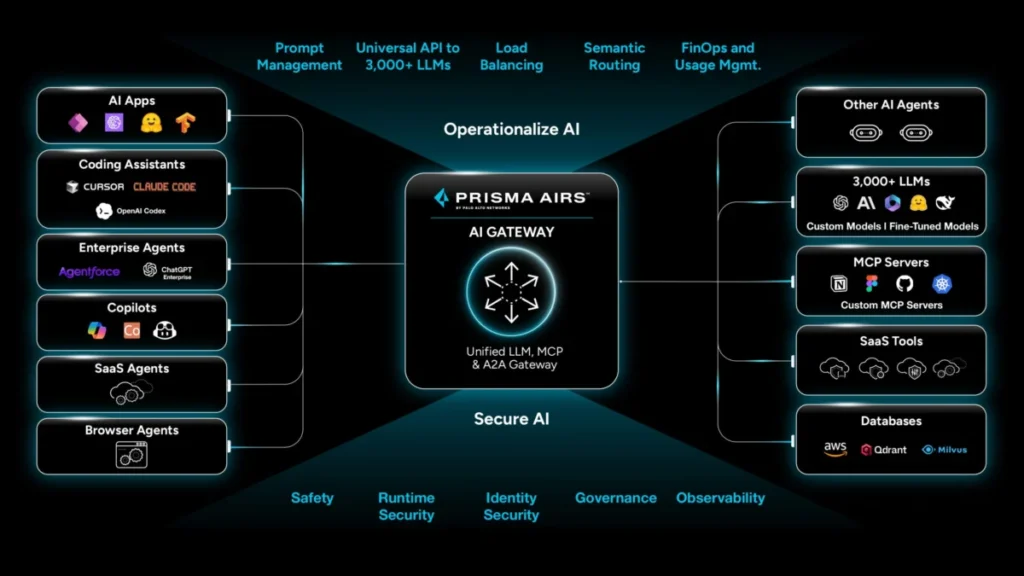
To enable organizations to scale AI adoption safely and effectively, a unified control plane is indispensable. This control plane must sit strategically between every AI interaction, the underlying models, and the various AI agents or applications. The Prisma AIRS AI Gateway fulfills this vital role by consolidating AI governance, identity management, and runtime controls into a single, cohesive platform.
With the Prisma AIRS AI Gateway, organizations can:
- Gain Comprehensive Visibility: Understand who is using AI, what models they are accessing, which projects are involved, and the associated costs and resource consumption.
- Enforce Granular Governance: Define and enforce policies on approved AI models, tools, and access permissions without requiring developers to alter their configurations.
- Secure AI Interactions: Protect critical assets like credentials, proprietary code, and development systems from risky AI actions by managing scoped access and identity.
- Mitigate Runtime Threats: Inspect AI prompts and responses in real-time to prevent data leakage, neutralize prompt injection attacks, and ensure compliance with emerging AI security standards.
- Streamline Operational Controls: Apply data protection measures, usage limits, and policy checks as AI interactions occur, ensuring a secure and compliant AI ecosystem.
- Manage Costs Effectively: Track AI expenditure by team or project, enabling proactive budget management, identification of unsanctioned usage, and enforcement of rate limits.
How the Prisma AIRS AI Gateway Operates: A Unified Enforcement Point
The Prisma AIRS AI Gateway is engineered to operate inline, acting as a central nexus for all AI interactions. It sits between every user or application initiating an AI request and the backend AI models and service providers. This strategic placement allows it to function as a unified gateway for LLMs, Machine Control Plane (MCP) tools, and Agent-to-Agent (A2A) communications, providing a single point of enforcement for all operational and security controls.
This architecture ensures that development teams can continue to leverage their preferred coding assistants, enterprise agents, and copilots without disruption. Meanwhile, the critical enforcement of security and governance policies shifts to the infrastructure layer, where dedicated platform teams can maintain centralized ownership and oversight.
The capabilities delivered through this unified control plane are multifaceted and address the core challenges of enterprise AI adoption:
Observability: Unmasking the AI Landscape
The Prisma AIRS AI Gateway provides a single, unified view of all AI requests. This comprehensive telemetry tracks key metrics such as:
- Usage Patterns: Identifying which AI services and models are being accessed most frequently.
- User and Project Mapping: Attributing AI usage to specific users, teams, and projects for accountability and cost allocation.
- Token Counts and Latency: Monitoring resource consumption and performance metrics for optimization and troubleshooting.
- Cost Tracking: Providing granular insights into the financial implications of AI usage across the organization.
This deep observability is crucial for retiring "shadow AI" infrastructure and gaining a clear understanding of the organization’s actual AI footprint.
Governance: Centralized Policy and FinOps
The gateway empowers organizations to establish and enforce AI governance policies from a central console. This includes:
- Model and Tool Approval: Defining a curated list of approved AI models and tools, ensuring that only vetted and secure options are utilized.
- Access Control: Implementing granular access controls to restrict who can access specific AI capabilities or models.
- FinOps Management: Providing detailed cost breakdowns by team, project, or usage metric. This allows for proactive budget management, the identification of cost anomalies, and the ability to shut down unsanctioned or inefficient AI usage before it escalates.
- Rate Limiting and Quota Enforcement: Proactively enforcing usage limits and rate caps to prevent overspending and ensure fair resource allocation.
Coding Assistant Security: Shielding Development Assets
A significant concern with AI adoption is the potential for coding assistants to inadvertently expose sensitive development assets. The Prisma AIRS AI Gateway addresses this by:
- Scoped Credential Management: Replacing raw provider API keys with securely scoped credentials that are assigned per user and team. This limits the potential damage if an individual agent’s credentials are compromised.
- Proprietary Code Protection: Implementing policies to prevent proprietary code or sensitive development configurations from being transmitted to AI models or external services.
- System Access Control: Ensuring that AI agents only access development systems and resources that are explicitly authorized, preventing unauthorized modifications or data breaches.
Operational Controls: Real-time Policy Enforcement
The gateway acts as a dynamic enforcement point for operational policies as AI interactions unfold:
- Data Protection: Applying data loss prevention (DLP) policies to scan and block sensitive data from leaving the organization during AI interactions.
- Usage Limits: Enforcing predefined limits on the number of requests, tokens, or duration for specific AI services or users.
- Policy Checks: Performing real-time policy checks against prompts and responses to ensure compliance with organizational standards and regulatory requirements.
- Universal API Distribution: Utilizing a Universal API to distribute traffic across multiple AI providers, ensuring that quotas are enforced and that service outages do not disrupt critical AI workflows.
Agent Identity Security: Establishing Trust in AI Interactions
As AI agents become more sophisticated and autonomous, establishing their identity and ensuring their trustworthiness is paramount. The Prisma AIRS AI Gateway facilitates this by:
- Verifiable Agent Identity: Binding a verifiable, ephemeral identity to AI agents at the time of their execution. This ensures that only authenticated and authorized agents can initiate AI calls.
- Enforcement Point for Authentication: Acting as the central enforcement point to permit only authenticated agents to make approved calls to AI models and services.
Runtime Security: Proactive Threat Neutralization
Leveraging the power of Prisma AIRS AI Runtime Security, the gateway provides robust protection against novel AI-specific threats:
- Inline Prompt and Response Inspection: The gateway meticulously inspects every prompt sent to an AI model and every response received. This real-time analysis allows for the immediate identification and mitigation of threats.
- Data Leakage Prevention: Proactively stopping sensitive information, including source code, secrets, and customer data, from being exfiltrated through AI interactions.
- Prompt Injection Mitigation: Neutralizing prompt injection attempts by detecting and blocking malicious inputs that aim to manipulate AI behavior. This is aligned with the latest security recommendations from OWASP, including the OWASP LLM Top 10 and the OWASP Top 10 for Agentic Applications.
The company emphasizes the foundational role of an AI gateway in any modern AI architecture. Organizations can learn more about the Prisma AIRS AI Gateway and register for an upcoming webinar to witness its capabilities in action.
The Agentic Enterprise: A New Era of AI-Driven Operations
The reality of the "agentic enterprise" is here, with developers already embracing AI agents and copilots to accelerate their workflows. Palo Alto Networks, recently recognized by Gartner as a "company to beat" in AI Security Platforms, is strategically positioned to guide organizations through this transformative period. The Prisma AIRS AI Gateway is not just a product; it is the essential architectural component that enables enterprises to build and operate securely in the AI-driven future.
By offering a unified control plane that integrates governance, identity, and runtime security, Palo Alto Networks is empowering businesses to unlock the full potential of AI without succumbing to the associated risks. As the adoption of AI continues its exponential trajectory, the Prisma AIRS AI Gateway stands as a critical enabler for secure, controlled, and efficient AI integration, ensuring that innovation and security advance hand in hand. The company invites organizations to collaborate: "Let’s build it securely, together."