




The commercial real estate landscape is undergoing a silent, high-voltage revolution. As modern buildings transition from passive brick-and-mortar structures into "living" intelligent ecosystems, the demand for data and electricity has surged in tandem. AI-powered surveillance, 4K high-definition security cameras, multi-sensor environmental monitors, and high-performance Wi-Fi 7 access points have become the new standard for property owners. However, these advanced tools have outpaced the capabilities of legacy network infrastructure.
The solution lies in the adoption of Type 4 Power over Ethernet (PoE), specifically the IEEE 802.3bt standard. By delivering up to 90W of power over a single Ethernet cable, Type 4 PoE is effectively serving as the universal "power cord" for the smart-building era, bridging the gap between high-performance hardware and electrical accessibility.
Main Facts: Redefining Network Power Standards
At its core, Type 4 PoE represents a massive leap forward from the early days of simple network power. While legacy PoE standards (like 802.3af/at) were designed primarily for VoIP phones and basic security cameras, the modern "Internet of Things" (IoT) environment requires significant electrical throughput.

Type 4 PoE (IEEE 802.3bt) operates by utilizing all four pairs of an Ethernet cable to transmit power, allowing for a staggering 90W at the power source and roughly 71.3W at the powered device (PD). This is a game-changer for commercial infrastructure. It removes the necessity of running high-voltage AC electrical lines to every corner of a ceiling or exterior wall, which traditionally requires expensive certified electricians and complex conduit installations. Instead, IT departments can deploy sophisticated hardware with a single, streamlined cable run, drastically reducing installation costs and labor timelines.
Chronology: The Evolution of PoE
To understand the necessity of Type 4, one must look at the trajectory of Ethernet technology:
- 2003 (IEEE 802.3af): The initial PoE standard provided a modest 15.4W per port. It was revolutionary for its time but limited to low-power devices.
- 2009 (IEEE 802.3at / PoE+): As security cameras gained motorized zoom and basic heating capabilities, power needs grew. PoE+ pushed the limit to 30W, enabling more robust indoor security devices.
- 2018 (IEEE 802.3bt / PoE++): The current benchmark. Type 3 (60W) and Type 4 (90W) were introduced to support the high-drain requirements of modern AI-driven hardware, including PTZ (Pan-Tilt-Zoom) cameras, large-format digital signage, and advanced biometric access control systems.
Supporting Data: Why High-Power PoE is Necessary
Market research from organizations like Global Market Insights indicates that the PoE solutions market is experiencing exponential growth, driven by the push for "smart cities" and integrated security frameworks. The technical requirements for modern devices are clear:

- AI-Driven Security: A standard 4K AI-enabled camera requires constant processing power for object detection, facial recognition, and data transmission. When coupled with built-in IR illuminators for night vision and heaters for cold-weather operation, the power draw often exceeds 40W—rendering legacy PoE switches insufficient.
- Wireless Densification: Modern Wi-Fi 6E/7 access points utilize multiple radios and advanced beamforming technology, which demand consistent, high-wattage input to maintain performance levels during peak traffic.
- Cable Efficiency: By migrating to Cat6A cabling in conjunction with Type 4 PoE, enterprises not only secure more power but also benefit from significantly reduced heat dissipation, which is critical when cabling is bundled in enclosed ceiling plenums.
Step-by-Step: Upgrading Your Network Infrastructure
Upgrading to Type 4 PoE is not a "plug-and-play" endeavor; it requires a systematic, risk-averse approach.
1. Assessment of Current Infrastructure
Before purchasing hardware, perform a full audit. Inventory every existing switch, power source, and cabling run. Use power meters to measure the actual draw of your current devices versus their theoretical peak usage. Identify bottlenecks—if your current switch is operating at 90% power capacity, adding a single new AI-security camera could trigger a cascading system failure.
2. Planning and ROI
A successful migration considers long-term scalability. Calculate the total cost of ownership (TCO), comparing the expense of traditional electrical contractor work against the cost of upgrading to PoE++ switches. Ensure you factor in the "future-proofing" benefit: a network capable of 90W today will likely be able to power the sensors of tomorrow.

3. Equipment Selection
When selecting hardware, prioritize managed industrial switches that support IEEE 802.3bt. Look for features such as:
- Redundant Power Supplies: To ensure 24/7 uptime for critical security systems.
- Intelligent Power Budgeting: The ability to prioritize power to specific ports during an outage.
- Thermal Management: Switches should be rated for the environment they occupy, particularly if placed in non-climate-controlled IT closets or outdoor enclosures.
4. Implementation and Testing
Once the hardware is deployed, rigorous testing is mandatory. Conduct "load testing" by simulating peak power usage across all ports simultaneously. Verify that auto-negotiation protocols between the switch and the PDs are functioning correctly to prevent power surges or under-voltage issues.
Official Perspectives: The Industry Shift
Industry experts emphasize that the transition to Type 4 PoE is about more than just power; it is about "Network Convergence." By centralizing the management of security, lighting, and data, facility managers can gain unprecedented control over their building’s energy profile.

"The Ethernet cable is the universal power cord of the smart-building era," note infrastructure engineers. By consolidating the data and power planes, businesses reduce their physical footprint and simplify troubleshooting. If an AI camera goes offline, the technician has one point of contact to check for both data connectivity and power delivery, rather than coordinating between an IT team and an electrician.
Implications for the Future
The horizon for high-power PoE is expanding into areas previously deemed impossible for Ethernet-based power.
5G Densification
As 5G networks roll out, the need for small cells (micro-base stations) is increasing. These cells must be placed in high-traffic, dense locations. High-power PoE provides the most efficient way to backhaul data and provide power to these nodes, which are often mounted on streetlights or building facades.

AI-Driven Energy Management
We are moving toward an era of "Predictive Power." Imagine a smart building where an AI controller monitors the occupancy of a floor. If the sensors indicate no one is present, the system automatically dims PoE-powered LED lights and puts non-essential IoT sensors into a sleep state, reallocating that power to high-bandwidth security cameras in sensitive zones. This level of granular control is only possible when the network hardware can dynamically manage power budgets via PoE++ standards.
The 100W+ Frontier
Research is currently underway to push power delivery beyond the 100W threshold. While thermal management remains a primary hurdle, innovations in shielded, high-gauge cabling and advanced power-negotiation protocols are paving the way for PoE to power high-performance workstations and even small-scale industrial robotics.
Choosing the Right Partner: Versa Technology
For enterprises ready to make the transition, the D62-084-MX-DC managed industrial L2 switch stands out as a prime example of modern PoE integration. It provides a flexible, robust solution for environments ranging from warehouse security systems to high-traffic commercial lobby surveillance.

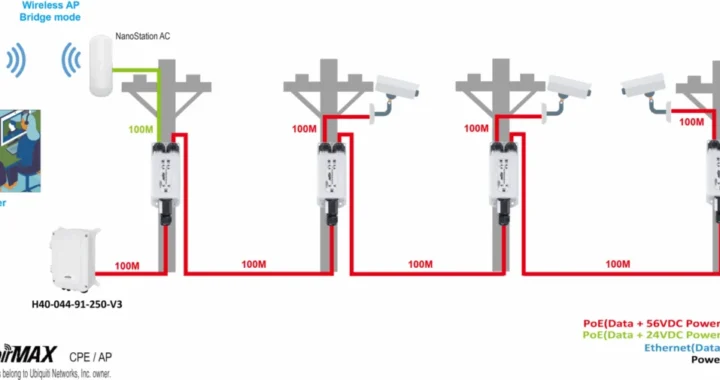
With IEEE 802.3bt support, this switch handles the rigorous power demands of PTZ cameras and multi-sensor units without breaking a sweat. Its ability to manage 24V and 56V DC passive outputs makes it an ideal "bridge" for facilities that have a mix of legacy and modern hardware, ensuring that the migration to high-power PoE is as seamless as possible.
As commercial properties become more complex, the reliability of the underlying network becomes the most valuable asset. By investing in Type 4 PoE today, property owners are not just upgrading their security—they are building the power-efficient foundation upon which the future of smart, automated architecture will stand.
For more information on upgrading your facility or to consult with an expert on network infrastructure, visit Versa Technology.