





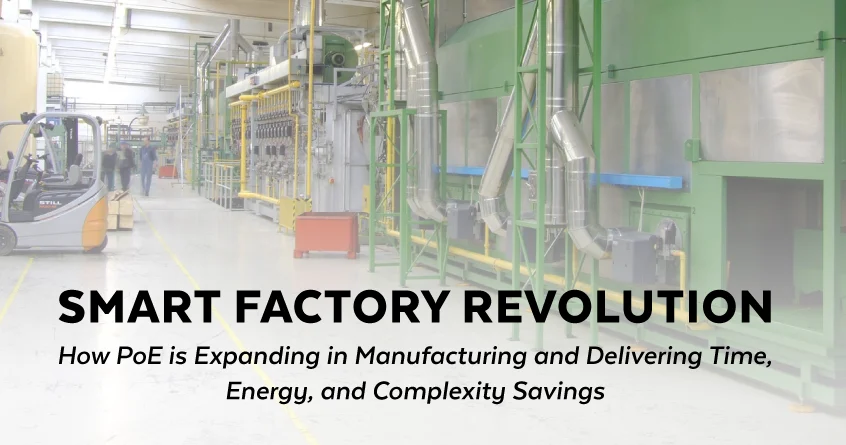
The modern factory floor is undergoing a metamorphosis. Where once stood a chaotic web of high-voltage conduits, bulky power bricks, and daisy-chained extension cords—a "spaghetti" of cabling that posed both safety risks and operational bottlenecks—a new standard is emerging. As manufacturers pivot toward Industry 4.0 and the Industrial Internet of Things (IIoT), the infrastructure required to support high-density connectivity is shifting. At the center of this transformation is Power over Ethernet (PoE), a technology that has evolved from a simple office connectivity solution into the high-bandwidth, high-wattage backbone of the smart manufacturing ecosystem.
Industry experts project that the market for PoE solutions will grow at a compound annual growth rate (CAGR) of 17% through 2034. This surge is not merely a preference for convenience; it is a fundamental reaction to the demands of modern automation, where the speed of deployment, energy efficiency, and operational uptime dictate a facility’s global competitiveness.
Main Facts: The Convergence of Power and Data
At its core, PoE technology allows a single Cat 6a (or higher) Ethernet cable to simultaneously deliver both data and electrical power to end devices. This convergence eliminates the redundant infrastructure that has historically plagued industrial environments.
For decades, industrial engineers were forced to treat power and data as distinct systems. A camera, sensor, or controller required two separate paths: one for the electrical grid and one for the network. In a facility with thousands of IoT nodes, this led to massive material waste, complex installation timelines, and a susceptibility to electrical interference. PoE simplifies this architecture by treating the Ethernet cable as a unified delivery mechanism.
The primary advantage is structural: by consolidating these needs, manufacturers remove the "tangled mess" of legacy wiring. Furthermore, by moving from distributed AC power to centralized DC power managed through a network switch, manufacturers gain granular control over their factory’s power consumption, allowing for remote diagnostics, automated scheduling, and real-time power monitoring.
Chronology: From VoIP Phones to Robotic Nerve Centers
The journey of PoE is one of gradual sophistication, mirroring the rapid evolution of digital infrastructure.
- 1999–2003 (The Genesis): The concept of PoE began with the need to power VoIP phones and early network cameras without running individual power lines to every desk or ceiling corner. The IEEE 802.3af standard (2003) officially defined the technology, providing up to 15.4 watts per port.
- 2009 (PoE+): As devices became more complex, the IEEE 802.3at standard, or PoE+, increased power output to 30 watts, supporting devices like dual-band wireless access points and pan-tilt-zoom (PTZ) cameras.
- 2018 (PoE++ / 4PPoE): The IEEE 802.3bt standard represented a watershed moment for industry. By utilizing all four pairs of an Ethernet cable, PoE++ provides up to 60–100 watts of power, enabling the support of industrial-grade devices like smart lighting, high-performance edge computing nodes, and sophisticated robotic arms.
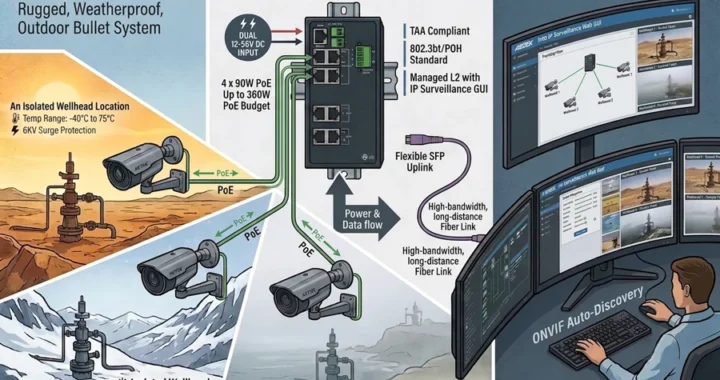
- 2024–Present (The Industrial Era): Today, the integration of hardened, ruggedized PoE switches—capable of withstanding extreme vibration, dust, and temperature fluctuations from -40°C to 75°C—has signaled the technology’s full arrival on the manufacturing floor.
Supporting Data: The ROI of Streamlined Infrastructure
The economic argument for PoE is built on three pillars: reduced labor, lowered operational expenses, and future-proof scalability.

1. The Cost of Labor and Installation
In a traditional factory setup, installing a new device requires a licensed electrician to pull high-voltage lines, install conduit, and ensure local building code compliance. This process can take days and significantly inflate the cost of adding a single node. In contrast, a PoE deployment is a "plug-and-play" operation. Because PoE operates at low-voltage levels, it often bypasses the need for intensive electrical permits, allowing IT personnel to install and relocate sensors in minutes.
2. Intelligent Power Management
AI-driven PoE systems are currently yielding a reported 25% reduction in energy bills for connected facilities. By centralizing power at the switch, facility managers can implement "smart power budgets." If a specific machine is inactive, the switch can intelligently throttle or cut power to its associated sensors, eliminating the "always-on" waste of traditional AC outlets.
3. Reduced Material Footprint
Fewer cables mean less physical weight on cable trays, less heat generation, and a smaller carbon footprint. In massive facilities, the cumulative reduction in copper and plastic shielding supports corporate ESG (Environmental, Social, and Governance) goals, while simultaneously improving airflow and reducing fire hazards.
Official Perspectives and Industry Implications
Industry leaders, including the Ethernet Alliance, emphasize that PoE is no longer an optional upgrade; it is the "nervous system" of the smart factory.
"We are seeing a shift where connectivity is becoming synonymous with reliability," says an industry spokesperson. "As AI-integration tightens, the switch is no longer just a power distribution hub—it is a predictive diagnostic tool."
Modern industrial switches are now capable of monitoring the health of connected devices. By analyzing power consumption patterns, these systems can flag "pre-failure" conditions. For example, a motor on a conveyor belt might draw slightly more current as its bearings begin to seize; an intelligent PoE switch detects this anomaly and alerts maintenance teams before a catastrophic shutdown occurs. This transition from reactive to predictive maintenance is the hallmark of the transition to Industry 4.0.
Furthermore, the integration of IT and OT (Operational Technology) networks is creating a unified data environment. By bridging these networks via a single Ethernet backbone, manufacturers can feed real-time factory floor data directly into cloud-based AI analytics platforms, creating a closed-loop system of constant optimization.

Future Horizons: The 10G+ Frontier
Looking forward, the evolution of PoE shows no sign of slowing. The industry is currently transitioning toward "Multi-Gigabit" PoE, where massive data throughput is required to support the next generation of 4K machine vision and high-definition factory-floor analytics.
The emergence of Single Pair Ethernet (SPE) is another critical development. By reducing the number of wires within the cable while extending the reach of the signal, SPE allows IP connectivity to penetrate the deepest, most rugged corners of the factory—places where traditional bulky Ethernet cables were previously impractical.
As the Ethernet Alliance continues to standardize transmission speeds—with roadmaps reaching 200 Gbps, 400 Gbps, and eventually 1.6 Tbps—the role of PoE will continue to expand. We are moving toward a reality where every single mechanical component in a factory is not only connected but also powered by a software-defined infrastructure.
The Strategic Necessity
For manufacturers, the choice is clear. The complexity of modern automation cannot be supported by the electrical infrastructure of the 20th century. While the initial capital expenditure for high-end, industrial-grade PoE switches may appear higher than traditional wiring, the long-term gains in uptime, labor savings, and energy efficiency offer a superior return on investment.
The smart factory of the future is lean, agile, and interconnected. It is a factory where power and intelligence flow through the same wire, enabling a level of precision and real-time control that was previously the stuff of science fiction. As we move toward 2034, the adoption of PoE will likely serve as the dividing line between those manufacturers who are merely keeping up and those who are leading the industrial revolution.
Key Takeaways for Facilities Managers:
- Scalability: PoE allows for modular growth; new devices are added as easily as plugging in a phone.
- Safety: Low-voltage delivery reduces fire and shock risks in high-traffic or hazardous environments.
- Reliability: Centralized management via industrial-grade switches allows for instant remote troubleshooting and power cycling.
- Sustainability: Lower energy consumption and reduced raw material usage contribute to a smaller environmental footprint.
The infrastructure of the factory floor is no longer just "cabling." It is a strategic asset. By investing in PoE today, manufacturers are laying the foundation for the resilient, data-driven, and highly automated manufacturing landscape of tomorrow.