

By Barry Elliott, Director, Capitoline Ltd
The rapid ascent of Artificial Intelligence (AI) and the subsequent demand for High-Performance Computing (HPC) have fundamentally altered the landscape of data center design. We are currently witnessing a transition of historical proportions: the shift from the traditional "servers-in-racks" model to what industry observers are calling "data centers-in-cabinets."
At the heart of this transformation are massive GPU clusters—exemplified by NVIDIA’s GB200/300 NVL72 architectures. While these machines represent the pinnacle of computational capability, they present a profound challenge to the established standards of resilience and availability that have defined the industry for two decades.
The Collision of Legacy Standards and Future-Tech
For twenty years, the data center industry has matured under the guidance of the ANSI/TIA-942 standard. This framework provides a benchmark for reliability, categorized into four distinct availability ratings. Historically, these facilities were designed to support air-cooled racks with power and cooling densities ranging from 5 kW to 15 kW.
To achieve the "professional grade" of data center operations—specifically Rating 3 (concurrently maintainable) or Rating 4 (fault-tolerant)—operators relied on redundant cooling systems, dual-path power supplies, and geographically diverse cabling routes. However, as GPU "superpods" begin to demand power densities of 132 kW per rack, with industry projections pushing toward 1 MW per rack, the classic TIA-942 architecture is being pushed to its breaking point.
Chronology of a Crisis
- The Air-Cooled Era (2000–2015): The industry standardized on rack densities of 5–10 kW, cooled primarily by CRAC (Computer Room Air Conditioning) units and raised-floor plenum delivery.
- The Immersion Experiment (2015–2022): As densities began to creep upward, liquid cooling and immersion techniques gained traction. However, adoption remained niche, and the majority of the global fleet remained air-cooled.
- The Generative AI Explosion (2023–Present): The release of large-scale LLMs necessitated a massive spike in GPU interconnectivity. The "Superpod" era arrived, characterized by proprietary interconnects and power requirements that rendered traditional air-cooled, room-level infrastructure obsolete.
The Power Dilemma: From 48V to 800V
The sheer scale of power consumption in modern AI HPC environments necessitates a total rethink of electrical distribution. Current GPU compute units rely on 48V DC power. In a standard setup, a three-phase UPS feeds an AC bus within the rack, which then utilizes AC-to-DC power supply units (PSUs) to feed a DC distribution bus.
Currently, this system lacks inherent redundancy. While N+1 configurations for power supplies are technically feasible, the sheer volume of current required for a 132 kW rack makes traditional copper-heavy cabling inefficient. To address this, NVIDIA and other industry leaders are proposing a shift to an 800V DC distribution system.
By increasing the voltage, operators can significantly reduce the current, thereby minimizing $I^2R$ (ohmic) heating losses. Delivering 1 MW using legacy 48V technology would require copper busbars of impractical dimensions. While the 800V move is logical, it introduces significant cost and safety complexities, as the data center must now treat the entire rack "superpod" as a single, massive, integrated computer rather than a collection of independent servers.
Cooling: The Transition to Direct Liquid Cooling (DLC)
Air cooling has reached its thermodynamic limit. Even full immersion cooling struggles to keep pace with the localized heat flux of modern AI accelerators. Consequently, chipmakers are mandating Direct Liquid Cooling (DLC), where coolant is delivered directly to the silicon.
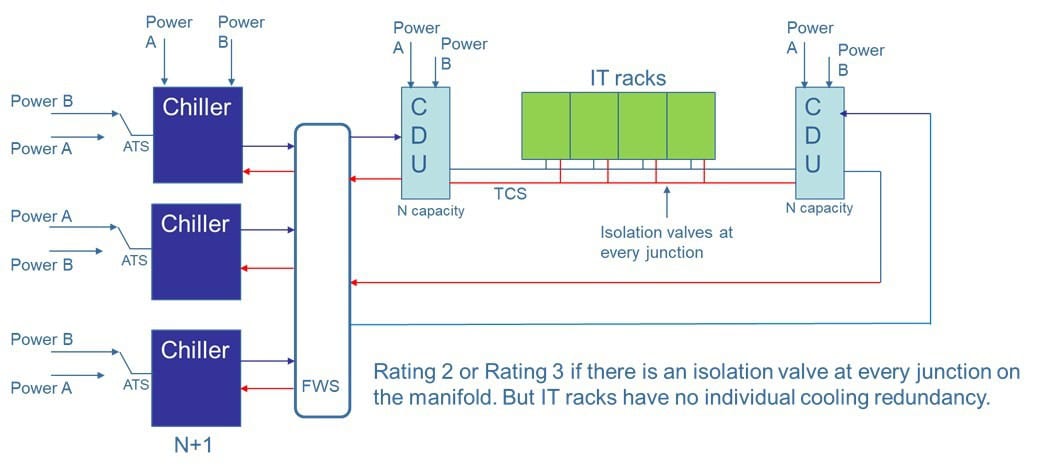
The architectural challenge here is one of failure domains. In a typical DLC setup, compute units feature a single water feed pipe in and one out. There is no internal redundancy. These connect to a rack-level manifold, which links to a pod-level manifold, eventually connecting to a Cooling Distribution Unit (CDU). The CDU acts as the vital interface between the IT cooling system (Technology Cooling System) and the facility’s primary water loop.
The vulnerability is clear: if a manifold or a primary pump fails, the entire pod loses cooling. Furthermore, the stringent requirements for water purity—with some manufacturers suggesting filter changes every 1,000 hours—introduce the risk of "planned downtime." Under the strict definitions of ANSI/TIA-942 Rating 3 or 4, this level of scheduled maintenance downtime is often unacceptable, creating a fundamental friction between high-performance hardware requirements and data center availability standards.
The Cabling Paradox
Perhaps the most drastic change occurs in the cabling layer. The traditional TIA-942 model is built on structured cabling, where every device is accessible via patch panels, ensuring flexibility and redundant pathways.
In the AI HPC world, this model effectively collapses. These environments rely on "scale-up" and "scale-out" networks using ultra-Ethernet and InfiniBand, requiring direct-attached cables (DAC) of only 3 to 7 meters. In a single twelve-rack model, one might find as many as 131,000 individual cable links.
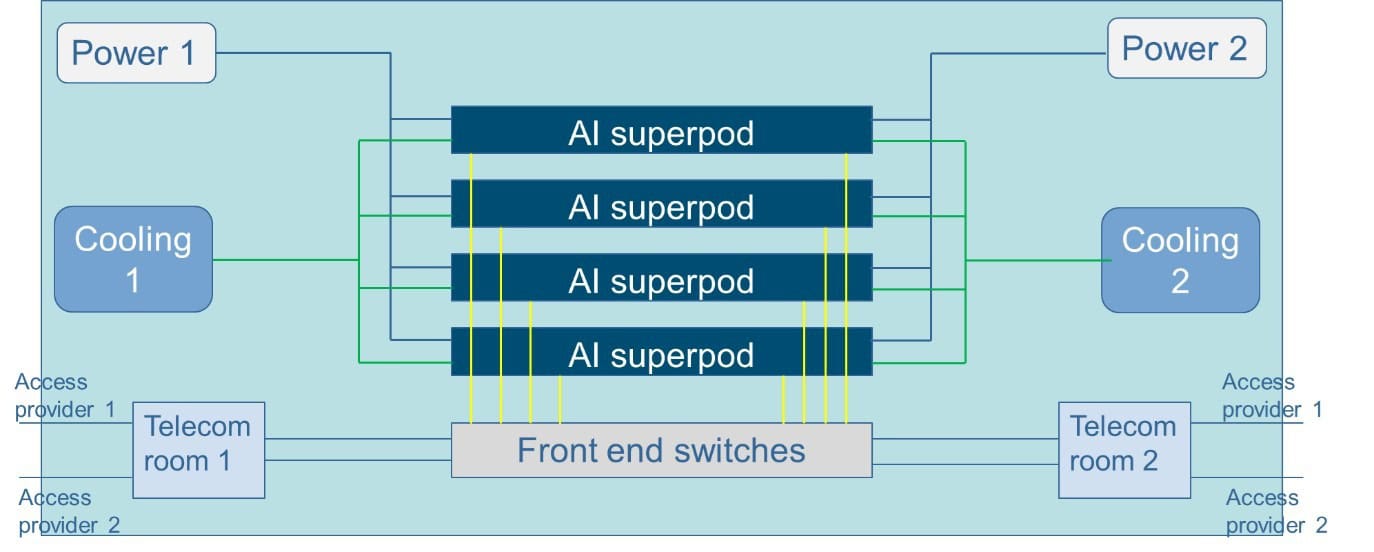
There is physically no space for conventional patch panels or the redundant routing paths required by legacy standards. Instead, redundancy in these clusters is managed at the logical level; networking equipment is designed to reroute data packets around faulty nodes or cables automatically. While this solves the "connectivity" problem, it creates a new challenge for facility managers who must ensure that the "front-end" network—which connects these superpods to the outside world—remains compliant with traditional high-availability standards.
Implications for the Future
The current trajectory suggests that the data center industry is bifurcating. We have "commodity" data centers that remain well-served by current TIA-942 standards, and "AI HPC" facilities that operate as massive, specialized manufacturing plants for intelligence.
Proposed Architectural Adjustments
To harmonize these worlds, we suggest a two-tiered approach:
- The "Single Computer" Concept: Treat the AI HPC rack or pod as an integrated appliance. Its internal components (power, cooling, and cabling) are proprietary and highly optimized. Redundancy at the internal level is currently cost-prohibitive and physically constrained.
- Facility-Level Resilience: The ANSI/TIA-942 model should focus on ensuring that the support for these pods is redundant. This includes dual telecommunications feeds, redundant facility-water loops, and independent, multi-path power distribution to the pod entry point.
Official Stance and Collaborative Path Forward
The TIA TR-42 committee, which oversees the ANSI/TIA-942 standard, is currently evaluating how to incorporate these high-density requirements into future iterations of the standard. The goal is not to force AI clusters to fit into the "servers-in-racks" box, but to evolve the standard to recognize the unique failure domains of HPC environments.
Data center operators are at a crossroads. Those who attempt to build AI pods without considering facility-level resilience will find themselves managing "black box" installations that are vulnerable to single points of failure. Conversely, those who work with standards bodies to develop new, hybrid resilience models will be better positioned to provide the 99.99% availability that the enterprise and cloud sectors demand.
Moving Toward Certification
As we look to the future, Capitoline Ltd remains committed to training and certifying data center professionals to meet these evolving challenges. We are actively working with the TIA to propose solutions that offer clear, measurable redundancy for AI HPC environments. By defining where the "IT equipment" ends and the "Facility Infrastructure" begins, we can create a framework that allows operators to choose their desired level of availability, even in the era of the 1 MW rack.
The transition to AI HPC is not merely a change in hardware; it is a change in the philosophy of infrastructure. It requires a shift from viewing the data center as a room of independent servers to viewing it as a coordinated, high-availability ecosystem. Through continued collaboration between manufacturers, facility designers, and standards committees, we can ensure that the AI revolution is built upon a foundation of reliability.
For more information on TIA-942 certification and how to participate in the TR-42 committee, please visit the official TIA website or contact the Capitoline training team. The future of the data center is being written today—let us ensure it is built to last.