




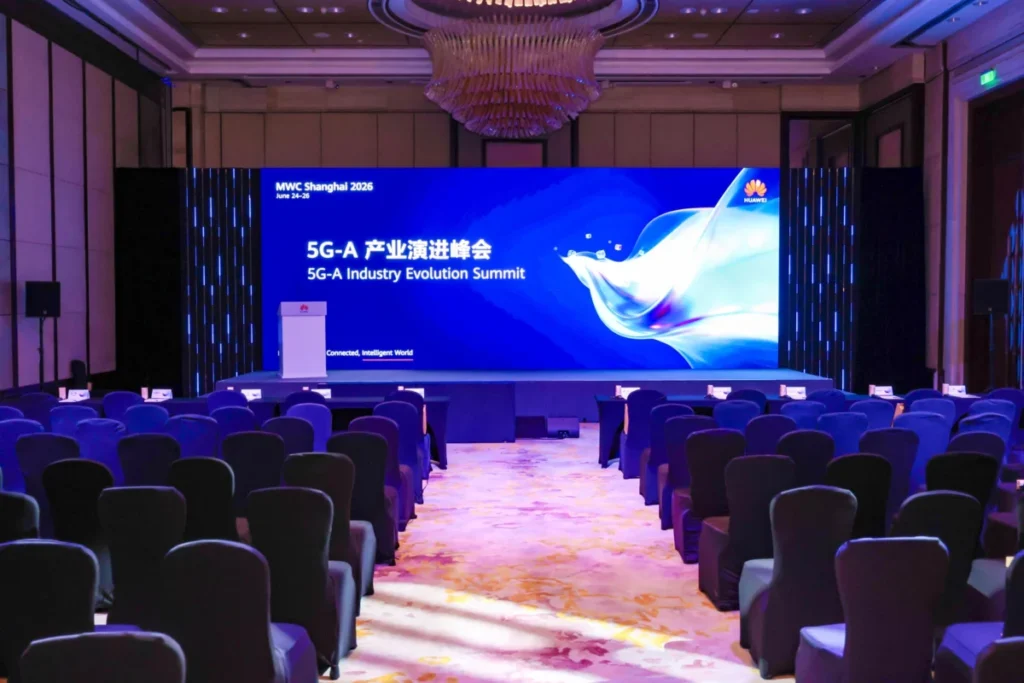
SHANGHAI — For years, the presence of robotics at major technology trade shows was often dismissed as "spectacle"—a series of high-tech parlor tricks designed to draw crowds. Whether it was a mechanical arm pouring a latte or a quadruped robot performing backflips, these displays served as amusing, if somewhat impractical, demonstrations of wireless connectivity. However, at the MWC Shanghai 2026 5G-A Industry Evolution Summit, the narrative has shifted fundamentally.
The "novelty" era of robotics has ended, superseded by the "Embodied AI" revolution. As artificial intelligence leaps from the confines of smartphone screens and data centers into the physical world, the telecommunications industry is facing a reckoning. The infrastructure that powered the mobile internet is no longer sufficient for a world populated by billions of autonomous agents. To bridge this gap, the industry is rallying around 5G-Advanced (5G-A) as the essential foundation for a new, token-based economy.
Main Facts: The Convergence of 5G-A and Physical AI
The central thesis emerging from MWC Shanghai 2026 is that the success of physical AI is inextricably linked to the evolution of 5G-Advanced networks. Unlike previous iterations of mobile technology, which focused primarily on increasing download speeds for consumer media, 5G-A is being engineered to serve as a "silicon nervous system" for autonomous machines.
Key pillars of this technological convergence include:
- The Uplink Revolution: A shift from downlink-heavy networks to symmetrical or uplink-prioritized architectures to handle the massive data streams generated by robotic sensors.
- The 20Mbps Baseline: A new industry consensus that 20Mbps of consistent uplink is the minimum requirement for real-time AI modeling and situational awareness.
- Deterministic Latency: The move away from "best-effort" delivery toward guaranteed, human-like response times (sub-650ms) necessary for safe human-robot interaction.
- Token-Based Economics: A radical shift in how telecommunications companies (telcos) monetize their infrastructure, moving away from billing by the gigabyte toward billing for AI computational tokens.
Chronology: From Mechanical Novelty to Humanoid Reality
The journey to the current physical AI boom has been rapid, marked by a transition from controlled demonstrations to unconstrained real-world performance.
2022–2024: The Proof-of-Concept Era
During this period, robots at MWC events were largely "remote-controlled" or programmed for specific, repetitive tasks. 5G was used primarily for low-latency command-and-control, but the "intelligence" was often localized or limited.
2025: The Breakout Year
The world began to see the practical application of embodied AI in high-stakes environments. Honor’s humanoid robot, ‘Lightning,’ made global headlines by breaking the human world record for a half-marathon, demonstrating that humanoid forms could achieve mechanical efficiency and endurance beyond human capability. Simultaneously, robot dogs began patrolling the FIFA World Cup, providing autonomous security in complex, crowded environments.
2026: The 5G-A Integration
At the current MWC Shanghai, the focus has moved from the robots themselves to the "brain-to-body" connection. The industry has realized that for robots to be commercially viable—meaning light, energy-efficient, and affordable—the "compute" cannot live solely on the device. This realization has triggered the urgent deployment of 5G-A to facilitate cloud-edge synergy.
Supporting Data: The Infrastructure Bottleneck
The scale of the coming AI transition is staggering, and the data suggests that current 4G and standard 5G networks will struggle to cope with the demand.
The Terminal Explosion
According to Huawei’s Intelligent World 2035 report, the world is on track to host 15 billion AI terminals by 2035. This includes everything from autonomous industrial vehicles and delivery drones to household humanoid assistants. Each of these devices requires constant, high-bandwidth connectivity to function safely.
The Power Paradox
A critical data point raised during the summit concerns energy efficiency. Chen Qi, President of the AI Product Line at TD Tech, noted that running a "robotic brain" (high-end GPUs) directly on a terminal consumes approximately 20 times more energy than offloading that computation to the cloud via a high-speed network. For a robot to have a functional battery life of 8–12 hours, the network must bear the computational burden.
Capacity Requirements
While consumer video streaming requires high downlink, a single robot equipped with eight high-definition cameras and LiDAR sensors requires a massive "uplink" to the cloud for real-time processing. Industry experts at the summit established 20Mbps as the "baseline" for a single AI agent. In an industrial setting with 100 robots, the aggregate demand reaches 2Gbps of sustained uplink—a feat impossible for legacy 5G architectures.
Official Responses: Industry Leaders Speak
The summit featured a rare alignment of interests between equipment manufacturers, network operators, and research bodies.
Huawei’s Technological Offensive:
Eric Yang, President of Huawei Carrier Business, emphasized that "Big bandwidth, uplink expansion, and user experience guarantee" are no longer optional features but the core requirements of the mobile AI era. To meet this, Huawei unveiled its "GigaUplink" solution, which utilizes multi-antenna upgrades and sophisticated algorithms to deliver a five-fold increase in uplink capacity compared to standard 5G.
The Operator’s Perspective:
Yang Lifan, Deputy General Manager of China Unicom Beijing, highlighted the practical challenges of scaling these systems. "We can handle two cameras per robot, but what about eight? We can support five robots at the site, but what about a hundred operating simultaneously?" he asked. His conclusion was clear: 5G-A networks must be highly optimized for high-density, high-uplink environments.
The Spectrum Debate:
A significant portion of the summit was dedicated to the "Upper 6GHz" (U6G) band. David Li, President of Huawei’s TDD Product Line, argued that U6G is the "second-best spectrum for widespread 5G-A deployment after C-band." He pushed for a global consensus to allocate this band to mobile services rather than Wi-Fi, arguing that mobile networks are more capacity-constrained and critical for the AI revolution.
Tim Hatt, Head of Research and Consulting at GSMA Intelligence, supported this view, noting that the combination of U6G and the refarming of legacy 2G/4G bands through carrier aggregation would be the only way to provide the "ultra-wide bands" that 5G-A demands.
Implications: Escaping the "Volume Trap"
Perhaps the most profound implication discussed at MWC Shanghai 2026 is the potential for a total overhaul of the telecommunications business model. For the last decade, telcos have been stuck in a "volume trap"—where data traffic grows exponentially, but revenues remain stagnant because customers pay for simple gigabytes.
From Bytes to Tokens
The "Physical AI" era introduces a new unit of value: the AI Token. Transmitting a million tokens (the building blocks of AI thought) requires much more than just bandwidth; it requires prioritized routing, deterministic latency, and often, edge computing resources.
By re-engineering their networks around "token-based" models, operators can:
- Monetize Quality, Not Quantity: Charge premiums for "deterministic" connections where latency is guaranteed (crucial for surgical robots or autonomous driving).
- Network-as-a-Service (NaaS): Offer tier-based service guarantees based on application profiles. A security robot at a stadium would have a different "token priority" than a consumer browsing social media.
- Become Compute Orchestrators: Huawei and other leaders argue that telcos must evolve to become orchestrators of both data and compute power. This positions the telco as an indispensable partner in the AI value chain, rather than a "dumb pipe" provider.
The Road Ahead
The consensus from Shanghai is that the transition to 5G-A is not merely a technical upgrade; it is a strategic necessity for the survival of the mobile industry. By providing the infrastructure for embodied AI, telcos have a unique opportunity to lead the next industrial revolution.
As the summit concluded, the message to the global tech community was clear: The robotic era is no longer "coming"—it is being built, one 5G-A base station at a time. The success of the 15 billion AI terminals expected by 2035 will depend entirely on whether the networks of today can transform into the intelligent, uplink-heavy, token-driven nervous systems of tomorrow.