





As the manufacturing sector accelerates its integration of Artificial Intelligence (AI) and autonomous robotics, the physical limitations of traditional networking have reached a breaking point. Modern industrial environments are no longer just about moving data from point A to point B; they are about orchestrating complex, microsecond-perfect movements across a vast web of sensors, actuators, and intelligent controllers.
To bridge this gap, industry leaders are turning to Time-Sensitive Networking (TSN). By moving beyond the "best-effort" delivery model of standard Ethernet, TSN chips are transforming the factory floor into a synchronized, deterministic landscape. This technological evolution is not merely an upgrade—it is a fundamental reconfiguration of how digital logic interacts with the physical world.
The Core Facts: Why Conventional Ethernet is Failing AI
In a standard networking environment, data packets are processed as quickly as the hardware allows. However, "as fast as possible" is not the same as "at the exact right time." Standard Ethernet protocols treat every packet with relative indifference, leading to variable latency, jitter, and congestion.
In an AI-driven robotic assembly line, this lack of predictability is a liability. If a robotic arm requires a command signal to arrive within a 50-microsecond window to prevent a collision with an Automated Guided Vehicle (AGV), a delay of just a few milliseconds—caused by a background software update or routine file transfer—can lead to catastrophic mechanical failure.
TSN solves this by embedding deterministic timing control directly into the silicon. Unlike standard chips, which act as high-speed data pipes, TSN-enabled semiconductors act as precision instruments, ensuring that mission-critical operational data is never queued behind non-essential traffic.
A Chronology of Connectivity: From Proprietary Buses to Converged Ethernet
The evolution of industrial networking has been marked by a shift from fragmented, proprietary systems to unified, standards-based architectures.

- 1980s–1990s: The Era of Proprietary Fieldbuses. Manufacturers relied on closed-loop, vendor-specific communication protocols. These were highly reliable but created "silos" that prevented data from flowing freely between different brands of equipment.
- 2000s: The Rise of Industrial Ethernet. As Ethernet became the standard for enterprise IT, it was adapted for industrial use. However, standard Ethernet lacked the real-time capabilities required for high-speed motion control, forcing companies to maintain separate networks for IT and Operational Technology (OT).
- 2010s: The Birth of TSN Standards. The IEEE 802.1 working group began defining the standards for Time-Sensitive Networking. These standards aimed to bring determinism to standard Ethernet, allowing it to compete with the reliability of proprietary fieldbuses.
- 2020s–Present: The AI and IIoT Convergence. The rapid adoption of AI, machine vision, and real-time analytics has created a demand for high-bandwidth, low-latency communication. TSN is now the definitive bridge for these technologies, allowing IT and OT traffic to converge on a single, deterministic infrastructure.
Supporting Data: The Mechanics of Determinism
The transition to TSN-enabled hardware requires a fundamental understanding of why these chips differ from standard silicon.
Time-Aware Scheduling (TAS)
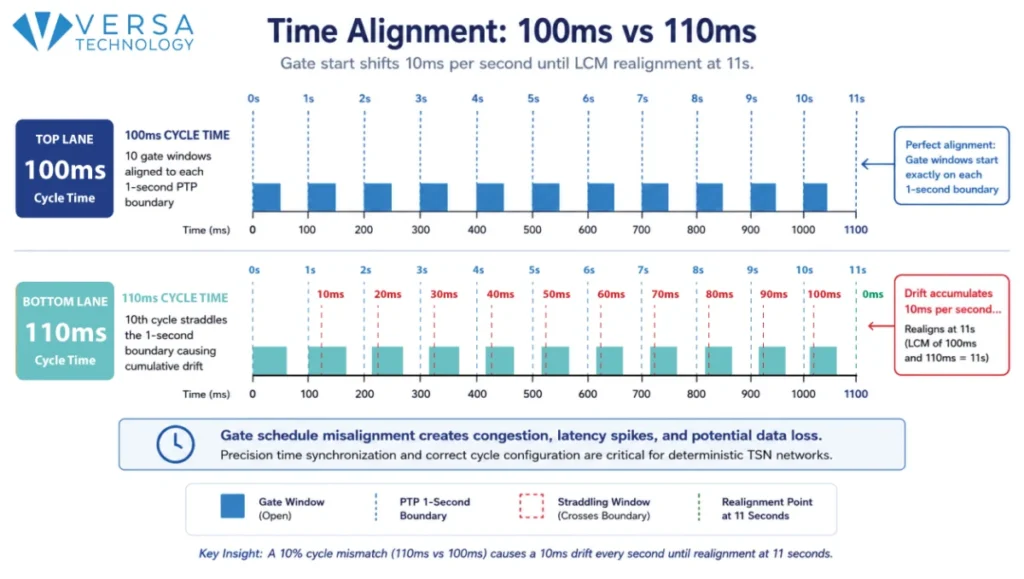
The most critical feature of a TSN chip is the ability to implement a "gate-control list." This mechanism functions like a traffic signal at a busy intersection. At nanosecond intervals, the network gate opens for critical control traffic, ensuring that time-sensitive packets have an exclusive, reserved path through the network fabric. Even if the network is saturated with high-bandwidth video data from a machine vision system, the TSN controller will "clear the lane" for the critical robotic command, ensuring zero-jitter delivery.
High-Precision Synchronization (IEEE 802.1AS)
TSN chips utilize hardware-based timestamping to synchronize every device on the network to a common "Grandmaster" clock. By ensuring that every device—from a PLC to a remote sensor—understands time on the same microsecond-level scale, the network can execute complex, multi-axis movements with perfect synchronization.
Seamless Redundancy (IEEE 802.1CB)
Reliability is paramount in safety-critical applications. TSN chips support frame replication and elimination. A packet is sent simultaneously across two different physical paths. The receiving device processes the first packet to arrive and discards the duplicate. If one cable is damaged or a switch fails, the second packet ensures that the connection remains unbroken with zero-millisecond recovery time.
Official Industry Perspectives: The Shift Toward Convergence
Industry organizations and network architects are increasingly vocal about the necessity of this shift. According to recent white papers from leading automation consortiums, the convergence of IT and OT is no longer optional.
"The integration of AI into manufacturing processes demands a network that treats time as a first-class citizen," says a lead systems architect at a top-tier industrial semiconductor firm. "We are moving away from the era where we simply ‘hope’ the data arrives on time. TSN provides the hardware-level guarantee that the data will arrive on time, every time. This is the cornerstone of the autonomous factory."

Critics of the technology originally argued that the complexity of implementing TSN might outweigh the benefits. However, as the cost of TSN-enabled ASICs (Application-Specific Integrated Circuits) has decreased, the return on investment—driven by reduced downtime, higher precision, and consolidated infrastructure—has convinced even the most cautious manufacturers to pivot.
Implications for the Future: Building the AI-Driven Factory
The integration of TSN is fundamentally changing the design philosophy of modern factories.
1. Unified Infrastructure
Manufacturers no longer need to maintain parallel networks for IT and OT. By using TSN-enabled switches and controllers, companies can run high-bandwidth analytics, video feeds, and mission-critical motion control on the same fiber-optic or copper backbone. This reduces cabling costs, simplifies maintenance, and allows AI systems to access real-time sensor data without traversing complex gateways.
2. Edge-to-Cloud Intelligence
As AI models move from the cloud to the "edge" of the factory floor, the need for low-latency communication grows. TSN chips allow AI-driven sensors to communicate with local processors, execute a decision, and transmit a correction to a robotic arm within microseconds. This "closed-loop" AI is what makes fully autonomous, lights-out manufacturing possible.
3. Safety and Compliance
In industries such as automotive and aerospace, where safety is the highest priority, TSN provides a verifiable, deterministic path for safety-critical controls. By proving that the network can guarantee packet delivery within a specific timeframe, manufacturers can meet rigorous regulatory standards for autonomous systems that were previously difficult to achieve with standard Ethernet.
4. Scalability and Future-Proofing
The beauty of the IEEE 802.1 standards is their compatibility with existing Ethernet infrastructure. Organizations can upgrade their networks incrementally, replacing non-critical switches with TSN-enabled hardware as they expand their automation capabilities. This modular approach allows manufacturers to build a future-proof foundation that can handle the increased data demands of the next generation of AI and Machine Learning models.

Conclusion: The Definitive Bridge
As we look toward the next decade of industrial innovation, the mastery of time is the defining characteristic of successful organizations. AI, robotics, and machine vision are powerful tools, but they are only as effective as the network that supports them.
TSN chips provide the deterministic foundation required to turn these technologies into a cohesive, high-performance system. By ensuring that critical data is never caught in a traffic jam, TSN is paving the way for a more efficient, safer, and truly autonomous manufacturing future.
For organizations currently evaluating their digital transformation strategies, the message is clear: The physical limitations of standard networking are an obstacle to AI success. By adopting Time-Sensitive Networking, manufacturers are not just upgrading their cables—they are securing their position in the next industrial revolution.
For those looking to navigate the complexities of industrial networking, consulting with experts in PoE switches and TSN-ready components remains the most effective way to ensure a seamless transition to a high-speed, deterministic future.