





The rapid ascent of Artificial Intelligence (AI) and edge computing is fundamentally altering the requirements of enterprise IT networks. As organizations rush to integrate intelligent IoT, high-resolution AI-powered surveillance, and edge inference engines, they are discovering that their legacy network infrastructure is the primary bottleneck. For many sectors—including security, transportation, industrial automation, and commercial real estate—the prohibitive cost and logistical nightmare of "rip-and-replace" cabling projects have stalled digital transformation efforts.
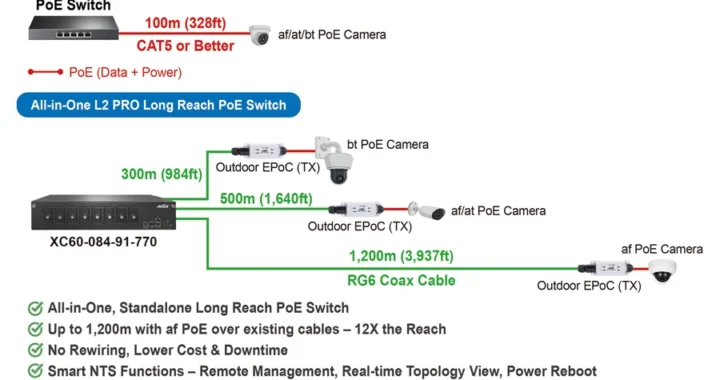
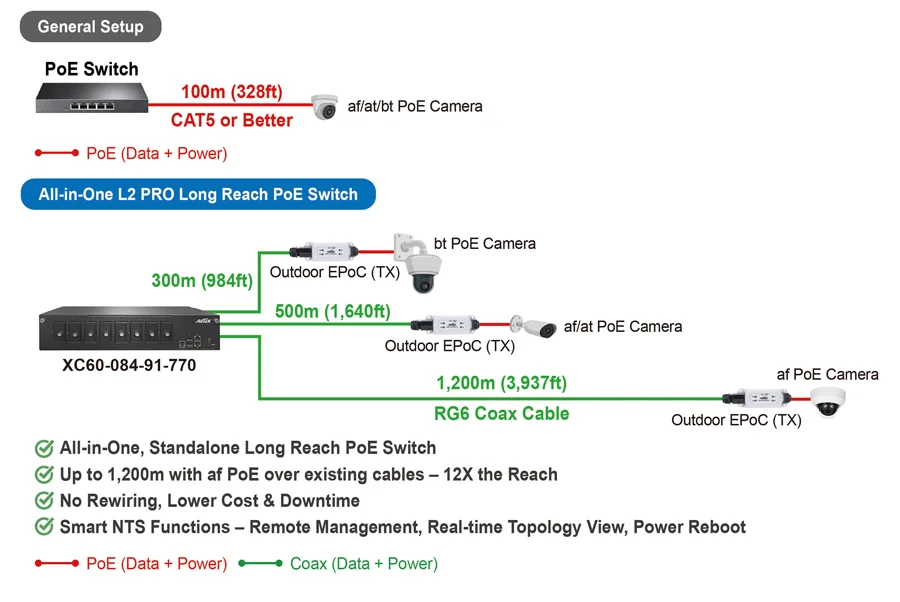
However, a technological solution is emerging that bypasses the need for massive rewiring: Ethernet and Power over Coax (EPoC). By leveraging existing 75-ohm coaxial cabling, EPoC switches, such as the Versa Technology XC60-084-91-770, are enabling a seamless transition to high-performance AI-ready networks.
Main Facts: The Intersection of AI and Legacy Infrastructure
The core challenge facing modern IT managers is the "infrastructure gap." While AI-driven applications demand higher bandwidth, robust power delivery, and ultra-low latency, the physical layer of many buildings remains anchored in older standards.
EPoC technology functions by transmitting high-speed digital Ethernet data and low-voltage electrical power over existing legacy coaxial cabling (RG59 or RG6). The XC60-084-91-770 managed RX switch represents the vanguard of this movement. It offers:

- Extended Reach: Connectivity up to 1,200 meters (3,937 ft.), vastly exceeding the 100-meter limitation of standard Ethernet.
- High Power Density: A PoE budget of up to 90W per port (720W total), sufficient to power energy-hungry AI edge devices like multi-sensor cameras and localized compute modules.
- Topology Flexibility: Support for daisy-chain, peer-to-peer, and ring configurations, allowing for versatile deployment in challenging physical layouts.
Chronology of the Network Transition
The evolution of enterprise networking can be categorized into three distinct phases, leading to the current AI-centric era:
- The Analog Legacy Era (1990s–2010): Organizations invested heavily in coaxial infrastructure to support analog CCTV and early-stage industrial monitoring. These systems were reliable but data-limited.
- The Initial IP Transition (2010–2020): As IP-based cameras became the standard, many organizations were forced to abandon their coax for Category 5e/6 cabling. This was the era of high-cost installation and massive construction disruption.
- The AI-Edge Integration Era (2020–Present): The current shift focuses on localized data processing. AI-powered edge devices require constant, high-speed data transmission and significant power. Rather than repeating the expensive cycle of the previous decade, organizations are turning to EPoC to "recycle" their legacy copper, effectively future-proofing buildings that were previously considered "un-upgradable."
Supporting Data and Technical Requirements
The transition to an AI-ready network is not merely about bandwidth; it is about managing the specific physical demands of the "intelligent edge."
The Bandwidth-Power Nexus
Modern AI cameras and inference engines are significantly more power-hungry than their predecessors. Traditional PoE switches often fail to provide the 60W or 90W (PoE++ 802.3bt) required by high-end units. The XC60-084-91-770 addresses this by utilizing the superior copper mass of coaxial cable compared to standard twisted-pair Ethernet, which minimizes voltage drop over long distances.
Reliability Through Diagnostics
AI workloads are intolerant of signal degradation. Unlike "dumb" media converters, the XC60-084-91-770 provides advanced management tools, including:

- Network Topology Systems (NTS): Provides a visual, graphical representation of the network, including integrated floor maps.
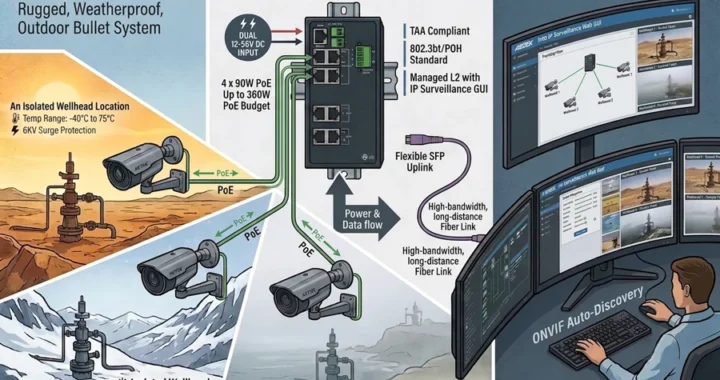
- Auto-Discovery (ONVIF): Simplifies the onboarding of new AI-enabled devices.
- Real-time Monitoring: Tracks live traffic trends and port-level power consumption, allowing IT teams to proactively address issues before they cause downtime.
Implications for Modern Organizations
The implications of adopting EPoC technology are far-reaching, impacting capital expenditure (CapEx), operational efficiency, and long-term sustainability.
Economic Impact
By eliminating the need for new cabling, organizations can see a drastic reduction in installation costs. When considering labor, materials, and the environmental impact of pulling miles of new wire through walls and ceilings, the cost savings associated with EPoC often range between 40% and 70% compared to traditional fiber or Category-6 retrofits.
Operational Agility
EPoC facilitates a "phased migration" strategy. An organization does not need to overhaul its entire facility at once. They can prioritize critical entry points or high-security zones for AI integration while allowing legacy analog systems to remain operational on the same network. This modular approach to scalability ensures that IT departments can align infrastructure upgrades with budget cycles rather than being forced into all-or-nothing capital investments.
Environmental Sustainability
Sustainability is becoming a core mandate for IT departments. The "circular economy" of networking—extending the lifespan of existing copper cabling—drastically reduces the carbon footprint associated with manufacturing and deploying new cabling materials. Furthermore, the centralized power management of EPoC-linked switches optimizes energy usage, ensuring that power is allocated only to active AI nodes.

Official Perspective: Bridging the Gap
Industry experts and the engineering team at Versa Technology emphasize that the primary barrier to AI adoption is not the lack of AI capability in software, but the lack of "pipe" capacity in the physical layer.
"The goal is to remove the physical friction that prevents innovation," says the technical leadership at Versa. By focusing on EPoC as a bridge, the company aims to help organizations transition from the legacy analog world to the AI-driven edge without the chaos of a full-scale renovation. This strategy is particularly effective for:
- Large Campus Environments: Where distances exceed standard Ethernet limits.
- Historical Buildings: Where structural constraints make new cabling impossible.
- Industrial Facilities: Where existing coaxial runs are shielded and rugged enough to withstand harsh environments.
Implementation Best Practices: A Guide for IT Managers
A successful transition to an AI-ready network requires more than just plug-and-play; it requires an audit of the physical environment.
- Conduct a Physical Audit: Before deployment, test existing coaxial lines for integrity. While coax is robust, decades of age can lead to oxidation at connection points.
- Verify Power Budgets: Calculate the total power consumption of all planned AI nodes. Ensure that the EPoC switch’s total power budget (e.g., 720W) exceeds the peak demand of the connected devices.
- Implement Phased Rollouts: Utilize the flexibility of daisy-chaining and ring topologies to isolate new AI-enabled zones from legacy segments during the transition period.
- Leverage Management Software: Use the built-in NTS and cable diagnostics to map the existing network. This visibility is essential for troubleshooting and ensuring the "five-nines" (99.999%) uptime required for mission-critical AI surveillance systems.
Future-Proofing the Intelligent Edge
As we look toward the future, the integration of AI into physical security and industrial automation is not a trend—it is the new baseline. Networks that cannot support these technologies will quickly become liabilities.

EPoC switches like the XC60-084-91-770 are not merely stop-gap solutions; they are architectural enablers. They provide the necessary bandwidth, power, and intelligent management to turn legacy infrastructure into a high-performance foundation for the future of the enterprise. By choosing to modernize intelligently, organizations can maximize their existing investments while ensuring they are fully equipped to harness the power of the AI revolution.
For organizations seeking to bridge the gap between their legacy past and their AI-driven future, Versa Technology stands as a strategic partner, providing the hardware and expertise necessary to build scalable, sustainable, and highly efficient network architectures. To begin the transition, IT managers are encouraged to perform a site assessment and explore how EPoC can serve as the backbone for their next-generation AI deployments.